
Identify concentration risk
Check common dependencies in the supply chain.
APPLY
DOCUMENT
Making shared causes visible behind different providers
Consider providers, subcontractors, platforms and locations along the actual performance. Compare different services of the same group with services of different providers that require the same infrastructure or subcontractor.
Check the path until recovery. Two contracts can name different operators and use the same backup platform. The default scenario must therefore contain precise information on which alternative is tested for its independence and which professional performance should be available in the result.
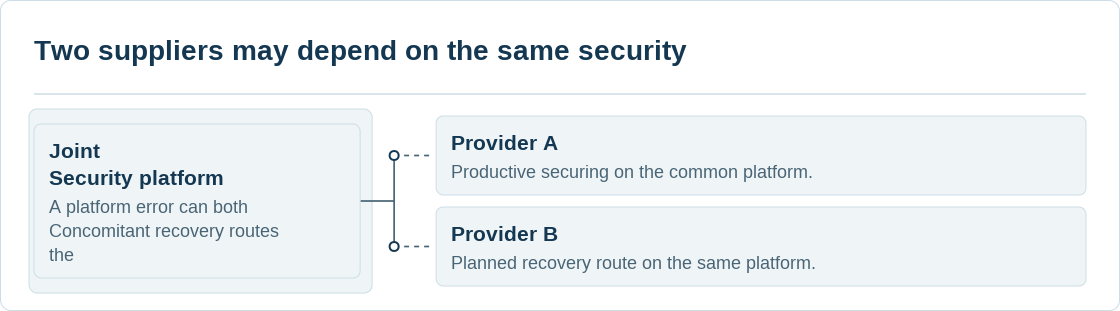
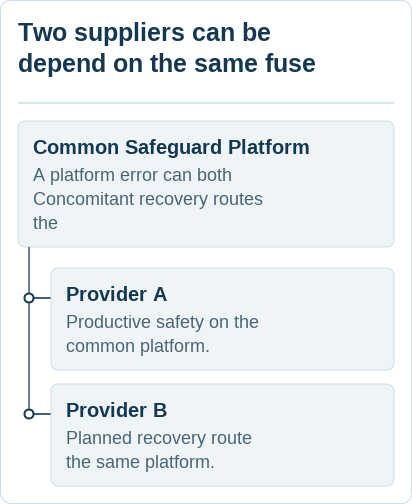
Fictional performance chain. The joint fuse determines the investigated failure scenario.
Checking contracts for common dependencies
Put vendor lists, contract facilities and evidence on the actual supply chain.
Identify common nodes with supporting documents
Use contract facilities and service records to determine which services are being combined at the same operating points. Collect open information and its importance for evaluation.
- Acceptance criterion
- A second reviewer can follow the statement to the original evidence and the version checked. Record the evidence identifier or file reference with the decision.
- Evidence
A comprehensible overview of the affected functions and shared dependencies.
Evaluate replaceability and time requirements
Compare available alternatives, technical transfers and actual runtimes. Check which alternative still contains the same bottleneck.
- Acceptance criterion
- Trace the decision to the agreed requirement and observed result. Assign an owner and review date to open conditions.
- Evidence
A well-founded risk assessment with realistic options for action.
Link risk decision with audit order
Determine which dependency should be monitored, reduced or secured by a proven alternative. Name triggers, responsible persons and a required proof.
- Acceptance criterion
- Trace the submission by time, version sent and acknowledgement. Resolve missing or changed information for each reporting stage.
- Evidence
A verifiable decision with measures and resubmission.
Secure the statement with a sample
Track two direct providers until backup service. Document which functions are affected simultaneously in the event of its failure.
- Acceptance criterion
- Trace two apparently separate providers to a shared dependency. Record the functions that fail together in the same scenario and the alternative that breaks that dependency.
- Evidence
- Evidence list recording original source, version, documented mapping and owner.
Two providers secure in the same service
The primary and alternative providers obtain the recovery from the same backup service. The bank assesses the common dependence and checks the data transfer in an independent alternative.
Concentration assessment with proven alternative The organization can show which function a common dependence has and how the chosen transition changes it.
- What you are examining
- Find out which recovery routes actually use the common backup service. Set up the technical route and the data required for a replacement in addition to both contract files.
- What the post-test decides
- Test the alternative on the assumption that the joint backup service is not available. The test file proves data transfer, technical acceptance and the remaining need for action.
- Audit record
- Agreement reconciliation linking the service, current clause, operating evidence and decision on any discrepancy.
Templates and worksheets
The filler tool is directly under the task. Download the template for editing or open the Quick View.
Workbook for joint supplier dependencies
Compare several power paths along their real, commonly used infrastructure.
Outcome A robust decision to concentrate is called common nodes, critical functions and independent alternative.
Read the instructions
Fictional example Providers A and B operate separate frontends, but their backups are on RECOVERY-X. The supposed alternative shares the same backup platform.
- Identifying Common Dependency Use the same identifier for the same upstream service and verify controlled alternatives with a proof.
- Linking Evidence For relevant checkpoints, deposit the specific source, the verified version and the proof ID.
- Treatment of deviation Reassess concentration and perform an evasive test without a common platform.
Legal basis for this task
Compare the decision from the test example with the relevant rule.
Art. 29 DORA · Preliminary assessment of the ICT concentration risk
The provision addresses, inter alia, poorly replaceable suppliers and several relevant agreements with the same or closely related providers.
For your exam The organization can show which function a common dependence has and how the chosen transition changes it.

Trying to get out with an independent alternative
Check data return, transition services and technical resumption using a realistic exit scenario. For internal evaluation, the assessments on EUGRC.AI are available.

