
Oversight of critical ICT providers
Match the provider status and service reference.
EVIDENCE
SAMPLE
Determine provider status and own performance relationship separately
Separate the internal meaning of a service from the European classification of its provider. The first results from the supported function. The second follows the formal procedure of the European supervisory authorities.
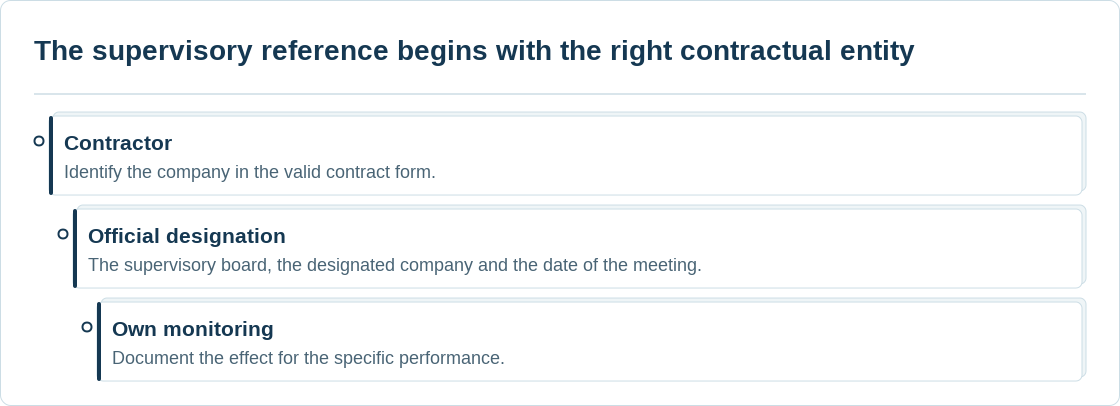
An officially named provider and the company listed in the contract may have different roles. First, confirm which service the own unit actually receives. Then connect the official information to the company relevant for your performance and to your internal evaluation of dependency.
Work steps and verifiable documents
Documenting your own benefit
Capture provider identity, contract, services, using unit and supported functions. Determine which function is internally rated as critical or important.
- Acceptance criterion
- A second reviewer can follow the statement to the original evidence and the version checked. Record the evidence identifier or file reference with the decision.
- Evidence
Functional benefit in the own register.
Matching official designation status
Use the official list with version date and identification. Check which legal entity a hit is referring to and what effect it will have on your own monitoring.
- Acceptance criterion
- The item under review and the documents refer to the same approved version. Record obsolete evidence as a separate discrepancy.
- Evidence
Comparison note with exact provider identity and source level.
Maintaining own measures
Check with the responsible body which supervisory information is relevant for the service. Work on findings in contract monitoring, scenarios and, if necessary, the exit plan.
- Acceptance criterion
- Check the official designation at the relevant date and identify the actual service used. Translate the result into a recorded task for internal third-party management.
- Evidence
Decision with measures, owners and impact control.
Decision in the test example
A provider for an important function is mentioned in the bank's register of services. A similarly named company is on the supervisory list.
- Compilation of documents
- Compare the aforementioned contractual partner with the official designation and the actual service. The documentation determines which source bears the result and which subsequent audit is carried out by the financial company.
- Keeping a decision
- The bank compares the legal identity and pursues the contracts separately. Its risk monitoring remains aligned with documented benefits and its own exit plan.
- Complete the test file
- Comparison of own functional evaluation and official designation status.
- Sample and acceptance
- Select a provider with several companies. Support which company registers and official list are referred to.
- Audit record
- Handover record covering the scope, source-to-target reconciliation, accepting role and remaining conditions.
Provider identity and functional relationship must match
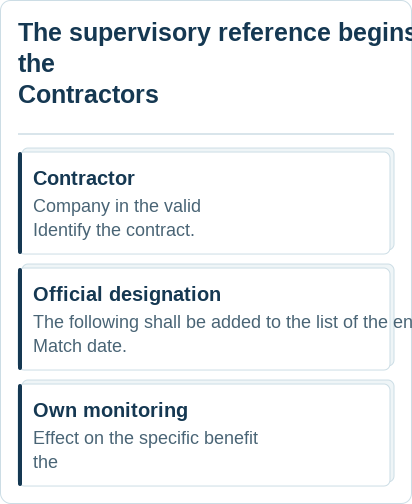
Link the formal designation to the actual contractually bound unit. Own risk management follows the performance used.
Legal basis for this task
DORA · Art. 31 · Designation of critical ICT third-party service provider
The regulation regulates European designation and publication.
For your exam Check the exact identity of the provider in the published status.
ESMA · Monitoring framework and current list of providers
The European supervisory authorities publish the state of play and regulatory framework here.
For your exam Keep the list as a reference.

What is the next decision?
Track the service of your own organization from the officially assigned provider. In the dossier, you connect the published source with contractual partners, function and ongoing risk assessment.
Dependencies and supervision
Check whether different providers need the same infrastructure. Check for intended subcontracting changes and measure if an independent alternative data can be fully transferred.
Your result A proven risk assessment with tested evasive solution.
Detection dossier
Test job, original sample, version reference, correction and documented retest.
Link target criterion, drawn sample, findings and retest. The memory example shows which protocols prove the effectiveness of alarming to the checked status.
Work result A dossier in which a third party monitors expectations, observations, findings and conclusions per test criterion.
Your result A dossier from which another person can repeat the same sample.

