
A restore misses its target
Evaluate time and data levels separately.
DECISION
RETEST
Is the back-up enough for a professional release?
The fictitious port bank checks a backup for its payment service. They compare duration, data level and technical usability and derive from it an after-test.
You represent the department at the acceptance. Determine the completion of technical provision, time of professional usability and data level separately. Decide for each target criterion which observation it proves and what to repeat in the subsequent test.
Initial data of the exercise
- Objectives of the exercise
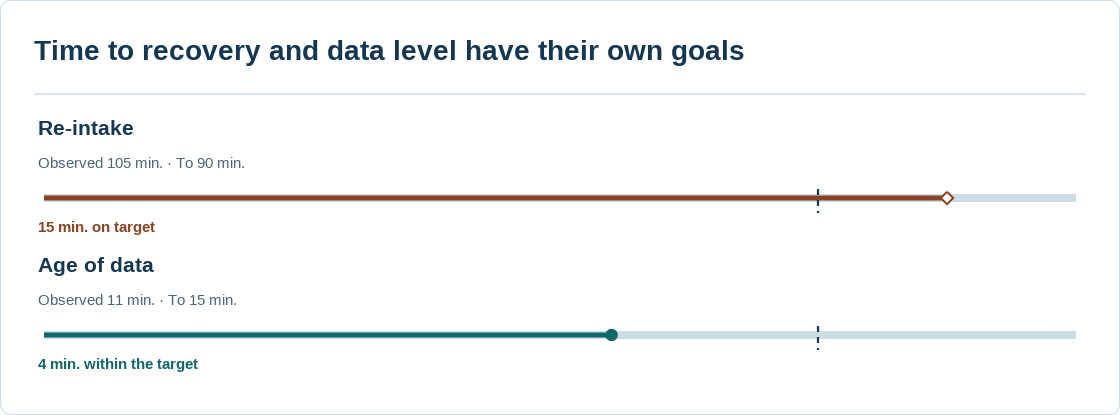
- Technically usable after a maximum of 90 minutes. The last confirmed data level may be no more than 15 minutes before the interruption.
- First test
- Technical provision after 80 minutes, technical usability after 105 minutes. The confirmed from the fuse stand is 11 minutes before interruption.
- Finding
- The technical comparison takes additional time. The measuring points in the plan already end with technical provision.
Tasks for processing
Keep track of your decision, the original document used and still open information. Only open the sample solution once you have documented your justification.
- Arrange each measurement result to the right time or data criterion.
- Acceptance criterion
- Use the same metric, population and unit for expected and observed results. Record the measurement point at which the business service is achieved.
- Evidence
- Measurement record with baseline population, source, expected and observed values, unit and timestamp.
- Decide and document the findings with the relevant role and a follow-up order.
- Acceptance criterion
- A second reviewer can follow the statement to the original evidence and the version checked. Record the evidence identifier or file reference with the decision.
- Evidence
- Evidence list recording original source, version, documented mapping and owner.
- Set measurement points for the follow-up run, which represent the actual completion of the technical examination.
- Acceptance criterion
- Use the same metric, population and unit for expected and observed results. Record the measurement point at which the business service is achieved.
- Evidence
- Measurement record with baseline population, source, expected and observed values, unit and timestamp.
Model solution with justification
Situation The fictitious port bank checks a backup for its payment service. They compare duration, data level and technical usability and derive from it an after-test.
- Distinguishing between the two criteria
- The time value of 105 minutes exceeds the internal target by 15 minutes. The documented data gap of 11 minutes is within the assumed target.
- Measurement to lead to technical release
- The technical provision is an intermediate step. Technical usability decides on the achievement of the goal of re-starting.
- Define post-test
- The follow-up process uses the same objectives and a pre-measured professional comparison. It also records the data sample and the release.
Restart and data result in two findings
The technical provision is within the time window. The professional usability marks the end of the time measurement.
Secure the result in the post-test
Situation The fictitious port bank checks a backup for its payment service. They compare duration, data level and technical usability and derive from it an after-test.
Repeat the exercise with a data deviation despite the time limit. Both goals must be assessed separately and the release must reflect the remaining findings.
Keep the technical endpoint, the technical acceptance and the verified data gap separately. Link changed values to the concrete remedy and justify the new acceptance decision.
Templates and worksheets
The filler tool is directly under the task. Download the template for editing or open the Quick View.
Measurement protocol for a back-up
Compare time to the technical usability, effective data level and sampled scope.
Outcome RTO and RPO are calculated separately and associated with the technical release.
Read the instructions
Fictional example The restart target is 90 minutes, tolerated data loss 15 minutes. The run takes 105 minutes, data level 8 minutes before failure. RTO is exceeded by 15 minutes, the RPO is maintained.
- Restart and check data Capture restart target, data level, completeness and technical release separately.
- Linking Evidence For relevant checkpoints, deposit the specific source, the verified version and the proof ID.
- Treatment of deviation Document the separate results. Make a cause clarification and a follow-up test with an unchanged scale.
Legal basis for this task
DORA · Art. 12 · Backup and restoration
The regulation covers data backup, recovery and related testing.
For your exam Separate the verified data level from the measured time to usability.
DORA · Art. 11 · Response and restoration
The article covers the planning and audit of ICT business continuity.
For your exam Align the follow-up test to the documented business needs.

What is the next decision?
Transfer the decision to your own process and set the checked criterion. Then, in the case directory, select an exercise with other source data or a different role.
Restart test
Restart plan, agreed time and data targets, test stock and contact for the technical acceptance.
Edit a restart log with time measurement, data reconciliation and release request.
Work result Protocol with measuring points, data matching, decision and, where appropriate, date of the post-test.
Edit DORA case studies
Edit a DORA case with fictitious initial data, for example to the information register or to a payment malfunction. Solution and counter-probe help in the transfer.
Your result Reasoned decisions with supporting evidence and a repeatable follow-up test.

