
Learn from incidents and tests
Translate observations into verifiable improvements.
EVIDENCE
SAMPLE
Lead a learning point to verifiable improvement
Execute a verifiable improvement task from a fault or test. The conclusion shows separately which cause has been fixed and which rule, control or exercise needs to be adjusted.
After an incident, specify the effect of the planned change in operation. For a missed alarm, the subsequent test can show whether exactly the recipient concerned takes over the same warning stimulus. Note which observation confirms the measure and when the effect is re-examined.
Work steps and verifiable documents
Reconstructing History and Assumptions
Create a time sequence from the operations, releases and observations of the department. Determine open assumptions with owners and clarification date.
- Acceptance criterion
- The item under review and the documents refer to the same approved version. Record obsolete evidence as a separate discrepancy.
- Evidence
Coordinated cause analysis with evidence and remaining uncertainty.
Distinguishing action and rule change
Define the repair of the observed error. In addition, check whether the policy, exercise or capacity planning will recognize the same pattern in the future.
- Acceptance criterion
- A second reviewer can follow the statement to the original evidence and the version checked. Record the evidence identifier or file reference with the decision.
- Evidence
Assigned improvement task with clear success criteria.
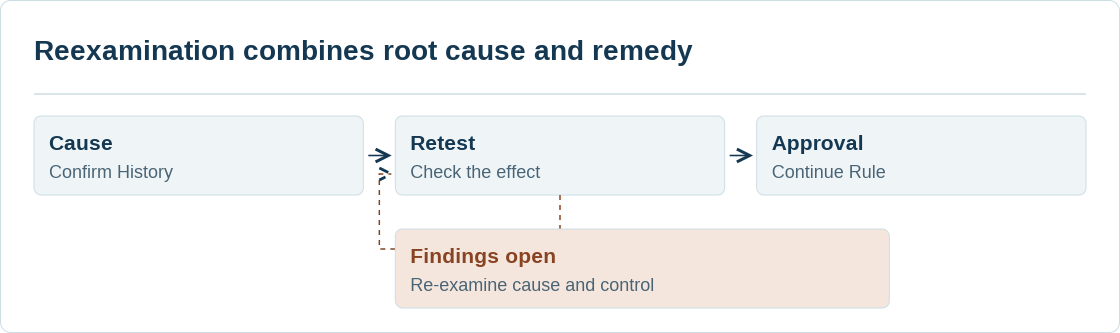
Check the effect and report results
Use a suitable scenario with the same limit values in the post-test. Enter the knowledge in the relevant instructions and the next frame review.
- Acceptance criterion
- Link a reviewed disruption to an identified cause and an approved action. Require a follow-up result that demonstrates the effect on the affected service.
- Evidence
Closed tracking with updated status and test documentation.
Decision in the test example
A memory migration extends the restart. The individual test shows missing monitoring of an external backup path. In the previous exercise there is no sample for this.
- Compilation of documents
- Secure two evidences of the same suspected cause from different times. Arrange the adapted work instruction to the repeated test, which checks its practical effect.
- Keeping a decision
- The immediate result leads to an operational correction. In the next exercise, the dependence on the external restoration path is also specifically re-established.
- Complete the test file
- Documented change of control and exercise plan with proof of re-examination.
- Sample and acceptance
- Select a completed measure. Check whether the modified procedure version actually takes up the triggering finding.
- Audit record
- Measurement record with baseline population, source, expected and observed values, unit and timestamp.
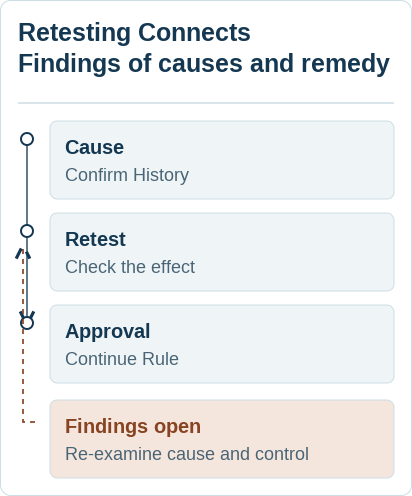
The post-test results in an open result to remedy
Refer to the confirmed cause and the previous success criterion.
Legal basis for this task
DORA · Art. 13 · Learning and further development
The regulation covers findings from incidents, tests and ICT risk management.
For your exam Track the change from cause to effective control.

What is the next decision?
Use the improvement task in the next continuation exercise as a concrete success criterion. Then document under which conditions the effect was actually observed.
Continuing and learning
Evaluate the consequences of a business interruption. Determine which data is needed for recovery and when the department can release the restored service.
Your result A protocol with measured time, data synchronization and technical release.
Detection dossier
Test job, original sample, version reference, correction and documented retest.
Link target criterion, drawn sample, findings and retest. The memory example shows which protocols prove the effectiveness of alarming to the checked status.
Work result A dossier in which a third party monitors expectations, observations, findings and conclusions per test criterion.
Your result A dossier from which another person can repeat the same sample.

