
Choose suitable ICT tests
Merge test method and business risk.
EVIDENCE
SAMPLE
Choose a test method for the actual risk question
A system test checks a certain risk for a business performance. Before performing it, determine which system version and what operating condition are representative and from which evidence the effect is evident.
A technical system check and a technical test answer different questions. First describe what should be known about the performance after a malfunction. From this, derive an observable sample with defined environment, data level and success criterion.
Work steps and verifiable documents
Deriving the test target and cover
Select a function and connect the scenario to affected applications, data and external services. Set which existing tests cover the same statement.
- Acceptance criterion
- Justify applicability using evidenced activity or intended use, role and date. Assign an owner and due date to any unresolved assumption.
- Evidence
Test assignment with risk, scope, environment and responsibility.
Select the appropriate method and success criterion
Use a suitable document matching, functional sample or recovery exercise depending on the risk. Describe previously observable success criteria and the powers of the examiners.
- Acceptance criterion
- The item under review and the documents refer to the same approved version. Record obsolete evidence as a separate discrepancy.
- Evidence
Released test description with defined purpose and comprehensible independence.
Ensure impact and remedy
Document expected and observed state with time and version. Distribute findings and check if the same criterion is met when you repeat it.
- Acceptance criterion
- Match a test system to a specific business service and agreed measurement points. Report technically successful steps separately from the end-to-end service outcome.
- Evidence
Test protocol with findings, remedies and results of the verification.
Decision in the test example
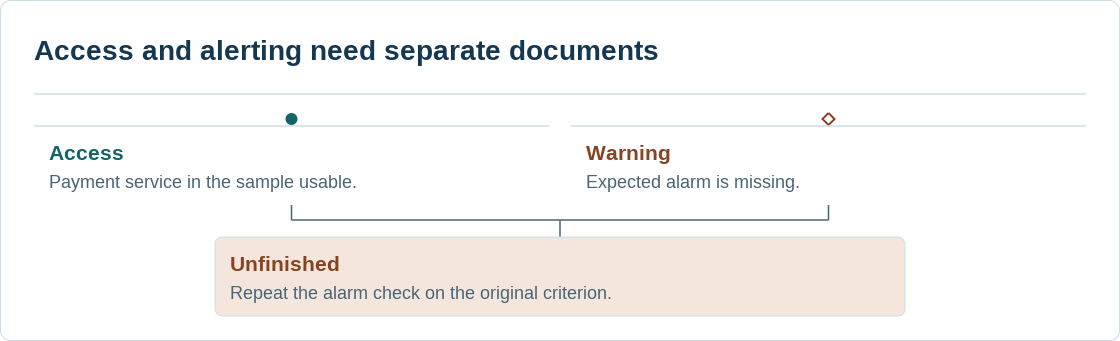
The port bank exchanges a storage. The surface shows proper operation, but the test order also calls for an alarm message in case of a simulated interruption.
- Compilation of documents
- Log two separate test results for access and alarm in the same system level. Replay uses the specified success criteria for both tests.
- Keeping a decision
- The test line evaluates access and alarm separately. The technical follow-up after the correction uses the same approved warning threshold.
- Complete the test file
- Released system test with documented coverage of technical and technical criteria.
- Sample and acceptance
- Track a mistry until the retest and adjust the system levels used.
- Audit record
- Comparison of the original finding and retest showing the changed condition, observed effect and closure decision.
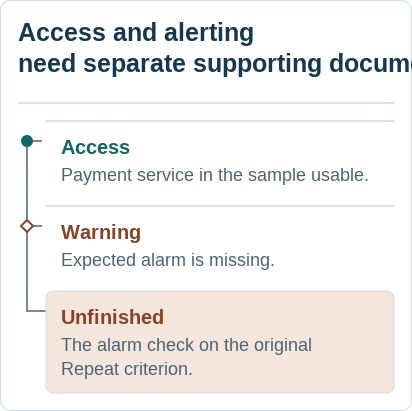
Access and alarm are separate test results
Check both in the shared test stand. A working access does not provide any proof of receipt of the warning.
Legal basis for this task
DORA · Art. 24 · General test requirements
The rule identifies risk-based tests, independence and tracking of identified problems.
For your exam Check test responsibility, coverage and completion per applicable paragraph.
DORA · Art. 25 · Suitable tests
The article lists possible test types for ICT tools and systems.
For your exam Select the test based on the required technical statement.

What is the next decision?
In the test program, compare two methods for the same risk. In the detection dossier, determine which method actually answers the technical question and which observation proves this.
Tests and tests
Plan a test program from the relevant dependencies. Distinguishing technical restoration, professional testing of all performance and special requirements for threat-oriented tests.
Your result A test file with success criteria, findings and final decision.
Detection dossier
Test job, original sample, version reference, correction and documented retest.
Link target criterion, drawn sample, findings and retest. The memory example shows which protocols prove the effectiveness of alarming to the checked status.
Work result A dossier in which a third party monitors expectations, observations, findings and conclusions per test criterion.
Your result A dossier from which another person can repeat the same sample.

