
Protect data and systems
Check protective measures from use to removal.
EVIDENCE
SAMPLE
Track protective measures over the actual data lifecycle
Arrange protective measures based on classification, technical dependence and business risk. A meaningful proof follows the data inventory from the provision to the regulated deletion or withdrawal.
Track a vulnerable data base in regular operation, in backups and after migration. Exports may also be located in another operating environment after the source system has been replaced. Check who is responsible for access, storage and subsequent treatment for this copy.
Work steps and verifiable documents
Translate classification into a protection requirement
Raise content, location, user groups and professional owners. Document the basic configuration released for this purpose and the intended access controls.
- Acceptance criterion
- Justify applicability using evidenced activity or intended use, role and date. Assign an owner and due date to any unresolved assumption.
- Evidence
Protection profile with concrete object and released target level.
Check deviations from target
Select a data set and compare shared template, actual setting, and valid exceptions. Evaluate the influence on the supported function.
- Acceptance criterion
- Reconcile expected and observed records using the same identifier. Resolve missing, duplicate or unmatched records individually.
- Evidence
Configuration reconciliation with accepted and open deviations.
End of use attest
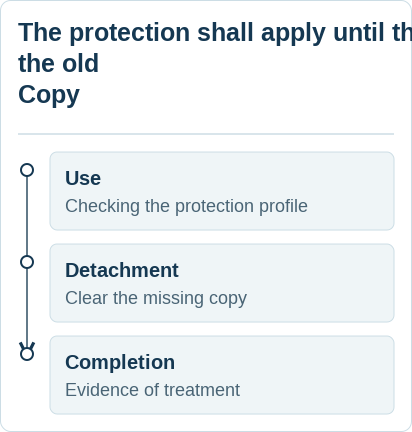
For a replaced system, determine the treatment of data, backups, permissions and documentation according to applicable rules. Check the sample until it is completed.
- Acceptance criterion
- Trace a requirement along the actual data flow to the configured control and its approved effectiveness evidence. Record the affected data and system versions.
- Evidence
Disposal log with responsible persons and clearance.
Decision in the test example
An old export environment contains sample copies with the same protection class as the original archive after changing. The new memory has already been checked.
- Compilation of documents
- Select a copy with known useful life and track it until the confirmed replacement. The file must show which data is still needed and who checks the handling of the remaining copy.
- Keeping a decision
- The responsible parties document the still existing data copy and check the storage. They define an appointment and a proof for the release or deletion.
- Complete the test file
- Protection profile and final file with actual configuration, data affected and valid decision.
- Sample and acceptance
- Determine the location of a left-over copy using the inventory. Check immediately on the receipt whether the treatment of the copy is proven.
- Audit record
- Versioned mapping of item, source and approved version with any discrepancy recorded.
An old data copy has its own conclusion
Check the old and new inventory. The decision must indicate which copy is stored or removed.

Legal basis for this task
ICT risk management · (EU) 2024/1774 · Art. 11 · Data and system security
The rule combines requirements for system and data security with data classification and risk assessment.
For your exam Check the target and is located on a data inventory along its use.

What is the next decision?
Follow a backup or export to the actual location used. In the detection file you link the permitted data scope, the confirmed assignment and the proof for further treatment.
ICT operation and protection
Arrange applications, data and external services of a business function. Then select a specific sample, such as a controlled memory change or the withdrawal of an authorisation.
Your result Inventory status with technical reference and documented control test.
Detection dossier
Test job, original sample, version reference, correction and documented retest.
Link target criterion, drawn sample, findings and retest. The memory example shows which protocols prove the effectiveness of alarming to the checked status.
Work result A dossier in which a third party monitors expectations, observations, findings and conclusions per test criterion.
Your result A dossier from which another person can repeat the same sample.

