
Classify AI risk
The prohibition, product-related high risk path, Annex III and transparency are independently assessed.
DEPLOYMENT
OVERSIGHT
Check risk classification at concrete use
First, check whether the intended use is subject to a ban or if there are still no prohibitions. In the product-related path, the relationship with an act referred to in Annex I and the required third party review must be considered together. In addition, check the specific use as described in Annex III.
An application covered by Annex III can only be classified differently under the conditions of Article 6(3). Support the activity mentioned there and the absence of a significant risk including the actual decision-making effect. Profiling natural persons in an Annex III system excludes this path. For example, other risk classification may also involve transparency obligations.
Test the classification on use
Check the two requirements of the product path
Confirm product or safety component under a relevant legal act and the mandatory conformity assessment by third parties. Compare the risk classification with and without required third party testing for the same product.
Testable evidence Findings in product law, concrete function and documented evaluation method.
- Acceptance criterion
- Justify applicability using evidenced activity or intended use, role and date. Assign an owner and due date to any unresolved assumption.
- Evidence
- Reasoned applicability assessment recording facts, reference, role, date and open assumptions.
Reviewing the decision-making effect of an exemption
Confirm the Annex III path, the relevant exception, the lack of significant impairment and the exclusion of profiling. Change a completeness note to an automatic rank shift.
Testable evidence The audit document shall be submitted to the competent authority for approval by the competent authority of the Member State concerned.
- Acceptance criterion
- Trace the decision to the agreed requirement and observed result. Assign an owner and review date to open conditions.
- Evidence
- Decision record with requirement, result, evidence references, approval status and dates for open items.
The exemption decision before making the provision shall prove
Put the justification, verified version and a reliable registration path together before deployment. A third party will find purpose, tested criteria and release for the same version in the dossier.
Testable evidence Dated provider decision and proof of the relevant registration.
- Acceptance criterion
- The item under review and the documents refer to the same approved version. Record obsolete evidence as a separate discrepancy.
- Evidence
- Versioned mapping of item, source and approved version with any discrepancy recorded.
Open the article register to find the relevant article or annex alongside its assessment questions and official source.
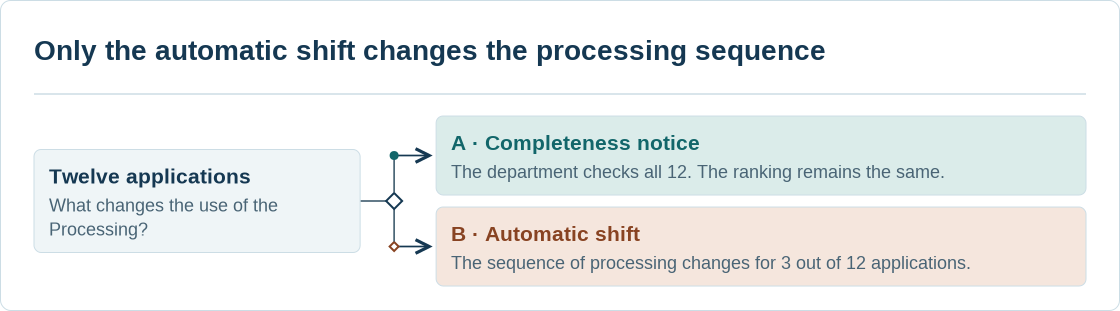
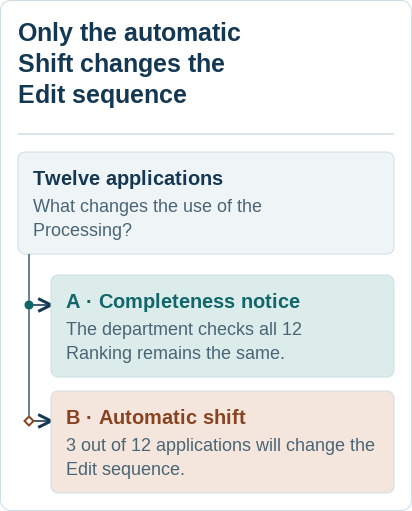
The surface is the same, and the effect on the process changes.
Intensifying tasks with audited results
Digital Audit Supervision
A reasoned classification and technical clearance decision on the suspected process.
View the guideClassification in insurance
A decision on new use with documented obligations, roles and conditions of release.
View the guide
Entry examination or ranking?
The fictitious academy Nord introduces an AI service for application to the study place. Variant A indicates the completeness of the files. The notice does not change the order of priority or deadline. The department opens each application and can request documents.
A human release button says little about the actual influence. Take a process in which the display could change the editing demonstrably.
Two classification notes with a technical relevance, analysed consequences and, where appropriate, the established exception.
Edit case · Entry exam or order of priority?Templates and worksheets
Use the workbook for your own data and calculations. The fillable quick view contains a sample sample and a protocol for your own process.
System inventory and risk classification
Determine the purpose, role, legal reference, prohibition, product path, Annex III and the separate transparency issue.
Outcome A work stock with a reasoned classification proposal, pre-sorted clarification cases and independent decision by system.
Read the instructions
Fictional example KI02 · The automatic shift of a study place application changes the documented decision influence. The documented exception reason does not bear then.
- The starting position Prove purpose, function and role
- Editing the Process Tracking unresolved prohibition and risk issues
- Secure Decision Release the decision to release the version
Official sources
First check for this task
Regulation (EU) 2024/1689 as amended on 27 July 2026
Readable version with the changes made by Digital Omnibus on AI. The application rules are to be read for your own deadline.
Guidelines on banned AI practices
Use examples of use and include later amended prohibitions from the current wording.
Regulation (EU) 2026/1744 · Digital Omnibus on AI
Officially published changes, including AI competence, high risk periods and transitional rules.

Other official references2
- Draft classification of high-risk systems (opens in new tab)
EU-Kommission · Leitlinienentwurf
The published draft shall provide separate verification questions on Annex I, Annex III and Article 6(3).
- Guidelines on transparency obligations of suppliers and operators (opens in new tab)
EU-Kommission · Leitlinie
The explanations help to determine responsibilities and the nature of information.
What is the next decision?
Choose the work path that fits your open decision. The descriptions show what you start with and which proof you then hold.
Applicability and roles
Explain which system is being considered, who provides it and whose decision it changes.
Starting point Inventory entry, vendor documents, contract, version, process sketch and an actual result used.
Work result A validity note with a proven role per legal entity, purpose, version level, spatial reference and open questions.
View the guideApplication data
Determine the relevant date per obligation, version and use.
Starting point Role, mandatory consideration, version history, documented deployment date and scheduled deployment start.
Work result A time-limit sheet with a confirmed legal basis, date of application, intermediate dates and separate existing decision.
View the guide

