
A new AI data upload channel
Mobile uploads are missing data in four out of 20 cases.
DEPLOYMENT
OVERSIGHT
Starting position and test order
A fictitious educational institution introduces a new mobile file upload for an AI already classified as highly critical to the evaluation of learning performance. The provider has described standardized text files. The setup controls the forms and file formats.
Of 80 paper and desktop sets, 79 are subject to the examination. There are 16 of 20 mobile submissions per channel for at least 20 internal cases, up to 5 percent of which are not required.
Compare baseline values
Paper and desktop
- Scale
- Not more than 5 percent of deficiencies
- Observed
- 1 out of 80, that is 1.25 percent
Mobile input
- Scale
- Not more than 5 percent of deficiencies
- Observed
- 4 out of 20, that's 20 percent
Total population
- Scale
- Own value per channel
- Observed
- 5 of 100 total
Check and prove
Determine data channel and responsibility
Compare the approved data according to the instructions for use with the fields at the actual input. Keep in mind who influences them.
Testable evidence Data overview with role, input source and covered formats.
- Acceptance criterion
- Trace execution, review and approval to named roles. Check handover and deputy arrangements in the exercise.
- Evidence
- Roles record naming responsibilities, deputies and documented approval or escalation.
Count missing mandatory data separately
Count complete and incomplete cases per channel. Compare the minimum number separately and the maximum rate.
Testable evidence 79 of 80 and 16 of 20 with confirmed reference size.
- Acceptance criterion
- Use the same metric, population and unit for expected and observed results. Record the measurement point at which the business service is achieved.
- Evidence
- Measurement record with baseline population, source, expected and observed values, unit and timestamp.
Block and alternative submission sample
Only continue the mobile input after a suitable follow-up test. Check beforehand whether affected persons have a reasonable, accessible alternative path.
Testable evidence Repeated trial and prospect of a technically confirmed resumption.
- Acceptance criterion
- Trace the submission by time, version sent and acknowledgement. Resolve missing or changed information for each reporting stage.
- Evidence
- Copy of the submitted version with version reference, dispatch evidence, acknowledgement and outstanding items.
What the test results
Situation A fictitious educational institution introduces a new mobile file upload for an AI already classified as highly critical to the evaluation of learning performance. The provider has described standardized text files. The setup controls the forms and file formats.
Model decision and justification
The joint quota of 5 percent hides the 20 percent in the mobile channel. The setup cannot decrease the new upload under the specified criterion. The existing channel meets the shown subcriterion.
For a new release, she uses her own mobile sample, checks the representativeness of actual file formats and confirms the alternate path.
Counter-sample and impact
Perform the follow-up test with ten mobile operations without any shortage. The error rate is zero. The released minimum size of 20 has not been reached, so that the sample remains open.
- Audit record
- Comparison of the original finding and retest showing the changed condition, observed effect and closure decision.
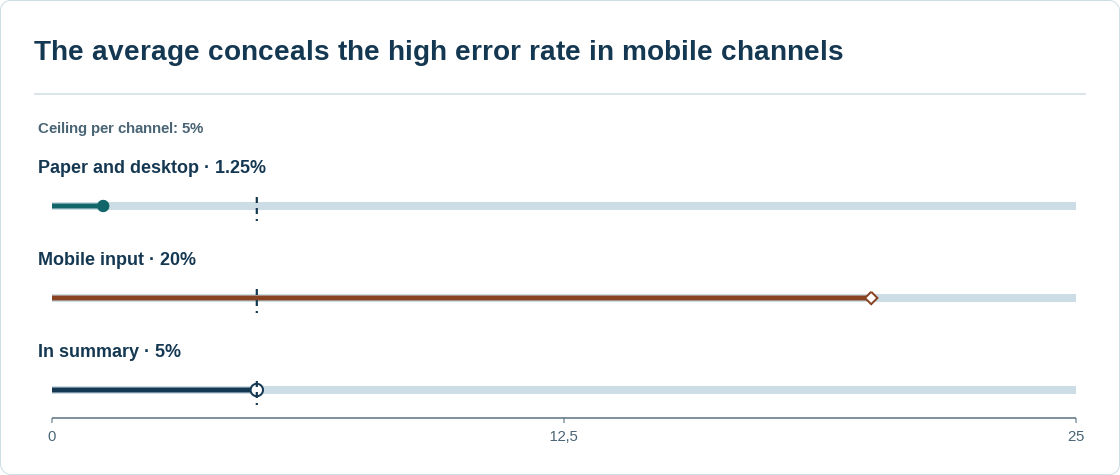
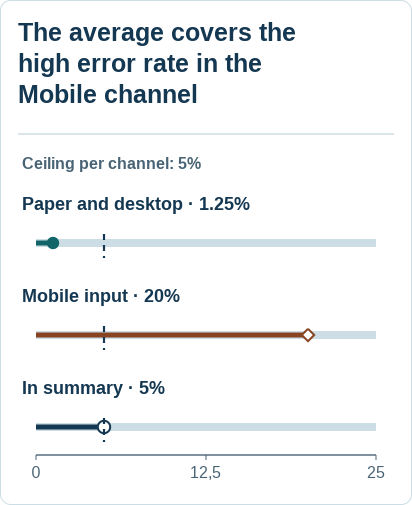
The total value of five percent conceals the mobile finding. Compare the quota of each channel with the same internal upper limit.
Documenting the test bench with your own data
A reasoned decision per input channel with verifiable coverage and remedy.
Operating acceptance by roll, data channel and operating path
Compare the operationally controlled fall groups and measure stop, cover and accessibility at the actual process.
Outcome Separate acceptance per input channel, roll or operating path with verifiable criterion and remedial action.
Read the instructions
Fictional example In mobile receipts, mandatory information is missing in four out of 20 cases. The overall rate is five percent. For the release, the mobile quota counts 20 percent.
- The starting position Create a row per roll, data channel or operating path
- Editing the Process Check sample and observed effect with the same scale
- Secure Decision Connect deviation with responsible persons, correction and post-test
Official sources
Regulation (EU) 2024/1689 as amended on 27 July 2026
Readable version with the changes made by Digital Omnibus on AI. The application rules are to be read for your own deadline.
Obligations of operators of a high-risk AI system
Check the actual limits of deployment, the powers of the responsible persons and the data under your control.

What is the next decision?
First, take the decisive observation from the case. Then, based on your open question, choose whether you want to check your own process or play a comparable case.
Data and case groups
Intensify dataset coverage and defects at the development interface.
Starting point Released reference, description of target population, sample size and observed errors per group.
Work result Decreased test coverage with separate detection for error rate, small sample and unexplained data origin.
View the guideInput data in actual use
Transfer the decision to your own use.
Starting point Use limits, reference data separated per channel and transfer protocol for evaluation.
Work result A reasoned decision per input channel with verifiable coverage and remedy.
View the guide

