
One evidence item, three rulebooks
Spread a receipt to product, AI system and banking operations with their own approval criteria.
DEPLOYMENT
OVERSIGHT
Starting position and test order
The fictitious port bank buys a product with digital elements for the creditworthiness assessment of natural persons. In the case of each CRA application, the high risk path Annex III No 5 (b) and the bank's own DORA role are confirmed. An external provider and the bank manage different releases for version 5.2.
The supplier confirms product requirements according to CRA Annex I Part I and manufacturer processes according to Part II. However, the EU declaration of conformity does not yet demonstrate the required cybersecurity level within the meaning of Article 12(1)(c). For the accuracy sample of AI 97 out of 100 correct results are available. The bank-internal evasive test takes 112 minutes with an internal target of no more than 90 minutes.
| Test track | Observation | Open question |
|---|---|---|
| CRA and AI cybersecurity | Product and process documentation available | Explanation of Art. 15 level missing |
| AI function sample | 97 of 100 correct results | In the example, 95% are considered to be internal |
| DORA-side operation test | 112 minutes | Internal target of the bank 90 minutes |
Prepare the decision
The scope of the common document shall be determined
Arrange the actual version for the proof. For Art. 42 para. 3 of the AI Regulation, check all conditions of Art. 12 para. 1 CRA including explanation. Evaluate accuracy and robustness independently.
Testable evidence Separate decision on the CRA bridge and system requirements under Art. 15.
- Acceptance criterion
- Justify applicability using evidenced activity or intended use, role and date. Assign an owner and due date to any unresolved assumption.
- Evidence
- Reasoned applicability assessment recording facts, reference, role, date and open assumptions.
Dispose of the bank's internal post-test
Link the technical documentation to the observed resumption of banking performance. Repeat the run with the same time base and internal goal. Arrange possible further obligations according to service and legal entity.
Testable evidence Reasoned bank decision with competent follow-up and supporting evidence.
- Acceptance criterion
- A second reviewer can follow the statement to the original evidence and the version checked. Record the evidence identifier or file reference with the decision.
- Evidence
- Evidence list recording original source, version, documented mapping and owner.
What the test results
Situation The fictitious port bank buys a product with digital elements for the creditworthiness assessment of natural persons. In the case of each of these, the CRA scope, the high risk path Annex III, point 5(b) and the Bank's own DORA role are confirmed.
Model decision and justification
The CRA bridge for cybersecurity requirements remains open until the declaration meets the third condition. Accuracy test reaches the internal target. The bank misses its own goal by 22 minutes. A subsequent statement does not close this business finding. The decision for the bank is waiting for its own follow-up.
Counter-sample and impact
Confirm the updated explanation and change the evasive test to 84 minutes. Both findings can be closed after proof is available. Then reset the state of the explanation to 5.1. The CRA bridge opens again for 5.2.
- Audit record
- Comparison of the original finding and retest showing the changed condition, observed effect and closure decision.
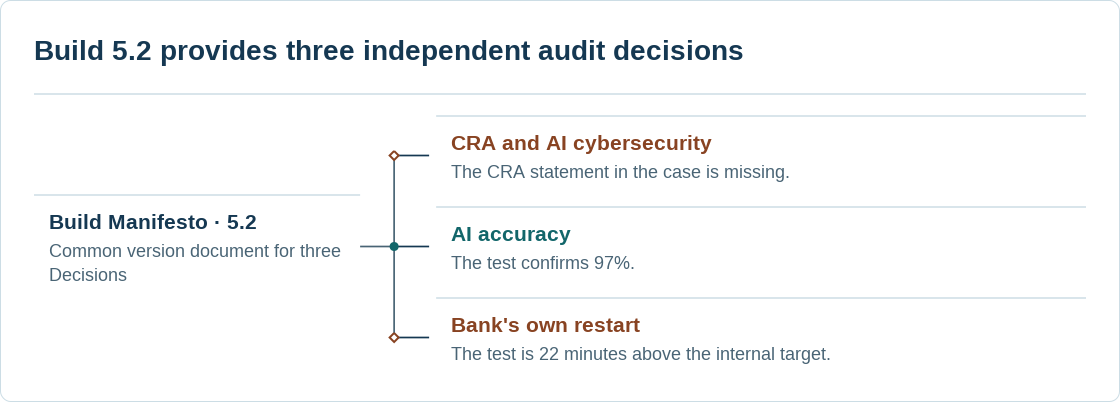
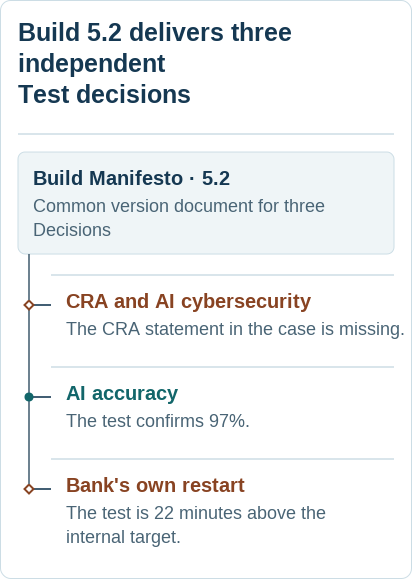
A common version reference allows reusable evidence and separate decisions.
Repeat with your own data
Three technically justified individual decisions that refer to the same version and show open findings per area of responsibility.
Joint evidence for AI Regulation, CRA and DORA
Separate three documents for the CRA bridge, the AI accuracy test and your own bank test. Common version and separate releases remain visible.
Outcome Three technically justified individual decisions that refer to the same version and show open findings per area of responsibility.
Read the instructions
Fictional example KI16 · The confirmation of cybersecurity is missing. Accuracy reaches 97 percent. The bank's crossing its target by 22 minutes.
- The starting position Confirm product scope, roll and version
- Editing the Process CRA bridge, accuracy and bank test separately check
- Secure Decision Repeat the remedy per legal framework with original documents
Official sources
First check for this task
Regulation (EU) 2024/1689 as amended on 27 July 2026
Readable version with the changes made by Digital Omnibus on AI. The application rules are to be read for your own deadline.
Regulation (EU) 2026/1744 · Digital Omnibus on AI
Officially published changes, including AI competence, high risk periods and transitional rules.
Art. 12 CRA · High risk AI systems
Check the three requirements of the cybersecurity bridge per product version.

Other official references1
- Art. 24 to 26 DORA · Tests of digital operational resilience (opens in new tab)
EUR-Lex · Finanzaufsicht
Arrange the risk-based test program and correction of findings to the financial entity that is covered. The operational target value follows its own justified audit plan.
What is the next decision?
First, take the decisive observation from the case. Then, based on your open question, choose whether you want to check your own process or play a comparable case.
Jointly examine AI and CRA
Transfer method and result to your own use.
Starting point Product and system version, supplier and operator role, technical proof and the respective contested operation process.
Work result A professionally justified assignment of reusable documents with a separate decision per duty and area of responsibility.
View the guideCase studies
You want to practice with fictitious data first or understand a similar decision from another role.
Compare how another decision needs to be taken.
Work result The cases provide initial data, a test order and a reasoned sample decision. Change a concrete condition and check the impact.
Select Case studies

