
One incident, four reporting paths
Reconstruct four reporting tracks and check permissible time limits.
DEPLOYMENT
OVERSIGHT
Starting position and test order
A fictitious malfunction on September 14, 2028 affects bank, independent IT service and a delivered product with digital elements. In the case of a serious ICT incident after DORA, a significant security incident for the NIS2 service and an actively exploited vulnerability in the CRA product are confirmed professionally. All time data are UTC.
The bank knows the 08.00 fault and classifies it around 10.15. The IT service knows the relevance of 09.10. The CRA manufacturer determines the actively exploited vulnerability around 10.00. For the high-risk AI system, the exercise confirms an independent serious incident according to Art. 3 no. 49 letter c. Significant knowledge is documented around 11.25. Around 11.45 the system provider determines the sufficient probability of the connection.
| Track | Trigger on September 14 | The selected path's compute mark |
|---|---|---|
| DORA · Bank | 08.00 Knowledge, 10.15 Classification | 14 September 14.15 |
| NIS2 · Service | 09.10 Knowledge of the relevance | September 15 09.10 |
| CRA · Manufacturer | 10.00 Knowledge of usage | September 15 10.00 |
| AI Regulation · Provider | 11.25 Knowledge, 11.45 context | 29 September 11.25 as a standard practice calculation mark |
Prepare the decision
Match time and jurisdiction
Secure the four triggers. Calculate in the normal DORA case classification plus four hours and knowledge plus 24 hours and check the previous mark. Use for NIS2 and CRA the knowledge confirmed per role.
Testable evidence Three independently derived first registration marks and two separate 72-hour stamps.
- Acceptance criterion
- Justify applicability using evidenced activity or intended use, role and date. Assign an owner and due date to any unresolved assumption.
- Evidence
- Reasoned applicability assessment recording facts, reference, role, date and open assumptions.
Check AI-reporting and shipping documents separately
Document the direct reporting reaction after establishing the connection. Capture operator transfer, shipping and achievable recipients. Keep possible special paths explicitly open.
Testable evidence Reporting track with original documents and documented decision on immediacy and case group.
- Acceptance criterion
- A second reviewer can follow the statement to the original evidence and the version checked. Record the evidence identifier or file reference with the decision.
- Evidence
- Evidence list recording original source, version, documented mapping and owner.
What the test results
Situation A fictitious operating disruption on September 14, 2028 concerns Bank, independent IT service and a product with digital elements delivered.
Model decision and justification
The DORA first-time notification is to be considered in the assumed default case until 14.15 of the same day. The first-time marks for NIS2 and CRA are to be viewed on the following day. The AI track applies immediately after established connection. The 15-day mark shown is a computational maximum mark in the assumed case.
Counter-sample and impact
Move the DORA classification to September 15 by 10.15. The standard formula may not now be used to issue any alleged breach of duty under the same rule. Check the special case according to Art. 5(2) of Delegated Regulation (EU) 2025/301.
- Audit record
- Comparison of the original finding and retest showing the changed condition, observed effect and closure decision.
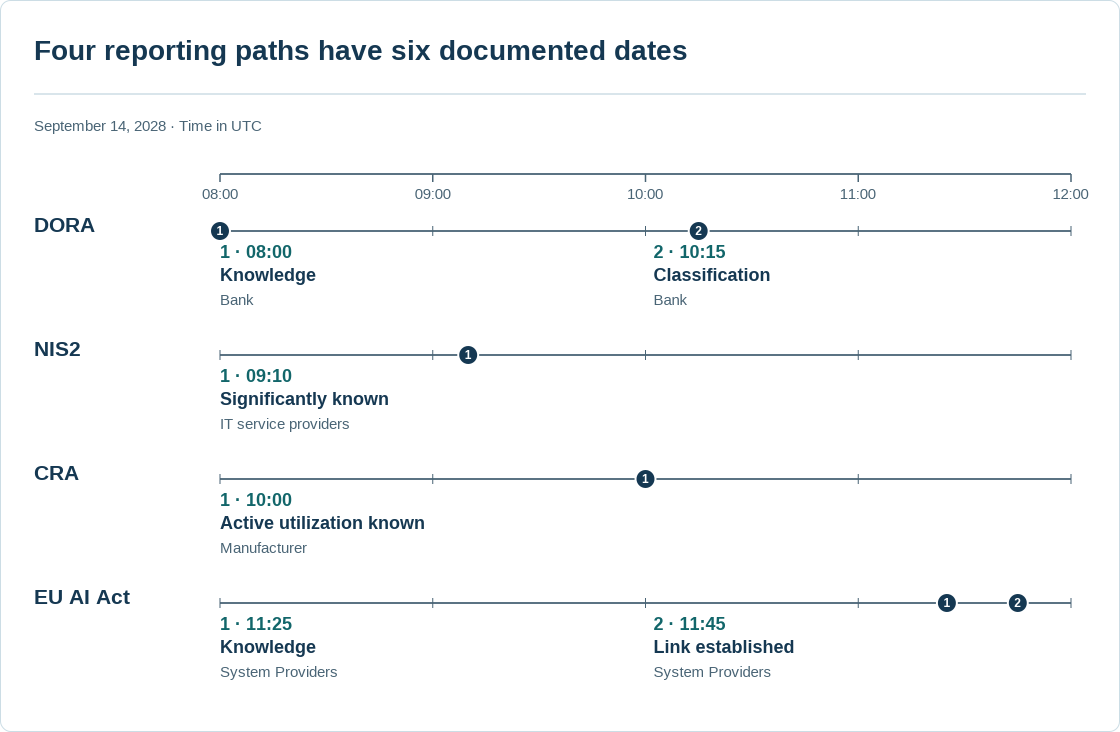
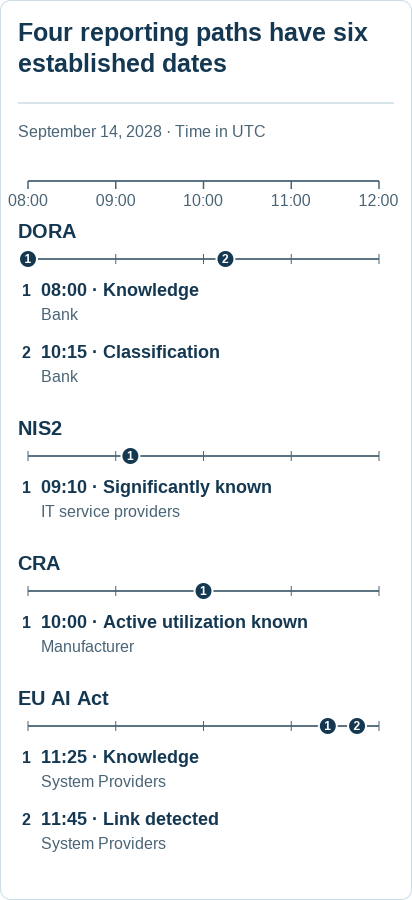
The timeline shows the exercise case of 14 September 2028 in UTC. DORA and the EU AI Act each have two established times. Determine the decisive trigger for each deadline separately.
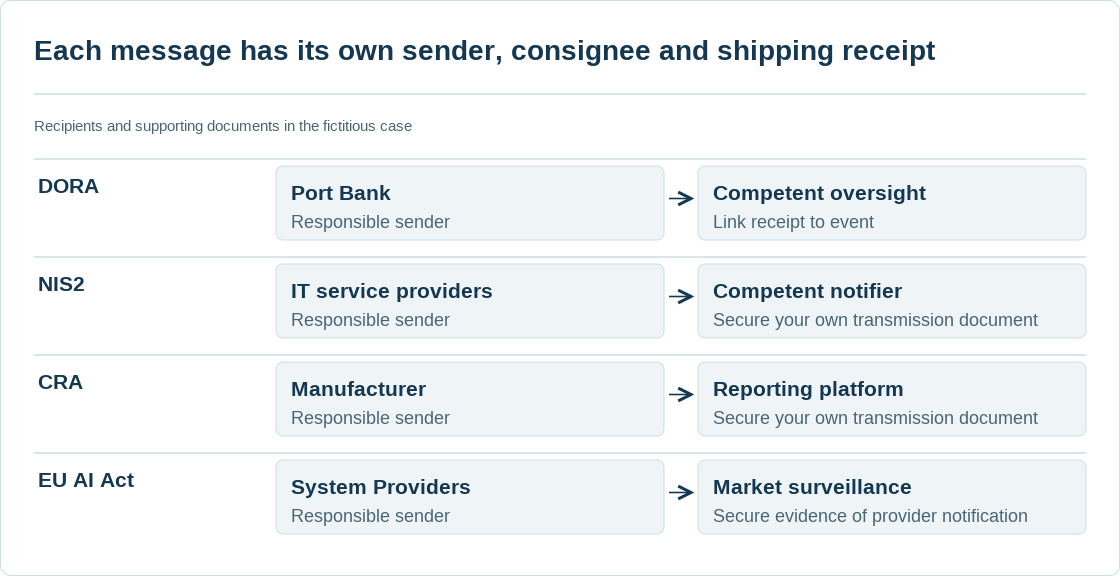
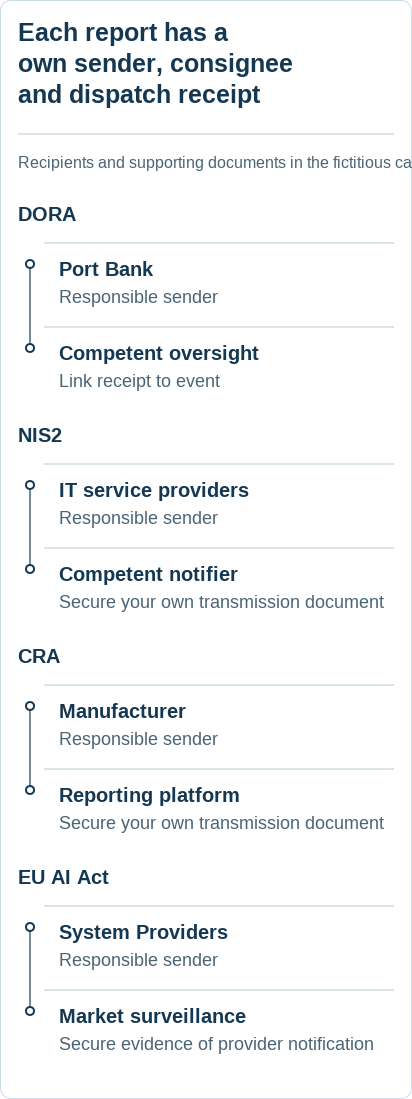
The transmission documents remain associated with the respective entity and confirmed triggers.
Repeat with your own data
A reproducible event file with separate reporting periods, documented special cases and own transmission receipts.
Four separate time-base tracks
Arrange filled-in UTC fields to the confirmed legal and case path. Compare shipping and calculated computed marks with original documents.
Outcome A reproducible event file with separate reporting periods, documented special cases and own transmission receipts.
Read the instructions
Fictional example KI23 · DORA starts with 08.00 and 10.15. NIS2 uses 09.10, CRA 10.00 and the AI track 11.25 with additional connection detection.
- The starting position Keep chronology and relevant triggers
- Editing the Process Special case, immediate reaction and calculation mark separately check
- Secure Decision Submission by competent authority
Official sources
First check for this task
Regulation (EU) 2024/1689 as amended on 27 July 2026
Readable version with the changes made by Digital Omnibus on AI. The application rules are to be read for your own deadline.
Article 5 Delegated Regulation (EU) 2025/301 · Reporting levels
Arrange knowledge, classification and actual dispatch of the respective reporting level. Check different cases separately.
§ 32 BSIG · Reporting of significant security incidents
Confirm the knowledge of relevance for the institution concerned and the official reporting process.

Other official references1
- Article 14 CRA · Manufacturers' reporting obligations (opens in new tab)
EUR-Lex · CRA 2024/2847
Distinguishing actively exploited vulnerabilities and serious security incidents. Evidence and completion reference must be given for the confirmed path.
What is the next decision?
First, take the decisive observation from the case. Then, based on your open question, choose whether you want to check your own process or play a comparable case.
Separate reporting tracks
An event concerns several entities, services or products and may trigger separate reporting obligations.
Transfer method and result to your own use.
Work result They carry out a common chronology with their own trigger, receiver and transmission receipt per obligation. Thus the parties can prove each deadline and notification individually.
View the guideCase studies
You want to practice with fictitious data first or understand a similar decision from another role.
Compare how another decision needs to be taken.
Work result The cases provide initial data, a test order and a reasoned sample decision. Change a concrete condition and check the impact.
Select Case studies

