
Rules for a bank, service and AI
Check common dependencies by means of own roles and service limits.
DEPLOYMENT
OVERSIGHT
Check the validity of bank, service and AI system on your own system
You must assign the obligation to each entity and service. Art. 1 para. 2 DORA and Art. 4 NIS2 determine the sector-related priority for covered financial companies. In German law, the specifically designated BSIG requirements and the special constellation in the operation of critical investments are to be read separately according to § 28 para. 6 and 7.
A group-internal IT service and the bank can use the same technical dependence and keep their own test track. Check Art. 28 and 30 DORAs per unit in actual performance, the service's own NIS2 classification as well as provider and operator role for the AI system. Arrange possible sectoral facilitations of individual AI obligations.
Clear boundaries between entities, service and role
The Bank's actual AI service is evidenced by:
Arrange providers, contract marks, operation and supported function to the institute. Check the dependency in the supply chain.
Testable evidence Proof of each relevant function and actual benefit.
- Acceptance criterion
- A second reviewer can follow the statement to the original evidence and the version checked. Record the evidence identifier or file reference with the decision.
- Evidence
- Evidence list recording original source, version, documented mapping and owner.
Merge amendment and contract requirements
Determine the basic requirements and, where applicable, additional requirements for critical or important functions support services.
Testable evidence The contract is drawn up with a proven information path and a specific service.
- Acceptance criterion
- Trace the commitment from the current agreement or amendment to the service actually used. Record discrepancies as specific conditions or open contractual points.
- Evidence
- Agreement reconciliation linking the service, current clause, operating evidence and decision on any discrepancy.
Checking sectoral priority over the entity and service
Document the bank and the independent classification of the IT company. Check the special case of certain critical investments separately.
Testable evidence Legal and role note with investment, service and confirmed decisions per company.
- Acceptance criterion
- Justify applicability using evidenced activity or intended use, role and date. Assign an owner and due date to any unresolved assumption.
- Evidence
- Reasoned applicability assessment recording facts, reference, role, date and open assumptions.
Test human supervision separately from resilience
Arrange a professionally authorized role, the observed possibility of intervention and the evidence. Check sectoral special rules for each individual obligation.
Testable evidence Proof of AI supervision and evidenced professional resumption as separate results.
- Acceptance criterion
- The responsible person performs the intended control in the approved workflow. Use the resulting transaction state to verify that the intervention worked.
- Evidence
- Evidence of the control showing role, time, affected transaction and observed effect.
Look up the AI Act article or annex and use the associated assessment questions to identify your next task.
A common platform and three areas of responsibility
The fictitious Hafenbank uses a high risk AI system for credit assessment. The separate Nordhafen Betrieb GmbH operates an managed identity service for the bank and other customers.
Decide which own proof bank, operator and IT service provider need.
A line taken or justified by each obligation with a responsible body and original document.
Edit case · A common platform and three areas of responsibility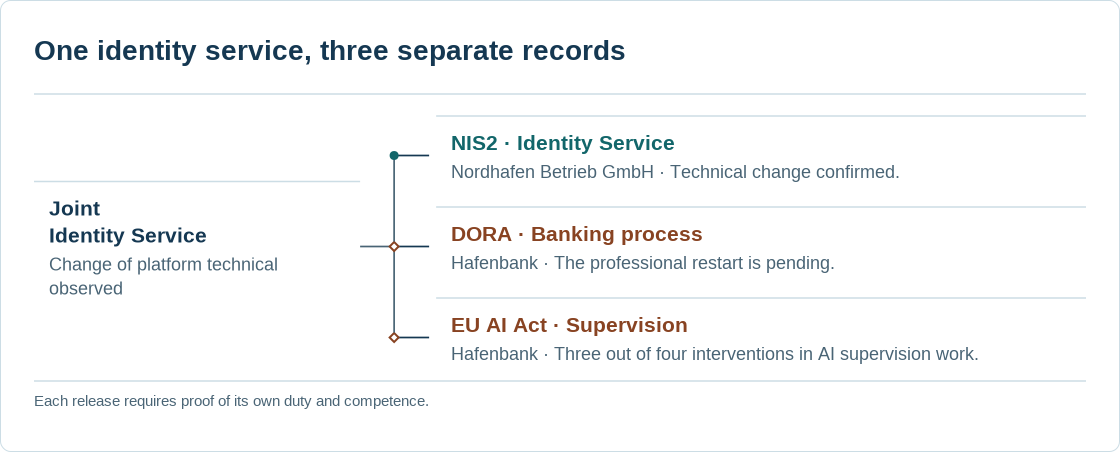
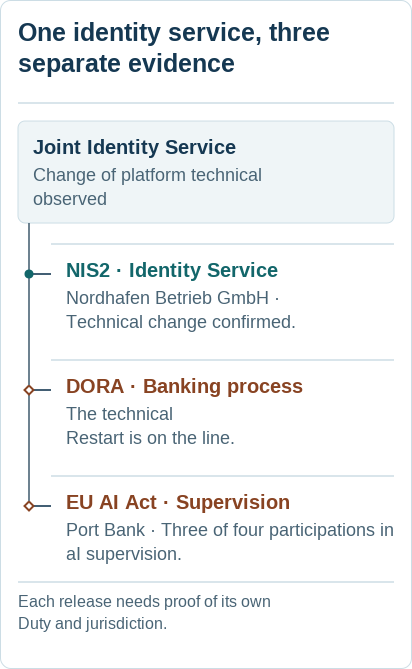
The platform change provides technical evidence. The bank checks the professional restart and AI supervision each with its own functional test.
Documenting your own test
Separate clearance per obligation, which makes visible documented common observations and open responsibilities.
Obligations and evidence per legal entity and service
Perform roles, application decisions, supporting documents and each individual sample for bank, IT service and AI use.
Outcome Separate clearance per obligation, which makes visible documented common observations and open responsibilities.
Read the instructions
Fictional example KI22 · The technical sample of the identity service is documented. Bank sample is missing. In AI supervision there are three out of four interventions.
- The starting position Confirm legal entity, service and applicable obligation
- Editing the Process Assign reusable evidence to the appropriate extent
- Secure Decision Decide on the test result and responsibility per track
Official sources
First check for this task
Regulation (EU) 2024/1689 as amended on 27 July 2026
Readable version with the changes made by Digital Omnibus on AI. The application rules are to be read for your own deadline.
Art. 28 DORA · ICT Third Party Risk
Check registers, risk, functional relevance and management of the specific ICT service by the financial company.
Art. 30 DORA · Contract content for ICT services
Arrange the service and the function it supports. Check basic requirements and, if necessary, the additional scope of contract separately.

Other official references2
- § 28 BSIG · Concern and sectoral demarcation (opens in new tab)
Gesetze im Internet · BSIG
Check the entity, activities and exceptions covered in paragraphs 6 and 7.
- Article 4 NIS2 and sector-specific Union acts (opens in new tab)
EU-Kommission · Leitlinie
The Guideline explains the scope of covered financial undertakings and the treatment of related ICT services.
What is the next decision?
Choose the work path that fits your open decision. The descriptions show what you start with and which proof you then hold.
Assigning evidence between DORA and NIS2
A bank and an ICT service provider use the same operational or test evidence. At least one entity is open to whether the proof covers its obligation.
Place the joint test report next to the technical acceptances of the two organizations. Compare what impact each page has actually tested.
Work result A proof matrix per service, legal entity and obligation. Missing examinations receive their own order.
View the guideSeparate reporting tracks
An event concerns several entities, services or products and may trigger separate reporting obligations.
When an event occurs, you assign knowledge, classification and dispatch of each reporting test separately.
Work result They carry out a common chronology with their own trigger, receiver and transmission receipt per obligation. Thus the parties can prove each deadline and notification individually.
View the guide

