
Check whether NIS2 applies
To merge activity, size and grouping up to the justified classification.
IMPLEMENTATION
EVIDENCE
What institution does what service?
The actual activity
Start with the legal entity that actually offers the service. Trade registers, contracts, billing and ongoing operation show from different perspectives who is a provider. A central IT department can be an organizational part of an institution depending on the structure or act as its own company towards other units.
Special circumstances and size testing
Then determine the specific type of establishment and the date. Size values, special stocks and any sectoral exceptions follow in separate decisions. Save the missing evidence and the competent authority for open questions.
So you go ahead
Determine performance and type of equipment
Select a performance that is actually performed per entity. Specify the investment position and check the definition based on contracts, prices, performance reports and actual activities.
- Acceptance criterion
- Trace the commitment from the current agreement or amendment to the service actually used. Record discrepancies as specific conditions or open contractual points.
- Evidence
Performance profile with unique installation and type of equipment.
Calculate thresholds with the same data level
Collect annual work units, sales and balance sheet total from released accounts. Depending on the case, partners and affiliated companies are included according to the SME recommendation. Check already consolidated values, period changes and a valid exception due to IT independence.
- Acceptance criterion
- Use the same metric, population and unit for expected and observed results. Record the measurement point at which the business service is achieved.
- Evidence
Repeatable size calculation with basic data and release.
Keep category and remaining obligations
Check size-independent cases first. Evaluate the legal exceptions and competent body by category for each activity. Determine which contract change, takeover or new service will be reexamined.
- Acceptance criterion
- Trace the submission by time, version sent and acknowledgement. Resolve missing or changed information for each reporting stage.
- Evidence
The next step and the resubmission of the application.
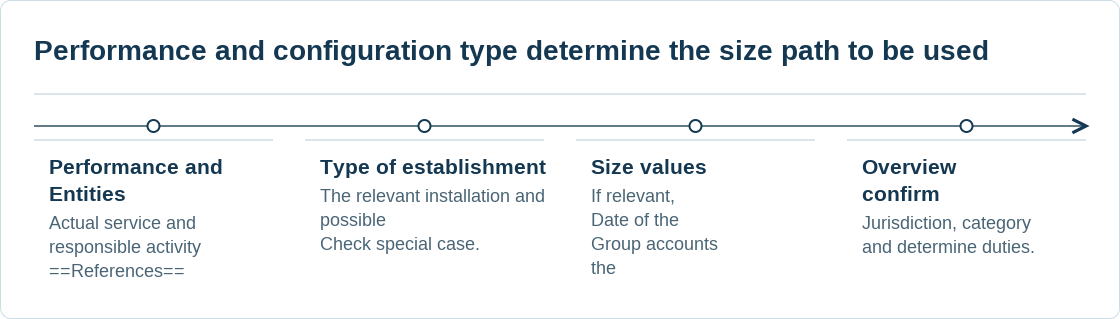
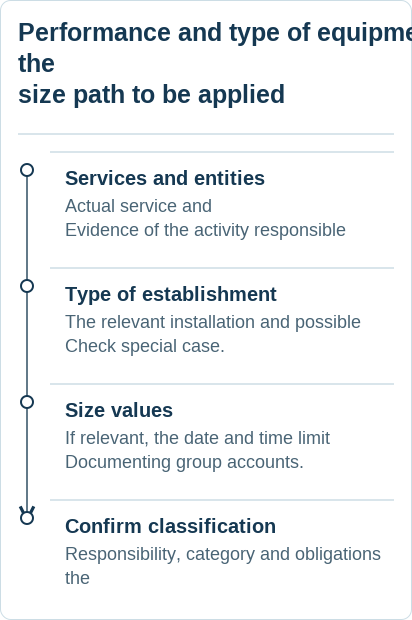
Actual performance, type of setup and special stocks determine the classification with the relevant size values.
Test example and counter-probe
Situation
The fictitious HanseWerk Technik GmbH offers an activity according to Appendix 1. It has 249 employees, 60 million. EUR turnover and exactly 43 million EUR balance sheet total at audited level. The big financial path requires both values above the threshold. The small size path is reached here. Then check special stocks, group values and the relevant periods.
Negative test
In the workbook, take a variant with 43.000.001 EUR balance sheet total. Document which previous periods or structural changes are also relevant. The result of a data level provides the starting point for the justified classification.
- Audit record
- Comparison of the original finding and retest showing the changed condition, observed effect and closure decision.
Work aids for your operation
Use the predictable template and check the result with the fully described example.
Affectedness and size values
Arrange activities per entity, calculate confirmed size values and record special cases and supporting documents.
Outcome The test method to be used for the calculation of the installation, size path and provisional category per activity.
Read the instructions
Fictional example HanseWerk achieves 62 annual work units with the confirmed group values. Another case with 249, 60 million. EUR turnover and exactly 43 million EUR balance sheet total remains below the main financial path.
- Legal entities and activities Enter the name, assignment, verifiable numbers and a stable reference.
- Group reference Check the partner share or full allocation and already consolidated values.
- Technically confirm decision The test shall be carried out in accordance with the following conditions:
Take the classification into an assessment
Use the confirmed validity note and service list as starting point. Take open classification questions with their jurisdiction into the further examination.
Select NIS2 on EUGRC.AIOfficial references for this task
First check for this task
§ 28 BSIG · Particularly important and important institutions
Check legal form, actual paid activity, type of facility, size values and special cases. § 28 para. 5–8 alters the scope of obligations for certain activities or institutions.
Appendix 1 BSIG · Sectors and types of equipment according to Appendix 1
Compare the real service with the specific type of facility and its legal definition. Check size level and special rules for basically relevant activities.
Appendix 2 BSIG · Sectors and types of equipment according to Appendix 2
For technical terms such as industrial production, research or marketplace operation, document the actual service. The size alone does not postpone an activity exclusively covered by Appendix 2 in Annex 1.

Other official references4
- Size features and group calculation (opens in new tab)
Empfehlung 2003/361/EG · Anhang Art. 3–6
Consider the reference and the deviations in § 28 para. 4 BSIG. Support data status, annual work units and consolidation.
- Article 2 NIS2 · Scope (opens in new tab)
Europäischer Rahmen · NIS-2-Richtlinie
Start with the type of institution, actual activity, size and responsibility. Check the explicitly size-independent cases additionally.
- Art. 3 NIS2 · Essential and important institutions (opens in new tab)
Europäischer Rahmen · NIS-2-Richtlinie
Link the European type of institution with the German classification and the applicable requirements. Check the individual performance areas for mixed activities.
- First classification with the examination of concern (opens in new tab)
BSI · NIS-2-Betroffenheitsprüfung
Use the evaluation as a guide and secure the decisive entries with your own documents.
Supporting your own classification step by step
Delimitation of legal entities and benefits
Merge activity, contractual partner and operational responsibility per company.
A coordinated portfolio of services with legal entities, investment position, period and evidence or open decision per performance.
Work through the caseDeriving size values in the group of companies
It is clear that own, proportionate and fully inclusive corporate values are calculated.
A freed calculation path with a definition of consolidated values and a reproducible basis for the category.
View the guideClear special cases before size testing
To assess DNA, TLD, trust services, public telecommunications and critical assets separately.
Reasoned special case with supporting documents and separately documented registration and reporting obligations.
View the guide
Reviewing the Group's assignment to actual independence
Establishing independence in the group
Two separate computational paths with reference date and relationship type.
The release contains the regular calculation method and the technical justification, which group-wide connections are decisive for the actual independence. If an essential connection remains unexplained, the deviation remains visible as an open decision point.
Work through the case
Clear assignment by activity profile or registration
Sectors and types of institution
You need the appropriate equipment from Appendix 1 or 2.
Determine the actual service and the relevant type of establishment with specialist documents.
Work result The service is assigned to a occupied type of facility. Open questions of specialist law receive their own order.
Sectoral law
Sectoral law and BSIG may be relevant to the same organisation.
Distinguishing applicable rules for financial undertakings, energy and telecommunications per service.
Work result The legal basis, decision-making, notification and appropriate evidence are visible per obligation.
Registration
The concern is certain and data or dates must be checked.
Merge the right entity, register and confirmed notification.
Work result The competent body, released output and registration confirmation are linked to each institution.

