
Put operational risks to the board
Document the option of action, impact, means and decision-making.
IMPLEMENTATION
EVIDENCE
The decision relates to the specific service
Take note of the observed effect of a deviation on the performance performed. Where § 38 is relevant, the management must organise and monitor the implementation of the necessary risk management measures. A decision specifies the chosen measure, responsibility, means and timing of the review.
Select a documented operational report and prepare the effects, tasks and responsible body for the management.
Present a decisive submission
Perform the test
Face two realistic alternatives using the same scenario. For each alternative, mention the expected impact, possible conflict of objectives and evidence to be used by management to assess implementation. Secure decision-making and open points in the protocol.
- Acceptance criterion
- Show which discrepancy changes impact on the affected service or product. Match it to an action and a responsible decision on residual risk.
- Evidence
- Risk entry with impact, action, residual risk and approval.
Result and further processing
A complete management order with aim, responsibility, date and verifiable decision basis. The released alternative creates an order, a scale and a follow-up date.
- Acceptance criterion
- The item under review and the documents refer to the same approved version. Record obsolete evidence as a separate discrepancy.
- Evidence
- Versioned mapping of item, source and approved version with any discrepancy recorded.
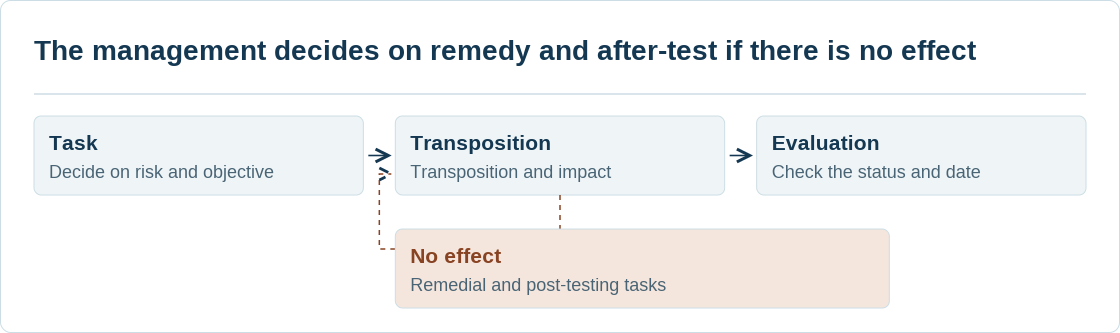
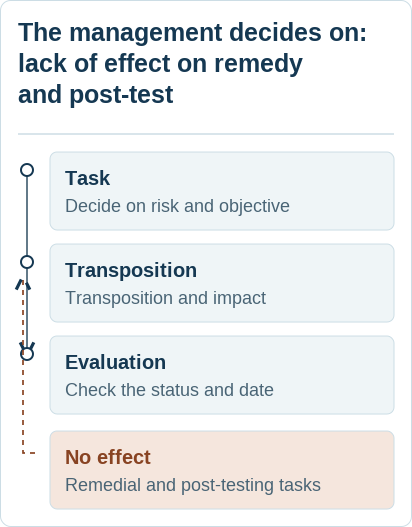
The management sets an effect as a goal, checks the observation and decides on remedy if there is deviation.
Decision and counter-test
Situation Capture the observed effect of a deviation on the performance performed. Where § 38 is relevant, the management must organise and monitor the implementation of the necessary risk management measures.
Initial situation and observed findings
The test protocol shows that a replacement path will be used professionally in 114 instead of 90 minutes. The line decides between additional capacity and a modified transfer process. It commissions a follow-up test with the same measurement method and requires the complete technical process in the test protocol before release.
Negative test
Change only the cost acceptance in the management sheet. The quality of the release will continue to depend on a comprehensible target value, a decision on funds and a new audit.
- Audit record
- Comparison of the original finding and retest showing the changed condition, observed effect and closure decision.
The own test bench
Track management mandate, review and regular training based on actual decisions.
Management decisions and training effect
Track management mandate, review and regular training based on actual decisions.
Outcome Overview of open management orders and training samples with due date and receipt.
Read the instructions
Fictional example A restart test provides a time difference. The management decides to remedy the situation and checks in the following date whether the business process concerned is fully possible again.
- Cover the decision Determine service, decision ID, target effect and responsible role on behalf
- Test training Prove participation and actually solved management task separately.
- Keep monitoring Join due date, actual examination and supporting documents.
Measures and efficacy samples
Arrange the ten fields of action. Treat test criteria, measurement, detection, findings and retest in the same work position.
Outcome Summary of measures with observed effect and pending retests.
Read the instructions
Fictional example A back-up is achieved in 88 minutes. The sample from the department is missing. The measure remains open until the agreed result is fully documented.
- Select criterion and type of test The ten action fields bear prepared examples. Set the appropriate yes-no criterion or a measurable setpoint.
- Record impact and evidence Refer to the target and is on the same performance and the relevant time.
- Track deviation and follow-up Record correction order, re-result and receipt with the same verification identifier.
Legal basis for this task
§ 38 BSIG · Implementation, monitoring and training
Support roles, decisions, supervised implementation and regular training at the services actually provided. Document responsibility and resubmission.
§ 30 BSIG · Risk management measures
For each relevant service, combine risks, ten fields of action, evidence and effectively verified effect. § 30 para. 3 gives priority to the technical requirements of the DVO for the providers covered there.
Art. 20 NIS2 · Responsibility and training of management bodies
Make management decisions and monitoring their implementation based on concrete services, effectiveness indicators and regular training.

Deriving the next order from the result
First, take the decisive observation from the case. Then, based on your open question, choose whether you want to check your own process or play a comparable case.
Making open risks visible to the management
The decision is given. Orders, residual risk and subsequent dates must be followed.
Starting point Open decisions, promised remedies, confirmed deadlines and known gaps in evidence of impact.
monitor effectiveness, overdue remedy and lack of evidence as its own decision-making parameters.
Work result The management will recognize where it must decide resources, date or a provisional measure.
View the guideControlling NIS2 effectively in the management
A decision by the management is missing for action or follow-up test.
Starting point Performance risks, previous decisions and open decisions with a deadline.
Decision, implementation, monitoring and training of specific services
Work result A management mandate with responsibility, target criterion and comprehensible monitoring.
View the guide

