
Prioritise service risks
Deriving from effects, dependencies and existing evidence prioritized test orders.
IMPLEMENTATION
EVIDENCE
Measuring the actual impact on the service
Combine possible scenarios with concrete benefits and risks. Consider the proportionality according to § 30 para. 1 among others exposure, size, probability of occurrence and impact. Figures for internal priorities make comparisons comprehensible. Your weighting remains recognizable as an internal rule.
Choose two risks that affect the same performance. Name for both the observable disturbance and the relevant period of time.
Deriving the order of work from the service
Perform the test
Describe fault, expected effects and existing measures per service. First check the most affected processes and prove which measure has already been tested. Follow unexplained basic assumptions and set a new assessment for changes.
- Acceptance criterion
- Use the same metric, population and unit for expected and observed results. Record the measurement point at which the business service is achieved.
- Evidence
- Measurement record with baseline population, source, expected and observed values, unit and timestamp.
Result and further processing
A prioritized and well-founded audit order per service with supporting documents and verifiable resubmission. The prioritized measure receives a test order with its own observation and date.
- Acceptance criterion
- Trace the submission by time, version sent and acknowledgement. Resolve missing or changed information for each reporting stage.
- Evidence
- Copy of the submitted version with version reference, dispatch evidence, acknowledgement and outstanding items.
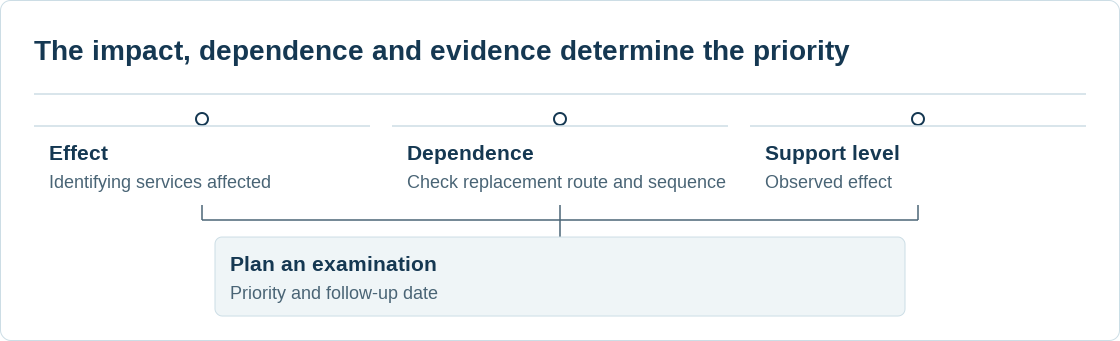
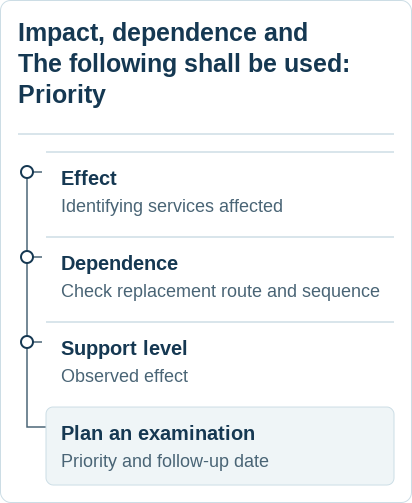
The reasoned test order follows from the effect, dependence and supporting evidence.
An example with negative test
Initial situation and observed findings
A comparison of the order platform results in a low technical error counter. Ten urgent orders depend on a manually maintained release list. In the model, the performance at risk is given priority until representation and replacement sequence are practically confirmed.
Negative test
Change the internal assessment at the recovery time and compare the priority with unchanged professional effect. Watch which statement may actually change.
- Audit record
- Comparison of the original finding and retest showing the changed condition, observed effect and closure decision.
The own test bench
Arrange operational consequences and restart targets per performance. Calculate necessary parallel and subsequent steps against the internal target
Operating effects and restart order
Arrange operational consequences and restart targets per performance. Calculate necessary parallel and subsequent steps against the internal target
Outcome Prioritized performance with comprehensible restart chain and visible target deviations.
Read the instructions
Fictional example N18 · The target of the order service is 90 minutes. The operational dependence takes 70 minutes, the subsequent handover 35 minutes.
- Coordinating objectives Set tolerable interruption, restart target and data loss.
- Count order Confirm the parallel requirements and the duration of the subsequent professional transfer.
- Sharing time and data Compare the calculated values and open evidence for the organizational decision.
Measures and efficacy samples
Arrange the ten fields of action. Treat test criteria, measurement, detection, findings and retest in the same work position.
Outcome Summary of measures with observed effect and pending retests.
Read the instructions
Fictional example A back-up is achieved in 88 minutes. The sample from the department is missing. The measure remains open until the agreed result is fully documented.
- Select criterion and type of test The ten action fields bear prepared examples. Set the appropriate yes-no criterion or a measurable setpoint.
- Record impact and evidence Refer to the target and is on the same performance and the relevant time.
- Track deviation and follow-up Record correction order, re-result and receipt with the same verification identifier.
Legal basis for this task
§ 30 BSIG · Risk management measures
For each relevant service, combine risks, ten fields of action, evidence and effectively verified effect. § 30 para. 3 gives priority to the technical requirements of the DVO for the providers covered there.
Art. 21 NIS2 · Risk management in cybersecurity
Determine verifiable criteria from the risk analysis for all ten policy areas. Consider applicability, proportionality and additional technical regulations.
Annex 2 · (EU) 2024/2690 · Risk management and verification
Link risk assessment, treatment, documented review and independent evaluation to the same extent.

Deriving the next order from the result
Choose the work path that fits your open decision. The descriptions show what you start with and which proof you then hold.
Establish a plan of measures with acceptance criteria
The order is justified, and the priority risk is not met by action and acceptance criteria.
Starting point Existing fields of action, assessed risks and responsibilities and existing evidence.
The ten risk fields translate into a responsible implementation and the same performance.
Work result The plan combines each measure with a deadline, measurable acceptance criterion and open post-test assignment.
View the guidePlan the ten action areas for own services
They must derive a specific test order from a risk.
Starting point Select a service. Capture already observed interference and its dependencies.
Put risk assessment, protective measures and effectiveness tests in a common work plan.
Work result The risk involves action, responsible persons, measurable targets and associated evidence of impact.
View the guide

