
Hand over a crisis decision
Released handover with time base.
IMPLEMENTATION
EVIDENCE
Passing a current crisis decision to the next shift
A longer disturbance leads over several shifts. The new responsibility must be able to make the next decision within the time limit from the given status. To do so, confirmed facts, forecasts and open orders belong to the same reference.
Perform the verification task
Secure the actual decision-making status
Take time, responsibility, commissioned measures, open facts and sources. Mark the next contractual, operational or legal reporting level with your own basis.
- Acceptance criterion
- Check the transferred service against the agreed scope in the target environment. Identify who confirms acceptance, business usability and open items.
- Evidence
Released handover with time base.
Sample the takeover
Let the following team process a fictitious intermediate without oral additions. Compare the mentioned time, order, decision and selection of the reporting path.
- Acceptance criterion
- Observe the intended effect in a defined transaction. Record how an absent effect changes acceptance or the follow-up action.
- Evidence
Monitoring for the re-establishability of the decision chain.
Establish open risks and representation
Complete a confirmed receipt and representation for open releases. Edit missing details with appointment and responsible body.
- Acceptance criterion
- Check the transferred service against the agreed scope in the target environment. Identify who confirms acceptance, business usability and open items.
- Evidence
Acknowledged handover and subsequent verification.
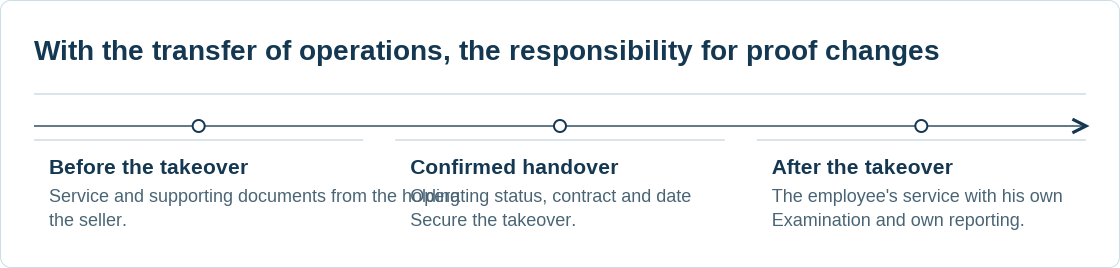
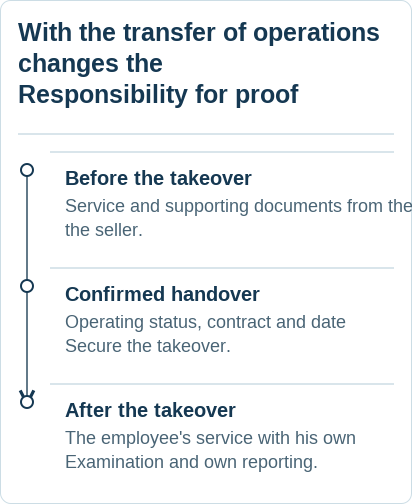
A time trail connects contract, actual handover and first incident. The second track shows operational responsibility before and after handover.
Check the decision in the example
Situation
The night shift takes place at 22:00. The stand contains a technical warning for the first service and significant restrictions in the second. The written note only mentions a common fault number and leaves open the confirmed knowledge time of the second service.
Evaluation and decision
The receiving layer requests the confirmed service and time allocation. The two reporting evaluations are conducted separately and remain linked to the same event reference.
Negative test for your own operation
Deposit the second knowledge time and a confirmed representation. Check whether the new team can name the next level with correct time origin.
- Audit record
- Comparison of the original finding and retest showing the changed condition, observed effect and closure decision.
Help for your decision
Calculate the basic periods of time for the same event from the respective knowledge, classification and transmission times. Run DORA and national paths in separate sheets.
Registration deadlines for DORA, NIS2 and specialist law
Calculate the basic periods of time for the same event from the respective knowledge, classification and transmission times. Run DORA and national paths in separate sheets.
Outcome Time and receipt chains per legal entity and reporting obligation. Each reporting stage has its own time reference.
Read the instructions
Fictional example N11 · The dispatch of the DORA initial report sets the 72-hour reference for the intermediate report. In the TK and MSP thread, knowledge of the significant incident determines the 72 hours. N12 adds EnWG and critical water system.
- Confirm Concern and Classification Link the same event identifier to service, jurisdiction, knowledge and each path of confirmed classification.
- Check shipping times and steps Capture actual shipping times. Use the last relevant intermediate message or the national No. 2 message matching the path.
- Confirm calendar and transmission Check work calendar, exception and progress reference if necessary. Link the decision to the relevant reporting channel.
Restart and restoration
Restart and data loss. Check data integrity, partition process and release separately.
Outcome Evidence of the professional resumption or a reasoned open finding.
Read the instructions
Fictional example The first run takes 105 minutes instead of 90 minutes and delivers 9.998 data sets from 10.000. In the subsequent test, the subject sample must be time and content.
- Set target values Decide on permitted time, data loss and expected records at the service.
- Record readings Determine technical usability only with a executed process as achieved.
- Check data and release The following shall be used for the purposes of this Regulation:
Legal basis for the verification task
Annex 4 · (EU) 2024/2690 · Management and crisis management
Link technical effects, restoration goals, safety test and release. Work ends with a proven business process.
§ 30 BSIG · Risk management measures
For each relevant service, combine risks, ten fields of action, evidence and effectively verified effect. § 30 para. 3 gives priority to the technical requirements of the DVO for the providers covered there.
§ 32 BSIG · Reporting of significant incidents
The early first report and the incident report are linked to the knowledge of the significant incident. The monthly reference follows the actual reported incident report. In case of a continuous incident, the reporting level changes.

Next step for your editing level
Choose the work path that fits your open decision. The descriptions show what you start with and which proof you then hold.
Report an incident separately after DORA, NIS2 and TKG
Use a common event identifier for technical observations. In addition, keep track of the reporting role, legal basis, level of knowledge and confirmed classification for each company concerned and every performance involved.
Several legally separate services are affected and require independent reporting times.
One event, three professional classifications and different time-limits for bank, telecommunications and managed service.
Your decision Determine your own starting point for each reporting route and confirm the dispatch of the next message.
Work through the caseTrying to Resume a Service
They work in parallel on tasks from the same department.
Starting point Minimum required performance, time and data objectives, reference stock and responsible department.
The overview will classify further audit orders and aids.
Work result A reasoned decision to resume with measured time value, data level and subject sample.
View the guide

