
Document duties under DORA and NIS2
The scope, roles and reusability of evidence between financial firms and ICT service providers.
IMPLEMENTATION
EVIDENCE
Clear the scope first, then assign the supporting documents
Scope and derogations
Consider financial companies and ICT service providers as separate entities. Check Art. 1 para. 2 DORA, Art. 4 of the NIS2 Directive and the expressly stated exceptions in § 28 para. 6 BSIG. For further obligations such as registration, the own investigation of the facts must be recorded. § 28 para. 7 BSIG limits § 32 only for the investment constellation recorded there.
Assigning contractual obligation and own obligation
A service provider can fall under NIS2 independently and at the same time fulfil contractual requirements of the financial customer. Check its actual performance, responsibility and type of facility. In case of outsourcing of reporting activities according to Art. 19 para. 5 DORA, the financial company remains responsible for reporting requirements. Document each obligation which part covers the common evidence.
From the test order to the secured result
Individually register legal entities, performance and standard
Merge the approval of the financial company, the confirmed role of the provider and the respective contract receipts. Also include standards for which a sectoral exception applies in the specific case.
Work result The legal basis for the obligation matrix is the date, decision and competent role of each entity.
Treat protection and reporting as decisions of its own
For the same service, follow Articles 19, 24 and third-party requirements on the bank side as well as the actual applicable BSIG and DVO obligations with the provider. Confirm the recipient per reporting route.
Work result Documented legal and role references with the respective assessment and clearance points.
Compare common measurement data with your own criterion
Compare version, service, period, observation and call-up. The ICT service provider confirms its technical target value. The bank also checks when its business could be fully executed.
Work result Reusable evidence with verified reach and own assessment per obligation.
Require missing evidence and follow change
Arrange the open part of a specific role and re-test. Secure the decision date, version used and the released assignment when making changes.
Work result Refreshable receipt chain with verifiable assumptions and clear follow-up steps.
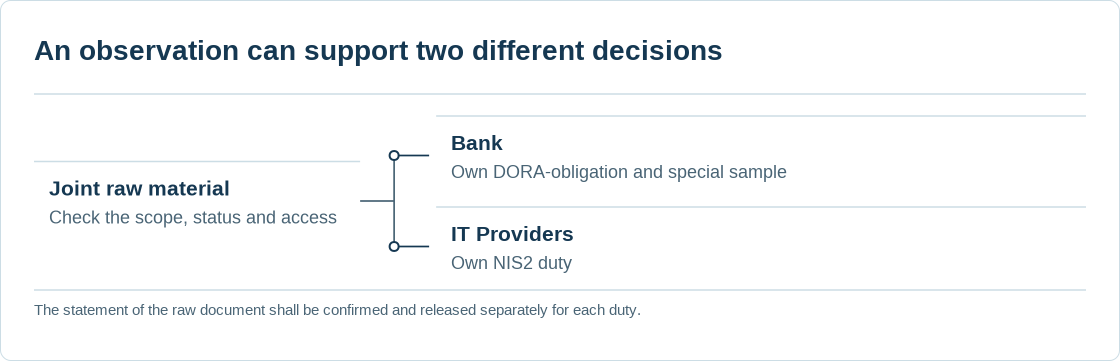
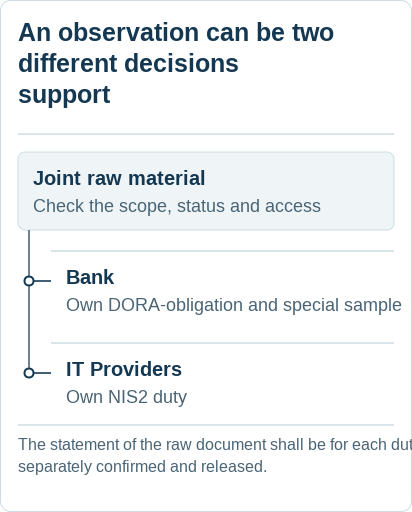
A common document shall be examined in accordance with its own obligation, scope and technical assessment per legal entity.
The same restoration, two targets
Situation Determine financial companies and ICT service providers as separate entities. Check Art. 1 para. 2 DORA, Art. 4 of the NIS2 Directive and the expressly stated exceptions in § 28 para. 6 BSIG.
Situation
Hafenbank AG obtains an administered service from HanseWerk Betrieb GmbH. The provider is independently certified as an important institution in Germany in the case of practice. The bank records the service as support for a critical or important function and evaluates its DORA requirements itself.
Monitoring and evaluation
The N10 protocol 07 joint service protocol measures technical availability after 92 minutes. The provider's agreement value is 120 minutes. The banking process is fully executable after 114 minutes, with an internal target of 90 minutes.
Reasoned decision
The technical protocol supports the provider's target-actual comparison and part of the bank audit. The bank's professional assessment requires its own business sample. The missed bank target time leads to a result with its own final decision.
Negative test
Remove the bank's access to the approved receipt or change the target process. The transfer into the respective obligation position remains open. Compare a merely contractual participation in a notification with the professional responsibility for your own reporting obligation.
Work result
Obligations released per legal entity and a verifiable allocation of the common protocol with its technical limits.
Working aids for your own operation
Document legal decisions per institution and performance. Check each proof whether the scope, status, access and statement support the assigned obligation.
Obligation and detection matrix
Document legal decisions per institution and performance. Check each proof whether the scope, status, access and statement support the assigned obligation.
Outcome Reasoned obligations and comprehensible decisions on the use of common evidence.
Read the instructions
Fictional example N10 · Bank and ICT service providers use the same technical protocol. A bank position remains open until their own business sample. Case N12 shows the separate assignment of common systems.
- Legal decision per obligation Capture confirmed entities, activity, exact reference, decision, role and deadline.
- Check the proof under the same identifier Link position and document form. Confirm evidenced depth of information and actual retrievability.
- Release your own evaluation Keep in mind who has released the use and what proof is missing.
Findings, post-test and completion
After a change, check whether the original criterion is met to a comparable extent. Track counter-test, release and date.
Outcome Reasoned financial status per finding and visible deviation from the agreed date.
Read the instructions
Fictional example N09 · The correction is documented. Only the comparable sample with counter-test and release is completed. Another criteria version and a stand without release are entered as counter-tests.
- Connect findings and first test Secure criteria, initial findings, proof and correction under the same identifier.
- Evaluate comparable sample Confirm result, counter-test, role and, if necessary, demonstrate required independence.
- Document release and appointment Collect date and release receipt. Use the valuation reference date for a comprehensible date.
Legal basis and official information
First check for this task
Article 4 NIS2 · Union sectoral law
Check that sectoral EU rules contain at least equivalent requirements in the specific area of obligations. Keep to each obligation the relevant basis.
DORA and sectoral application
Document the application per financial company, other group company and function.
§ 28 BSIG · Particularly important and important institutions
Check legal form, actual paid activity, type of facility, size values and special cases. § 28 para. 5–8 alters the scope of obligations for certain activities or institutions.

Other official references6
- Control ICT third party risk from purchasing to exit (opens in new tab)
Art. 28 DORA
The financial company remains responsible for DORA. Registering, preliminary examination, ongoing monitoring and proven exit capability interlock.
- § 33 BSIG · General registration and changes (opens in new tab)
Deutsche Anwendung · BSIG
Document the date of classification, register proof and changes. In case of changes and critical installations, you will check the version to be applied as specified in § 66.
- § 34 BSIG · Special registration of digital providers (opens in new tab)
Deutsche Anwendung · BSIG
Determine the main branch office, operating states as well as the additional data of the special register. Check initial registration and changes after each individual deadline.
- § 60 BSIG · Main office and EU representative (opens in new tab)
Deutsche Anwendung · BSIG
The assignment takes place in the legal order. First, prove where decisions on cybersecurity risk management are mostly taken. If there is no best possible solution, check the statutory catch criteria.
- Union and NIS2 sectoral law (opens in new tab)
Kommission · 2023/C 328/02
Check the equivalence and the regulations and facilities actually concerned. DORA is to be assigned separately according to Art. 1 para. 2 DORA and § 28 para. 6 BSIG.
- Controlling messages and customer information reliably (opens in new tab)
Art. 19 DORA
Serious ICT incidents are addressed to the competent authority. Reporting times and content are linked to Art. 20 and related standards.
Use the common test or notification document
Three reporting channels
Use a common event identifier for technical observations. In addition, keep track of the reporting role, legal basis, level of knowledge and confirmed classification for each company concerned and every performance involved.
An event concerns several notifiable benefits.
One event, three professional classifications and different time-limits for bank, telecommunications and managed service.
Your decision Determine your own starting point for each reporting route and confirm the dispatch of the next message.
Assign joint evidence
The starting point is the audit of the financial company.
assign common technical evidence to the relevant body and notification decision.
Work result A proof matrix per service, legal entity and obligation. Missing examinations receive their own order.

