
Manage ICT risk
link business risks with effective controls.
RISK
CONTROL
Where does the assessment of ICT risk begin?
Start with the business function and its failure-following image. Arrange dependencies on systems, data, locations and external services. The evaluation shows where a decision of the management is required.
Choose an observed business bottleneck and track it until the underlying risk assessment. The framework is intended to explain in this case what control effect is expected, how it is observed and who decides on an accepted deviation.
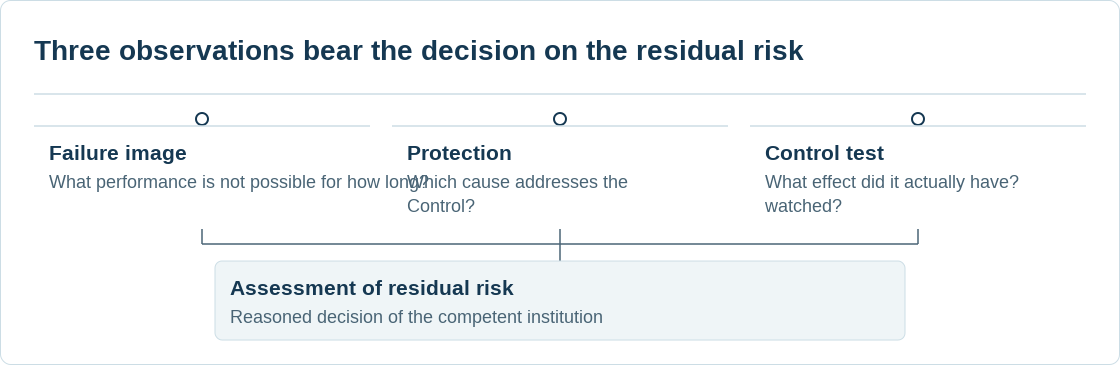
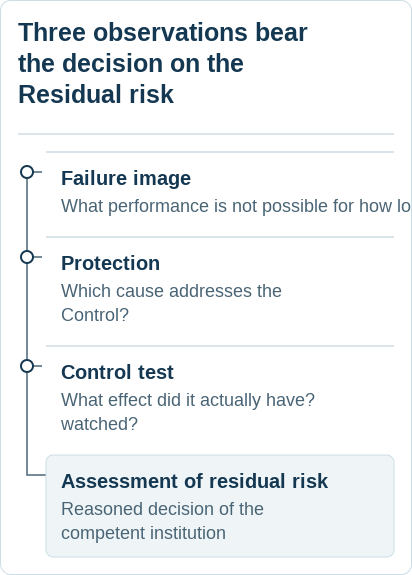
Read from the left how a proven failure sequence becomes a protective measure and an efficacy sample. The test result forms the basis for deciding on the remaining risk.
Choose the task that matches what you need to assess. Each work path identifies the records you need and how to evidence the outcome.
Checking the ICT framework in a function
Use the functional inventory, risk assessment and last documented efficacy check for a business function.
Capturing functions and dependencies
Describe per function the responsible persons, ICT assets, data and service providers. At critical or important functions, determine the classification basis.
- Acceptance criterion
- Justify applicability using evidenced activity or intended use, role and date. Assign an owner and due date to any unresolved assumption.
- Evidence
- Reasoned applicability assessment recording facts, reference, role, date and open assumptions.
Prioritize risks
Evaluate impact and probability of occurrence based on comprehensible criteria. Determine the remaining risk after effective controls.
- Acceptance criterion
- Show which discrepancy changes impact on the affected service or product. Match it to an action and a responsible decision on residual risk.
- Evidence
- Risk entry with impact, action, residual risk and approval.
Prove effectiveness
Link risk decision, control, implementation document and follow-up. Check whether the procedure detects new dependencies or significant changes.
- Acceptance criterion
- A second reviewer can follow the statement to the original evidence and the version checked. Record the evidence identifier or file reference with the decision.
- Evidence
- Evidence list recording original source, version, documented mapping and owner.
Secure the statement with a sample
Let us show you how a repeatedly missed target is taken over in evaluation, measures and reporting. The review must be found on a concrete finding.
- Acceptance criterion
- Select a repeatedly missed target. Use the same identifier to link risk assessment, action and effectiveness follow-up.
- Evidence
- Measurement record with baseline population, source, expected and observed values, unit and timestamp.
From the blog
Checking the effectiveness of security measures
The article shows how to connect a control to a specific risk and assess it using records from day-to-day operations.
Example of payments
A common memory supports two business processes. Check whether the evaluation takes into account the cumulative impact and the actual available alternative.
The identification chain for a significant risk The identification remains comprehensible across inventory, risk registers, control checks and decisions.
- What you are examining
- For both processes, set the effects of a simultaneous memory failure. Check whether the planned alternative requires common memory. Separate release per process does not yet prove independent restart paths.
- What the post-test decides
- Repeat the evaluation with the confirmed supply chain. Check whether common downtime, technical consequences and clearance limit can be found in both the test orders and the product.
- Audit record
- Versioned mapping of item, source and approved version with any discrepancy recorded.
Tasks in this thematic area
Select the work page for your role, next check point or corresponding proof.
Resilience objectives and risk tolerance
Translate business impacts into verifiable resilience targets and derive a justified risk assessment from tests and incidents.
Designing the ICT risk management framework
The framework combines the risk strategy with actually used procedures, responsibilities and measuring points. It is part of overall risk management and makes it clear how risks are handled and decisions are followed up.
Your result Framework overview with version-proof paths of strategy, responsibility and control for the test document.
Evaluate and treat ICT risks
Formulate risks as comprehensible default scenarios. The decision on the remaining risk requires a documented control, a competent decision maker and, if necessary, a temporary exception.
Your result Risk files with sources of impact, control and temporary measures.
Review ICT risk management framework
Deduce a verifiable update of the risk management framework from incidents, tests, changes and audits. Transfer findings to an audited framework change.
Applying the simplified ICT risk management framework
First, create a proven business status. For the financial undertakings referred to in Article 16(1) the simplified framework is specified by Title III of Delegated Regulation (EU) 2024/1774.
Your result Released classification with separate statements on risk frameworks, reporting and third parties.
Practice examination decisions in the case
Edit the initial data and compare your result with the well-founded solution.
Case D04
Building a simplified ICT framework for an institution
A fictitious e-money institute examines a simplified framework. A proven legal classification controls the procedure and is translated into concrete roles and tests.
Your result Compact framework overview with status receipt, service, risk, roles, test findings and open obligations.
Legal basis for this task
Compare the decision from the test example with the relevant rule.
Articles 5 to 16 DORA and Delegated Regulation (EU) 2024/1774
The technical regulatory standards specify frameworks, methods and processes.
For your exam The identification remains comprehensible across inventory, risk registers, control checks and decisions.

Intensify ICT operations and protection
Capture functions, information and ICT assets, prioritize protective measures and review changes. For internal evaluation, assessments on EUGRC.AI are available.

