
Treat ICT risks
Assess the control effect and residual risk.
EVIDENCE
SAMPLE
Decide the remaining risk level after verified control
Formulate risks as comprehensible default scenarios. The decision on the remaining risk requires a documented control, a competent decision maker and, if necessary, a temporary exception.
Write the risk assessment so that the effect of each measure is understandable. For example, assume that a re-start period has been observed and check which dependence affects the value. If you have an open proof of impact, determine which decision is provisional and what would confirm it.
Work steps and verifiable documents
Description of scenario and impact
Describe the performance concerned, the triggering condition and possible consequences. Use the agreed evaluation method. Note at which points the consequences were estimated.
- Acceptance criterion
- Show which discrepancy changes impact on the affected service or product. Match it to an action and a responsible decision on residual risk.
- Evidence
Risk entry with verifiable assumptions and business reference.
Prove control effect
Determine which measure changes which assumption. Take condition, date and result from a test sample. Reassemble the remaining exposure based on the proven protective effect.
- Acceptance criterion
- Use the same metric, population and unit for expected and observed results. Record the measurement point at which the business service is achieved.
- Evidence
Before and after assessment with concrete test certificate.
Decide on treatment and resubmission
Decide whether another measure, a justified acceptance or another treatment route is required. Determine responsibly when the decision will be reviewed.
- Acceptance criterion
- Compare initial risk, implemented measure and observed residual risk for the same service. Refer an exposure above tolerance to the authorised decision-maker.
- Evidence
Release note with date, condition and escalation path.
Decision in the test example
In fictitious payment operations, the restart has been tested once with 105 minutes against the internal target of 90 minutes. The operating plan assumes so far that all backup copies are available in the same time window.
- Compilation of documents
- To the test level, create a short comparison of internal tolerance, measured result and agreed after-test. If a change in memory is required, the deviation at the new measuring point must remain verifiable.
- Keeping a decision
- The evaluation for this test level remains above the time criterion. In the subsequent test, the operation measures the provision of the fuse separately and presents an updated decision to the responsible role.
- Complete the test file
- Risk files with sources of impact, control and temporary measures.
- Sample and acceptance
- Check the decision with a remote test protocol. The evaluation must recognize the lack of evidence and trigger a reassessment.
- Audit record
- Measurement record with baseline population, source, expected and observed values, unit and timestamp.
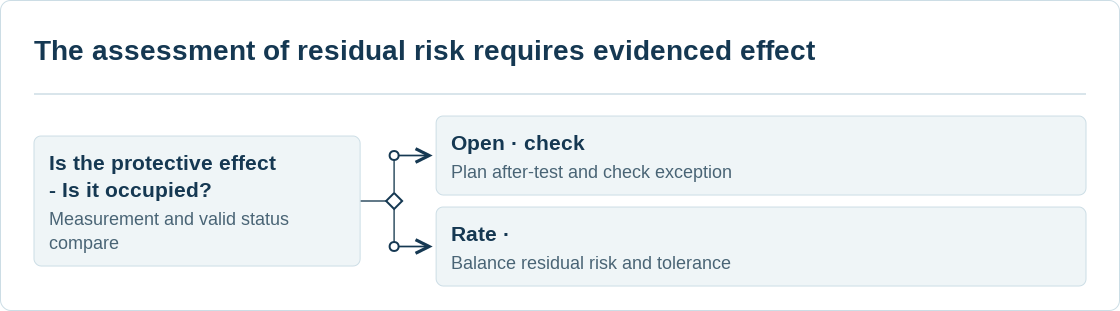
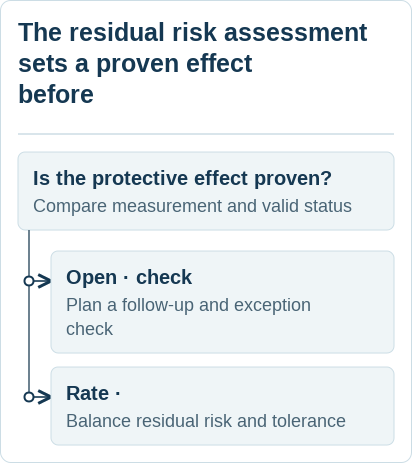
An open evidence of the effects changes risk management
First check which protection was actually observed. Then decide on treatment, conditions and next appointment.
Templates and worksheets
The filler tool is directly under the task. Download the template for editing or open the Quick View.
Decision on ICT risk
Calculate inherent and remaining internal risk values and document the authorised treatment.
Outcome Risk decision with assumptions, residual risk limit, effective measure and resubmission.
Read the instructions
Fictional example A central service has no alternative entry 4 and impact 5. With tested replacement the entrance drops to 2. For impact 5, the reliable expert evaluation is missing.
- Compare residual risk Evaluate the occurrence and impact of each scenario before and after the treatment, on the same internal scale.
- Linking Evidence For relevant checkpoints, deposit the specific source, the verified version and the proof ID.
- Treatment of deviation Keep the findings open, check the extent and dependence and release the assumptions by the competent authority.
Legal basis for this task
DORA · Art. 6 para. 8 · Risk tolerance
The resilience strategy includes the tolerance for ICT risks and the effects of disruptions.
For your exam Check which limit the treatment of the selected scenario is taking.

What is the next decision?
Select an open acceptance from the risk assessment. In the detection dossier, specify the sample that would confirm a temporary acceptance or trigger another measure.
Risk framework and strategy
Determine a measurable resilience target from the failure of a business function. Link function, risk and controls and check when the framework needs to be changed.
Your result Resilience target with a measurement and justified assessment of the risk framework.
Detection dossier
Test job, original sample, version reference, correction and documented retest.
Link target criterion, drawn sample, findings and retest. The memory example shows which protocols prove the effectiveness of alarming to the checked status.
Work result A dossier in which a third party monitors expectations, observations, findings and conclusions per test criterion.
Your result A dossier from which another person can repeat the same sample.

