
AI in recruitment
examine selection procedures and effective supervision.
ROLE
OVERSIGHT
Starting position and test order
The fictitious Hafenbank intends to pre-sort applications in January 2028 using an AI ranking sequence. The provider calls the purpose of the evaluation of applications. The staff team decides on invitations. In the exercise there are eight fictitious applications and one of two qualified persons independently confirmed aptitude reference. Six applications meet the minimum professional criteria.
The HR-2.3 version recognizes five of the six suitable applications. A suitable application with unusual part-time biography is missing. An unsuitable application is in the proposal list. The requirement for this release is to correctly record six out of six suitable applications and to be able to recognisably reset faulty recommendations before any external decision.
Edit the case independently
Delimiting the role and deployment
Arrange employers and providers separately. Evaluate the actual pre-selection for this purpose by applying Annex III, point 4(a) and Article 6.
Testable evidence Versioned note on the role and classification.
- Acceptance criterion
- Justify applicability using evidenced activity or intended use, role and date. Assign an owner and due date to any unresolved assumption.
- Evidence
- Reasoned applicability assessment recording facts, reference, role, date and open assumptions.
Check the original file
Open the appropriate, overlooked application and match the original feature based on the pre-defined criterion. Let the specialist actually reset the ranking without access to the provider.
Testable evidence Documented intervention with original receipt, role release and timing.
- Acceptance criterion
- The responsible person performs the intended control in the approved workflow. Use the resulting transaction state to verify that the intervention worked.
- Evidence
- Evidence of the control showing role, time, affected transaction and observed effect.
After-test in the same sample
Compare HR-2.4 with the same independent reference. Perform a second controlled sample with an incorrect candidate proposal and secure the observed replacement route.
Testable evidence Test protocol per version with hit rate, misproposals and intervention.
- Acceptance criterion
- The responsible person performs the intended control in the approved workflow. Use the resulting transaction state to verify that the intervention worked.
- Evidence
- Evidence of the control showing role, time, affected transaction and observed effect.
From the blog
A practical scope for AI governance
The question of which releases, changes and proofs an organisation must actually master in a concrete AI application is appropriate for the selection case.
What the test results
Situation The fictitious Hafenbank tests an AI system that pre-sorts applications. Six out of eight applications meet the minimum technical criteria. In the first run, the AI recognizes five of them. The staff team must be able to suspend a recommendation and check the original receipt.
Model decision and justification
In the first test, the system recognizes five of the six technically suitable applications. The 83.3 percent rate misses the pre-determined target of six correct hits. The staff team suspends the invitation and checks the original qualification certificate.
After the correction, AI recognizes all six suitable applications and does not create any misproposals. The department also checks whether it can actually stop and correct a recommendation. Only both documents bear the approval.
Counter-sample and impact
In the exercise, leave all six hits correctly, but block the suspension function. The staff team can't stop the recommendation then.
Keep the release open. The re-test must prove that the person responsible can intervene and decide the process with the original certificate professionally.
- Audit record
- Comparison of the original finding and retest showing the changed condition, observed effect and closure decision.
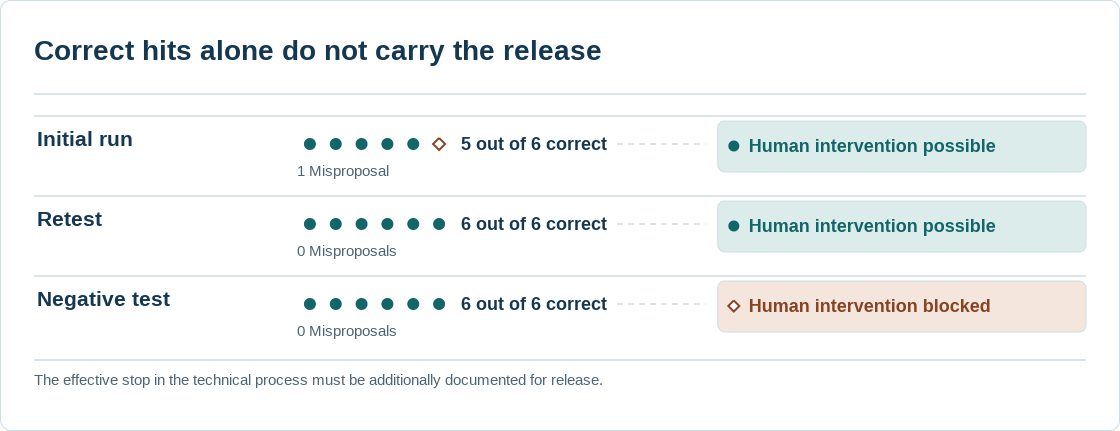
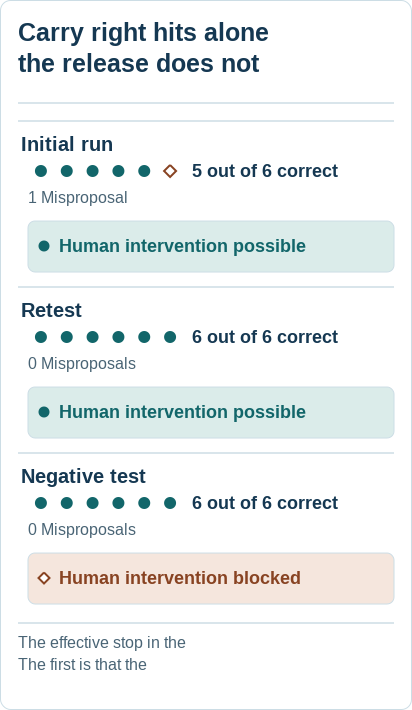
Results, misproposed and human intervention each receive their own findings.
Official sources
First check for this task
Regulation (EU) 2024/1689 as amended on 27 July 2026
Readable version with the changes made by Digital Omnibus on AI. The application rules are to be read for your own deadline.
Regulation (EU) 2026/1744 · Digital Omnibus on AI
Officially published changes, including AI competence, high risk periods and transitional rules.
Article 6 and Annex III, point 4(a) EU AI Act · List personnel selection
Describe how the system analyzes, filters or evaluates applications. Check the classification based on the specific purpose and, if applicable, the exceptional circumstances according to Art. 6 para. 3.
For your exam The inventory entry states that the AI puts applications in a ranking used for preselection.

Other official references1
- Art. 26 EU AI Act · Obligations of the operator (opens in new tab)
EUR-Lex · Amtliche Fundstelle
In particular, check whether qualified persons are used for human supervision and how the operation is monitored.
For your exam The release notice shall specify the supervisor, their access to the original application and the way to suspend use.
Templates and worksheets
Use the workbook for your own data and calculations. The fillable quick view contains a sample sample and a protocol for your own process.
Decreasing human supervision
Evaluate results after released reference. Disclose misproposals, operability of the procedure and effect in the follow-up test.
Outcome A acceptance protocol with a target-actual comparison, observed suspension and responsible follow-up test.
Read the instructions
Fictional example KI01 · 5 out of 6 suitable applications correspond to 83.3 percent. If six correct hits are made, a blocked procedure remains open as its own findings.
- The starting position Set reference and role sharing
- Editing the Process Watching hits, misproposals and intervention
- Secure Decision Evaluate counter-test and new release
EU AI Act Test sheet for AI personnel selection
Document decision, responsible person and supporting documents in the editable Word document.
Read the instructions
- Documenting the context of use Keep the role, purpose, system version and selected process.
- Understanding Human Trial Connect striking recommendation, verified document and own assessment.
- Release or correct Decision, authorised person and location of the document.
Protocol on human testing of AI recommendation
Document how a responsible person checks a specific AI recommendation and proves his own decision.
Outcome Test track for human assessment of a recommendation.
Read the instructions
Fictional example An application is given a low classification because of an incompletely recorded information. The person who checks the data compares with the available documents and justifies the correction.
- Decision and purpose Determine the concrete process, system version and test criterion.
- Checking abnormality Match results and admissible documents at the process.
- Evidence of Human Decision the assessment, the authorised body, the correction initiated and the date.
- Sampling for follow-up Document a corresponding control case and determine the responsible team.
Transfer the result to your own use
First, take the decisive observation from the case. Then, based on your open question, choose whether you want to check your own process or play a comparable case.
Check your own operation before restarting
They use a high-risk AI and must decide before or after an incident whether the technical process can continue.
Start with the application protocol and the last confirmed procedure. Check also on the follow-up test whether the suspension is effective in the associated specialist procedure.
Work result A reasoned re-start decision with confirmed version, responsible person and evidenced effect of the intervention.
View the guideOther cases
You want to practice with fictitious data first or understand a similar decision from another role.
Select a case by task and available sample.
Work result The cases provide initial data, a test order and a reasoned sample decision. Change a concrete condition and check the impact.
Select Case studies
Intensify the role and commitment of the EU AI Act
Preparing for practical documentation and human supervision. Assessments on EUGRC.AI are available for internal evaluation.

