
Mobile access and fundamental rights
Three decisions on the group concerned, confirmed remedy and update take.
DEPLOYMENT
OVERSIGHT
Starting position and test order
The fictitious city of Lindenhafen uses a high risk AI in the examination of eligibility for public support services. In the case, the obligation to fundamental rights impact assessment is confirmed. The data protection impact assessment already deals with storage and access roles. Access for persons with assistive devices is not yet evaluated.
A newly introduced mobile input rejects functional documents for 6 of 24 synthetic cases with assistive input. In the regular comparison channel it is 1 of 24. The internal target is at most 10 percent faulty references for at least 20 meaningful cases per group and an accessible manual way.
| Group | Cases | References previously | Retest |
|---|---|---|---|
| Assistive Input | 24 | 6 | 1 |
| Comparison channel | 24 | 1 | 1 |
Prepare the decision
Measuring effects on real workflow
Secure the same definition of incorrect referral per group. Link the findings to the concrete hurdle when accessing and check what the data protection file actually proves.
Testable evidence A reasoned proof which is affected by the change.
- Acceptance criterion
- A second reviewer can follow the statement to the original evidence and the version checked. Record the evidence identifier or file reference with the decision.
- Evidence
- Evidence list recording original source, version, documented mapping and owner.
Manual path and communication
Have the corrected version and alternative method checked separately. Update the impact assessment and document which notification procedure applies.
Testable evidence Case lists, documented replacement and competently released update.
- Acceptance criterion
- Trace the submission by time, version sent and acknowledgement. Resolve missing or changed information for each reporting stage.
- Evidence
- Copy of the submitted version with version reference, dispatch evidence, acknowledgement and outstanding items.
What the test results
Situation The fictitious city of Lindenhafen uses a high risk AI in the examination of entitlement for a public support service. In the case, the obligation to fundamental rights impact assessment is confirmed.
Model decision and justification
The quotas are initially 25.0 and about 4.2 percent. The new access exceeds the target of the exercise. The subsequent test results in each of around 4.2 percent. An additional recording requires that the manual path is actually achievable and that the update has been confirmed professionally.
Counter-sample and impact
Leave both groups at good odds and mark the manual path as not accessible. The release remains open. In addition, check a follow-up for assistive input with only 8 cases without errors. The scope is below the internal minimum value.
- Audit record
- Comparison of the original finding and retest showing the changed condition, observed effect and closure decision.
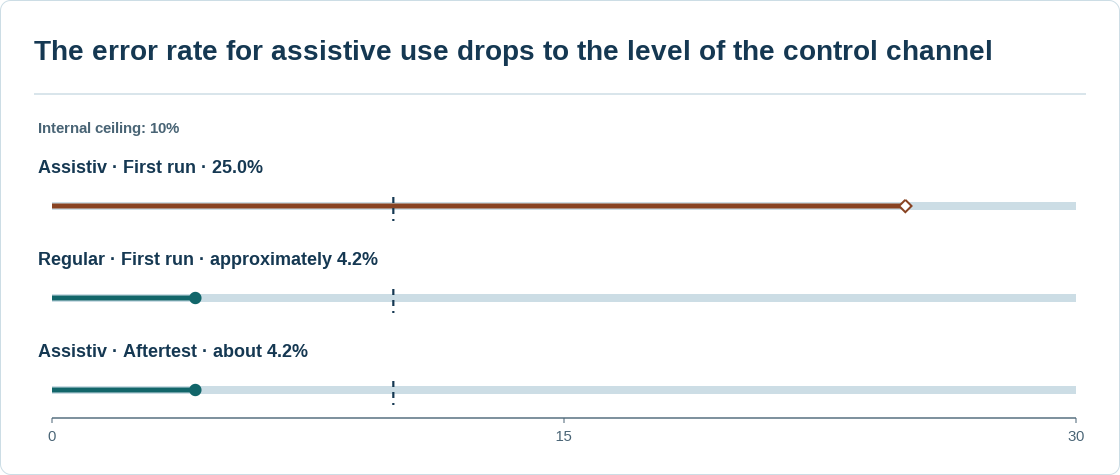
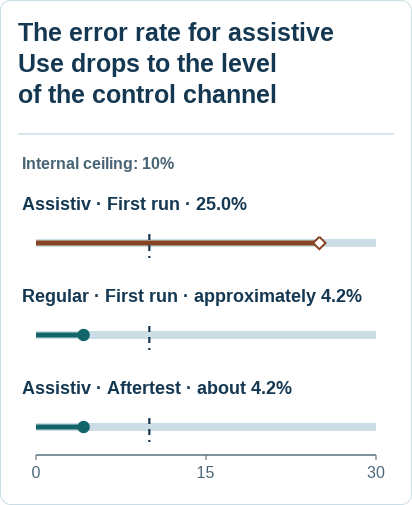
24 cases were evaluated per channel. The dashed line shows the internal target of the exercise.
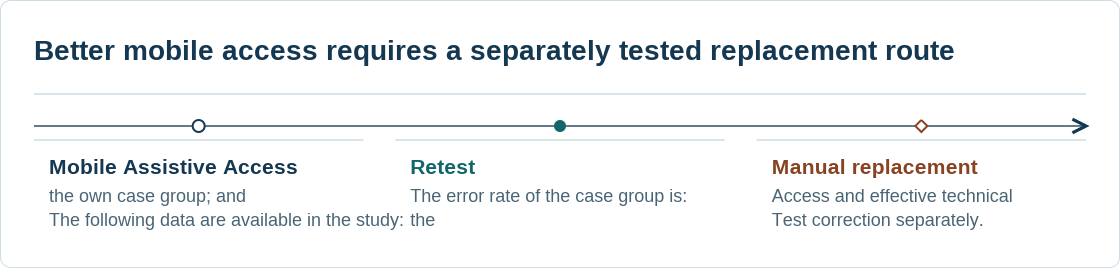
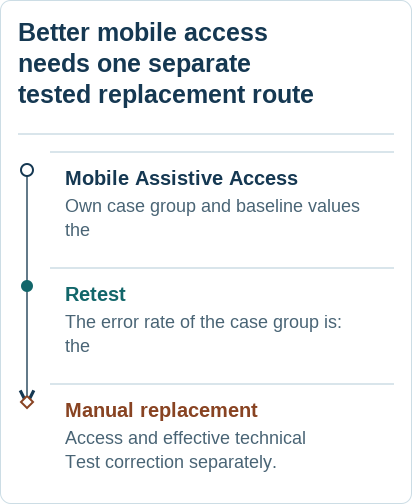
A manual path that is actually accessible is a separate release criterion.
Repeat with your own data
A robust fundamental rights impact assessment with updated evidence on the affected groups and a confirmed follow-up test.
Check fundamental rights in case of change
Evaluate access risks separately by case groups. Check minimum scope, manual remedy and update of impact assessment.
Outcome A robust fundamental rights impact assessment with updated evidence on the affected groups and a confirmed follow-up test.
Read the instructions
Fictional example KI20 · Assistive input is initially 25 percent of incorrect rejections. In the post-test, it is about 4.2 percent. The replacement has its own sample.
- The starting position Keep new groups and change of mission
- Editing the Process Evidence of quota, extent and observed intervention
- Secure Decision Document impact assessment, communication and follow-up
Official sources
Regulation (EU) 2024/1689 as amended on 27 July 2026
Readable version with the changes made by Digital Omnibus on AI. The application rules are to be read for your own deadline.
Art. 35 GDPR · Data protection impact assessment
Check data protection impact assessment and fundamental rights impact assessment based on the relevant requirements.
Charter of Fundamental Rights of the European Union
In particular, consider the relation to equal treatment and effective remedy. Arrange the effect of actual access or procedure.

What is the next decision?
First, take the decisive observation from the case. Then, based on your open question, choose whether you want to check your own process or play a comparable case.
Fundamental rights in concrete application
Transfer method and result to your own use.
Starting point Use, groups concerned, original sample documents, existing DSFA, role and clearance level.
Work result A rewriteable impact assessment with segmented findings, remedy, observable follow-up and communication document.
View the guideCase studies
You want to practice with fictitious data first or understand a similar decision from another role.
Compare how another decision needs to be taken.
Work result The cases provide initial data, a test order and a reasoned sample decision. Change a concrete condition and check the impact.
Select Case studies

