
Review rights in the actual use case
Determine protection needs, coverage, remedy and notification per deployment.
DEPLOYMENT
OVERSIGHT
Check fundamental rights in concrete use of the own system
Check the facts according to Art. 27 per operator and use. Capture the process, duration and frequency, affected persons, concrete damage risks, human supervision and reaction in case of impairment. Changing input channels or group may require updating.
Use existing data protection records for the content they actually cover. In fundamental rights impact assessment, refer to the relevant DSFA bodies and complete the missing effects. Keep track of data usage, access to proceedings and complaint options in each case. Check the relevant notification procedure.
Identifying groups and consequences before testing
Tracking changed access and affected persons in FRIA
Identify new affected persons, technical hurdles and consequences in the concrete procedure. Support a change of the application.
Testable evidence Updated impact assessment with separate groups, inputs and observed effects.
- Acceptance criterion
- Compare affected groups and real access before and after the change. Link each new barrier to the deployment version.
- Evidence
- Versioned mapping of item, source and approved version with any discrepancy recorded.
Separate notification and existing DSFA documents
Arrange the technical results and the appropriate communication path. Link only the actual relevant DSFA sections.
Testable evidence Version-related notification or justified exception and findable acquisition of DSFA documents.
- Acceptance criterion
- Record the DPIA evidence used and the notification decision separately. Link both to the same deployment version.
- Evidence
- Copy of the submitted version with version reference, dispatch evidence, acknowledgement and outstanding items.
Check the actual manual path
Have an authorised person effectively correct an unauthorized referral case. Check the practical accessibility of the replacement action.
Testable evidence Observed intervention with protocol, case identification and subsequent expert decision.
- Acceptance criterion
- Observe the outcome of the manual alternative for the rejected case. Record the authorised role that intervened.
- Evidence
- Evidence of the control showing role, time, affected transaction and observed effect.
Prove coverage of data protection impact assessment
Compare the processing already recorded with the real use. Name the concrete statement and the remaining topics.
Testable evidence Evidence index of data protection audit and supplementary fundamental rights review.
- Acceptance criterion
- List each unresolved impact as its own item with an owner and due date.
- Evidence
- Risk entry with impact, action, residual risk and approval.
Look up the AI Act article or annex and use the associated assessment questions to identify your next task.
Mobile access changes the risk of fundamental rights
The fictitious city of Lindenhafen uses a high risk AI in the examination of entitlement for a public support service. In the case, the obligation to fundamental rights impact assessment is confirmed.
Three decisions on the group concerned, confirmed remedy and update take.
An updated impact assessment, including repetition, manual remedy and documented notification or examination of the exception.
Editing case · Mobile access changes the risk of fundamental rights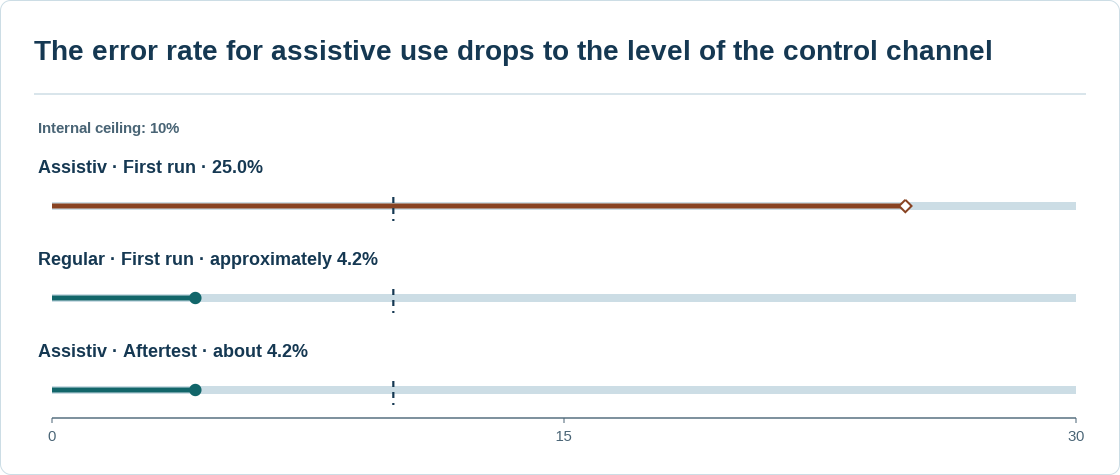
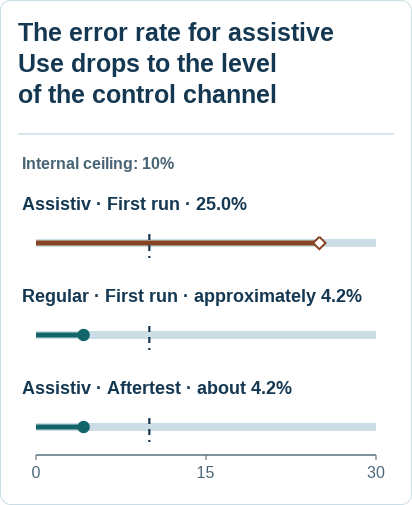
24 cases were evaluated per channel. The dashed line shows the internal target of the exercise.
Documenting your own test
A robust fundamental rights impact assessment with updated evidence on the affected groups and a confirmed follow-up test.
Check fundamental rights in case of change
Evaluate access risks separately by case groups. Check minimum scope, manual remedy and update of impact assessment.
Outcome A robust fundamental rights impact assessment with updated evidence on the affected groups and a confirmed follow-up test.
Read the instructions
Fictional example KI20 · Assistive input is initially 25 percent of incorrect rejections. In the post-test, it is about 4.2 percent. The replacement has its own sample.
- The starting position Keep new groups and change of mission
- Editing the Process Evidence of quota, extent and observed intervention
- Secure Decision Document impact assessment, communication and follow-up
Official sources
Regulation (EU) 2024/1689 as amended on 27 July 2026
Readable version with the changes made by Digital Omnibus on AI. The application rules are to be read for your own deadline.
Art. 35 GDPR · Data protection impact assessment
Check data protection impact assessment and fundamental rights impact assessment based on the relevant requirements.
Charter of Fundamental Rights of the European Union
In particular, consider the relation to equal treatment and effective remedy. Arrange the effect of actual access or procedure.

What is the next decision?
Choose the work path that fits your open decision. The descriptions show what you start with and which proof you then hold.
Information, explanation and correction
If an individual decision is challenged, you will reconstruct the role of AI and the competent specialist.
Starting point Case identification, system and data status, original decision and verifiable action of the competent professional role.
Work result An understandable explanation of the concrete decision with evidence of the correction route and separate test results.
View the guideData and case groups
If the sample leaves out a group, re-plan their minimum size and appropriate reference.
Starting point Released reference, description of target population, sample size and observed errors per group.
Work result Decreased test coverage with separate detection for error rate, small sample and unexplained data origin.
View the guide

