
Classify cloud and data centre incidents
Check the role of providers, EU competence and the relevance criteria for two digital services on the basis of the same event.
IMPLEMENTATION
EVIDENCE
Identify the service offered and the competent institution
Describe cloud computing service and data centre service from the perspective of customers and the actual operations responsible. The roles may coincide with the same entity or be distributed in a supply chain across different facilities. Check for each recorded performance the special registration and, based on the ranking in § 60 para. 2 BSIG, the EU main establishment. With the provider without an EU branch, check the representation according to paragraph 3.
Connect a requirement of the DVO attachment to exactly the service concerned. In case of an incident, record general effects and possible serial cases before processing all relevant service-specific alternatives. Use ENISA notes for measurement and detection. For DNS, TLD, content delivery networks, MSP or MSSP, platforms and trust services, use each individual rule in the standards register.
From the test order to the secured result
Confirm service, user base and EU competence
Check the performance description, EU user base and the body that makes decisions on cybersecurity measures. If you are unclear, document the other criteria in their order.
- Acceptance criterion
- List the service, EU user population and decision-making body separately for each service. Record the source for each mapping.
- Evidence
A service brief with a certified responsibility and reproducible denominator.
Evaluate Cloud by Art. 7
Evaluate full failure, limited availability and data impairment according to letter a to d separately. For b and d use the lower value of 5% of EU users and 1 million users. For b, the restriction must last longer than one hour.
- Acceptance criterion
- Hold the affected user count and observed duration against the criterion for each measure reviewed.
- Evidence
Separate findings per alternative with service measurement, user number and comprehensible observation period.
Evaluate data centre by Art. 8
Check complete unavailability, one hour limitation, data impairment in connection with suspected malicious actions and restricted physical access. Refer all criteria to the service operated by the provider or location.
- Acceptance criterion
- Record the service delivered, start and end of the disruption and type of access affected at each site.
- Evidence
Own classification with evidence of the actual relevant alternative.
Connect decisions and reporting of the same event
Check Art. 3, Art. 4 separately and the applicable exception for scheduled interruptions. Determine decision-making status, reasons, time of knowledge and transmission per service. Link both with the same event identifier.
- Acceptance criterion
- Link both service-level classifications to the same incident identifier. Evidence awareness and submission for each reporting decision.
- Evidence
The audited overall chronology which shows the triggering service record and open facts.
Read the official provisions on classification of cloud and data centre services and link your assessment to the relevant source.
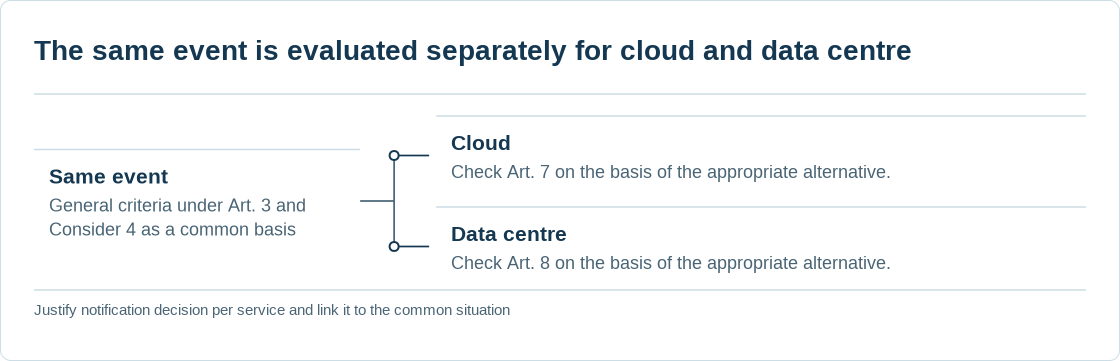
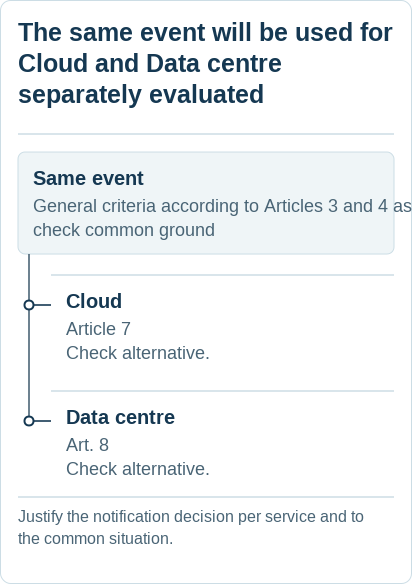
For the same event, general criteria and criteria from cloud and data centre are used separately.
Joint fault with two results
Situation Describe cloud computing service and data centre service from the customer's perspective and from the actual operational point of view. The roles may coincide with the same entity or be distributed across different facilities in a supply chain.
Situation
The fictitious HanseWerk Infrastruktur GmbH provides a cloud service and a data centre service in a data centre operated by it. Both services are completely out of place in the first test for exactly 30 minutes each. Art. 7 letter a therefore does not yet apply to the cloud service alone. The full failure of the data centre service already complies with Art. 8 letter a at this measurement value. The team documents cause and impact checks per service.
Monitoring and evaluation
The second separate test shows 1.001 affected EU users of the cloud service by 20.000 for 61 minutes. The user limit is 1.000. Thus, Art. 7 letter b in case of exercise is fulfilled. The alternative below its permanent condition at 60 minutes and its user condition at exactly 1.000 persons affected. The re-evaluation only uses the actual service population.
Reasoned decision
The workbook records the results of Articles 7 and 8 for each alternative and additionally asks Art. 3 and 4. Open alternatives appear to be open. An already confirmed fact remains visible, even if further effects are still being investigated.
Negative test
Change only the cloud full failure from 30 to 31 minutes. Then check 1.000 instead of 1.001 people in a separate test. For Art. 8 letter d, test a physical access result with available technical performance.
- Audit record
- Comparison of the original finding and retest showing the changed condition, observed effect and closure decision.
Work result
A reasonable level of relevance, a comprehensible notification decision and evidence linked to the same case identification.
Working aid for your own operation
Compare the alternatives of Articles 7 and 8 of the DVO per service and secure responsibility, further criteria and evidence for the same event.
Cloud and data centre relevance
Compare the alternatives of Articles 7 and 8 of the DVO per service and secure responsibility, further criteria and evidence for the same event.
Outcome Several verifiable findings per event, with calculated user and time limits and visible open conditions.
Read the instructions
Fictional example N07 · 30 minutes of full failure do not result in a hit for Art. 7(a) alone. For a completely failed data centre service, Art. 8(a) 1.001 of 20.000 Cloud users at 61 minutes meet Art. 7(b) in separate test.
- Determine service and already confirmed impact Confirm the role, EU competence and concrete service measurement. Repeat the recording of several affected services.
- Duration, User and Data Impairment Take measured values from the appropriate service. Check suspicious status or impaired access separately.
- Evaluate further criteria and open findings Determine Art. 3 and Art. 4, actual evidence and any exemption test separately.
From the blog
C5 and DORA on the cloud service provider
The article shows how audit reports, the customer’s responsibilities and exit planning fit together in a cloud service relationship.
Legal basis and official information
First check for this task
Art. 7 DVO (EU) 2024/2690 · Substantiality of cloud services
Check the service concerned, type and duration of restriction, impact on EU users and the applicable data criteria per alternative.
Art. 8 DVO (EU) 2024/2690 · Considerability of data centre services
Arrange the monitoring to the data centre service concerned, its relevant facilities and the appropriate criterion for service or data impairment.
Art. 3 DVO (EU) 2024/2690 · Common criteria for relevance
Check the alternatives in paragraph 1 and the specificities of planned maintenance. Direct losses are driven by the lower limit of EUR 500.000 and 5% of total sales in the previous year.

Other official references7
- § 32 BSIG · Reporting of significant incidents (opens in new tab)
Deutsche Anwendung · BSIG
The early first report and the incident report are linked to the knowledge of the significant incident. The monthly reference follows the actual reported incident report. In case of a continuous incident, the reporting level changes.
- Art. 4 DVO (EU) 2024/2690 · Recurring incidents (opens in new tab)
Technische Vorgaben · (EU) 2024/2690
Check at least two events that are not significant in themselves within six months. Support the same identifiable cause and the jointly fulfilled criterion of financial loss.
- § 34 BSIG · Special registration of digital providers (opens in new tab)
Deutsche Anwendung · BSIG
Determine the main branch office, operating states as well as the additional data of the special register. Check initial registration and changes after each individual deadline.
- § 60 BSIG · Main office and EU representative (opens in new tab)
Deutsche Anwendung · BSIG
The assignment takes place in the legal order. First, prove where decisions on cybersecurity risk management are mostly taken. If there is no best possible solution, check the statutory catch criteria.
- Technical requirements and criteria for relevance (opens in new tab)
Durchführungsverordnung (EU) 2024/2690 · EUR-Lex
The articles and the annex specify requirements for the specifically mentioned types of suppliers.
- Technical implementation assistance to the implementing regulation (opens in new tab)
ENISA · Technical Implementation Guidance, Juni 2025
Use examples of evidence and assignments for testing. The benchmark for the binding requirement remains the relevant legal act.
- Registration and notification in the BSI portal (opens in new tab)
BSI · BSI-Portal
Call on the official procedure for the appropriate legal entity. Inwardly secure proof of receipt and transmission.
Check your own benchmark for another digital service
Digital providers
The specific rule for a digital provider shall be examined.
Merge the type of supplier, technical requirements and service-specific reporting criteria.
Work result Technical requirements and incident criteria are assigned to the service actually provided.
MSP incident
The fictitious HanseWerk Technik provides ongoing system management for 20.000 EU users. On November 17, part of the service is only limited to 1.001 users 61 minutes. The service was not completely out of service at any time.
They want to test the MSP threshold with concrete duration and user base.
Evaluate user impact, duration and recurring incidents in two separate tests.
Your decision What alternative is the classification of partial performance? Evaluate the two recurring events separately.

