
Telecom incident reporting
Differentiating public telecommunications service and additional services, demonstrating security concept and reporting sequence
IMPLEMENTATION
EVIDENCE
Identifying the public service in the actual service supply
Secure in the network and service catalogue which networks are operated publicly and which services are provided publicly. Support the provider, access to the service and the affected network area. For public telecommunications § 28 BSIG leads through its own categories. If the confirmed values reach 50 employees or exceed turnover and balance sheet totals each 10 million euros, it is particularly important. The rest of public telecommunications falls under the important category.
For protection and notification, check the TKG and § 28 para. 5 BSIG. An additionally offered managed service receives its own performance and validity test. § 5 TKG and the BSI registration are separate processes. In the materiality decision according to § 168 para. 3 TKG, in addition to the observed effect, possible serious operating malfunctions or losses and potential significant damage of third parties belong to the proof.
From the test order to the secured result
Determine public service, operator and ancillary business
Compare offer, contract, service description and actual operation. In the case of common infrastructure, assign both services to the respective technical and legal responsibility area.
- Acceptance criterion
- Trace the commitment from the current agreement or amendment to the service actually used. Record discrepancies as specific conditions or open contractual points.
- Evidence
Shared service card with installation position, category receipt and coherent system delimitation.
Connecting safety concept with operational sample
Arrange protective measures and relevant catalogue version to the safety concept and the responsible body. Track a changed transfer from the concept to the confirmed operational observation.
- Acceptance criterion
- Justify applicability using evidenced activity or intended use, role and date. Assign an owner and due date to any unresolved assumption.
- Evidence
Versioned concept with concrete evidence and verified scope.
Develop technical report from the confirmed knowledge
Determine the relevance according to § 168 para. 3 TKG. Use the specialized procedure for Federal Network Agency and BSI. Capture 24 and 72 hours as maximum limits and secure the dispatch of the follow-up report to No. 2.
- Acceptance criterion
- Trace the submission by time, version sent and acknowledgement. Resolve missing or changed information for each reporting stage.
- Evidence
Timeline with decision-making documents and confirmed dispatch and own deadline for completion.
Keep up to date incident and other reporting channels
Check the processing status on the monthly reference date. In case of an incident, secure the progress report and a new deadline from the end of the processing. Evaluate another service concerned separately.
- Acceptance criterion
- Trace the submission by time, version sent and acknowledgement. Resolve missing or changed information for each reporting stage.
- Evidence
Final plan with original dispatch time, status, measures and recipients of each service concerned.
Read the official provisions on classification of the telecommunications services provided and link your assessment to the relevant source.
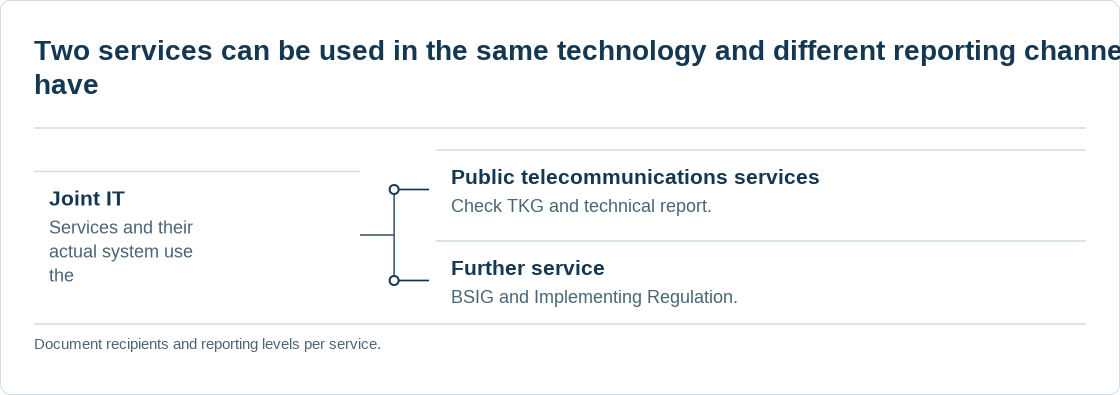
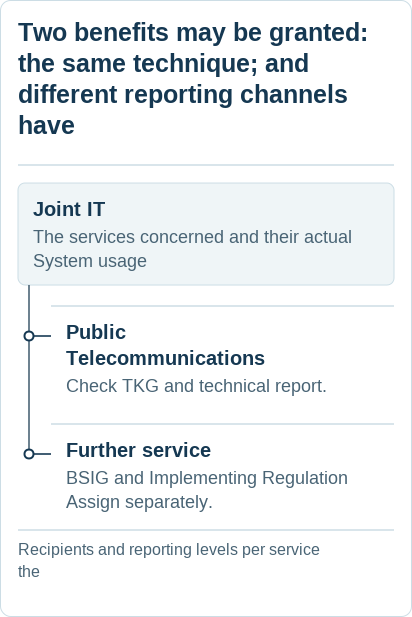
Public telecommunications and other services are also classified separately in common technology.
Internet access and service
Situation Secure in the network and service catalogue which networks are operated publicly and which services are provided publicly. Support the provider, access to the service and the affected network area. For public telecommunications § 28 BSIG leads through its own categories.
Situation
The fictitious HanseWerk Connect GmbH sells publicly accessible Internet connections. The confirmed values are 49 employees, 11 million. Euro turnover and exactly 10 million. Euro balance sheet total. It also offers an independently operated managed service for customers. The size values and the type of setup are checked separately for this second service.
Monitoring and evaluation
On November 12, 2026 around 10:00 UTC, network operations have a significant impact on business customers of public Internet access. The early first registration is about 16:00 UTC. The follow-up notification expires at 09:30 UTC on November 14. From No. 2 the monthly reference to December 14 follows. On this deadline, processing continues in the practice case. It ends on December 20. From then the further monthly limit for the closing notification must be checked.
Reasoned decision
In the initial case, the public provider is an important institution. The TKG incident follows the published procedure according to § 168. The workbook shows both the change of category at the employee's limit and the different time-receipts in the current incident.
Negative test
If the number increases to 50 employees, the category of public TK provider changes, the §-168 path remains. Then change the shipping time of the early first notification only. The monthly receipt from the follow-up report remains the same.
- Audit record
- Comparison of the original finding and retest showing the changed condition, observed effect and closure decision.
Work result
A confirmed service catalogue and a reporting calendar, from which duties, recipients, time origin and shipping documents follow.
Working aid for your own operation
Calculate the German TK category for confirmed values and run your own reporting calendar for § 168 TKG with progress and completion reference.
Telecommunications and technical reporting
Calculate the German TK category for confirmed values and run your own reporting calendar for § 168 TKG with progress and completion reference.
Outcome Category proof for the public service and verifiable timeline of transmissions to Bundesnetzagentur and BSI.
Read the instructions
Fictional example N05 · 49 employees, 11 million euros in turnover and 10 million euros in balance sheet total result in an important institution. 50 employees lead to the most important category. The TKG follow-up report of 14 November determines the first monthly limit
- Confirm public service Merge actual power, operator and size values from a verified calculation.
- Documenting relevance and recipients Keep track of confirmed impacts, knowledge and official technical procedures per reporting level.
- Check the right monthly reference Use the dispatch to No. 2 and the editing status on the monthly reference date. Document the possible new completion from the end of the processing.
Legal basis and official information
First check for this task
§ 165 TKG · Protection of telecommunications networks and services
Arrange the general protection obligations, risk management requirements and specific requirements of the relevant paragraphs to the systems responsible.
§ 166 TKG · Safety officer and safety concept
Support safety officers, protection concept, affected systems and tracking. Check separately which documents to submit to the Federal Network Agency.
§ 168 TKG · Report significant security incidents in telecommunications
Determine relevance by means of paragraph 3. Use the published technical procedure for the Federal Network Agency and BSI. The monthly period follows on from the notification according to paragraph 1, sentence 1, point 2.

Other official references6
- Notification procedures for significant telecommunications incidents (opens in new tab)
Bundesnetzagentur · § 168 TKG
Open the current technical procedure with forms and the officially designated transmission channels. § 168 (1) sentence 1 No. 4 and paragraph 2 TKG is decisive for the beginning and reference point of the month period.
- § 167 TKG · Catalogue of safety requirements (opens in new tab)
Sektorales Recht · Energie, Telekommunikation, Gesundheit und Wasser
Secure the applicable catalogue version. Arrange requirements and, if necessary, security targets for the network, services and evidence in the security concept.
- § 5 TKG · Display recording, modification and termination (opens in new tab)
Sektorales Recht · Energie, Telekommunikation, Gesundheit und Wasser
Check the notification to the Federal Network Agency with the relevant conditions and the exception for number-independent interpersonal telecommunications services. Run the registration according to § 33 BSIG as your own procedure.
- § 28 BSIG · Particularly important and important institutions (opens in new tab)
Deutsche Anwendung · BSIG
Check legal form, actual paid activity, type of facility, size values and special cases. § 28 para. 5–8 alters the scope of obligations for certain activities or institutions.
- § 33 BSIG · General registration and changes (opens in new tab)
Deutsche Anwendung · BSIG
Document the date of classification, register proof and changes. In case of changes and critical installations, you will check the version to be applied as specified in § 66.
- Registration and notification in the BSI portal (opens in new tab)
BSI · BSI-Portal
Call on the official procedure for the appropriate legal entity. Inwardly secure proof of receipt and transmission.
Clearing the reporting obligation for public and digital services
Report security incident
An event is taking place and you need to clarify the relevance and deadlines.
Track knowledge, early initial reporting, incident reporting and closure on the basis of the same event.
Digital providers
The specific rule for a digital provider shall be examined.
Merge the type of supplier, technical requirements and service-specific reporting criteria.
Work result Technical requirements and incident criteria are assigned to the service actually provided.

