
Document security patch coverage
Determined target stock with controlled exception.
IMPLEMENTATION
EVIDENCE
Prove security updates to the full target stock
A successful roll-out protocol only confirms processed systems. A reliable proof refers to the released target stock and includes replacement equipment, restarts and temporary exceptions.
Perform the verification task
Secure the denominator before running
Determine devices or instances with confirmed concern. Secure the receipt level and identifiers, so that exchange and decommissioning remain comprehensible.
- Acceptance criterion
- Observe the intended effect in a defined transaction. Record how an absent effect changes acceptance or the follow-up action.
- Evidence
Determined target stock with controlled exception.
Compare the actual active status
Determine whether a restart, change of the active node or take back has changed the observed state.
- Acceptance criterion
- Observe the intended effect in a defined transaction. Record how an absent effect changes acceptance or the follow-up action.
- Evidence
Comparison of the active status per system identifier.
Treating Open Deviations Effectively
Confirm the provisional measure and its date for exceptions. Perform a professional test and check open systems.
- Acceptance criterion
- Use the same metric, population and unit for expected and observed results. Record the measurement point at which the business service is achieved.
- Evidence
Release with post-test or temporary rest order.
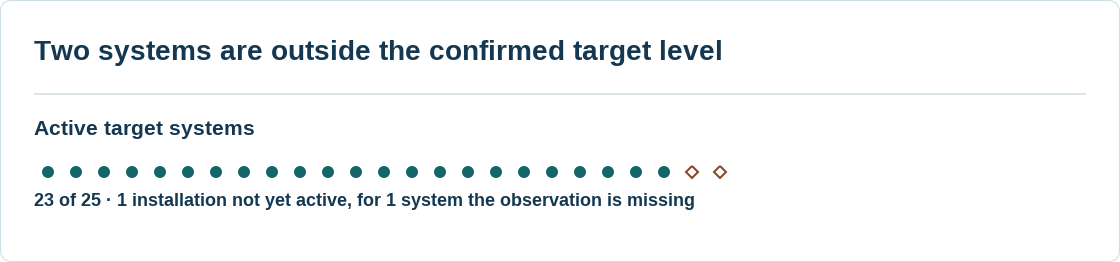
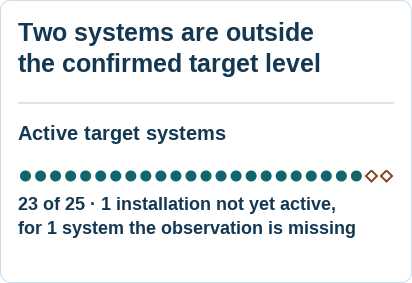
23 of 25 confirmed systems are on the active target level. Another installation is not yet active and a system is missing in the observation.
Starting position, assessment and counter-test
Situation A successful roll-out protocol only confirms processed systems. A reliable proof refers to the released target stock and includes replacement equipment, restarts and temporary exceptions.
Situation
HanseWerk expects 25 systems to be on the new stand. The rollout reports 24 installations. An installed system will only use the new stand after a supervised restart. The comparison shows 23 actually active target ranges, an open activation and a absent device.
Evaluation and decision
The coverage of active targets is 92 percent. The two open positions receive separate responsible persons and evidence. The technical test refers to the systems actually treated.
Negative test for your own operation
Set a affected machine as closed. Connect the correction of the denominator to a proven shutdown and a confirmed inventory change.
- Audit record
- Comparison of the original finding and retest showing the changed condition, observed effect and closure decision.
Help for your decision
Evaluate planned changes before release using measurable mandatory criteria, tested relapse time and proven target level.
Change release and relapse test
Evaluate planned changes before release using measurable mandatory criteria, tested relapse time and proven target level.
Outcome Release decision with visible blocking findings, verified version and approved window of time.
Read the instructions
Fictional example N17 · The professional test succeeds. Relapse time is 18 minutes at 15 allowed. A documented follow-up test reaches twelve minutes.
- Set the release conditions Define the actual blocking criteria, target version and verification evidence.
- Observe relapse Measure the relapse up to the predetermined usable performance.
- Confirm decision Connect the checked stand to the designated release manager and time window.
Detection coverage and evidence gaps
Check for each service and obligation whether the proof is available, fits the status and is currently released. Track the reliable denominator.
Outcome The following table shows the results of the assessment carried out by each test group:
Read the instructions
Fictional example N22 · Six positions are expected. Four documents are current and relevant, one has expired, one is missing.
- Determine target size Provide unique identifiers for the verified obligations and demonstrate their scope.
- Matching Evidence Confirm receipt date, validity, coverage and release separately.
- Solve gaps Arrange responsibility, appointment and professional standard for any open document.
Legal basis for the verification task
Annex 6 · (EU) 2024/2690 · Procurement, development and maintenance
Check the safety in selecting, changing, maintaining and controlled removal of a system under the relevant rule of the Annex.
§ 30 BSIG · Risk management measures
For each relevant service, combine risks, ten fields of action, evidence and effectively verified effect. § 30 para. 3 gives priority to the technical requirements of the DVO for the providers covered there.
Annex 7 · (EU) 2024/2690 · Evaluate the effectiveness of measures
Link individual test criteria to the observed result and the verified handling of a deviation.

Next step for your editing level
First, take the decisive observation from the case. Then, based on your open question, choose whether you want to check your own process or play a comparable case.
Prioritize weaknesses after personal concern
A system can only be updated later. You must evaluate the residual concern and interim measure.
Starting point Manufacturer's advice, confirmed inventory and version data as well as dependent supplier systems.
The inventory shows which occurrences are processed, how temporary measures are controlled and what test result can lead to closure.
Work result The status of work distinguishes affected, excluded and unexplained systems and documents remedy including post-test.
View the guideCheck accesses and system changes in operation
They work in parallel on tasks from the same department.
Starting point Select a service and a specific process to access, share or change the system.
The overview will classify further audit orders and aids.
Work result The agreed target state and the observed operating status bear the approval or an open finding.
View the guide

