
Assess CDN incidents
Time window with service, region, probe type and occupied perimeter.
IMPLEMENTATION
EVIDENCE
Evaluate CDN incidents through user visibility and service reference
The availability of a CDN at individual locations may differ from actual delivery in the agreed service. For the services covered, Art. 9 of the implementing regulation determines the appropriate alternatives. Service, impact and user reference must be collected for the same time basis.
Perform the verification task
Compare Delivery and Context
Check the customer services concerned instead of regional system states alone. Discuss, among other things, the complete loss of performance and partial impairments. Keep the underlying probe and user data to the permissible extent.
- Acceptance criterion
- Observe the intended effect in a defined transaction. Record how an absent effect changes acceptance or the follow-up action.
- Evidence
Time window with service, region, probe type and occupied perimeter.
Applying the relevant alternative
Check Art. 9 separately on the basis of the measured effects and the general criteria of Art. 3. Confirm the relevant circle and reference period at a user threshold. Keep open data explicitly.
- Acceptance criterion
- Justify applicability using evidenced activity or intended use, role and date. Assign an owner and due date to any unresolved assumption.
- Evidence
Classification note with a well-founded denominator.
Passing the recognition into the reporting path
Arrange the findings on a common timeline and keep in mind the confirmation of the relevant facts. Transfer knowledge, classification and affected service to reporting responsibility.
- Acceptance criterion
- The calculation and decision use the same substantiated trigger. Record actual events and planned timing separately, with a common time basis.
- Evidence
Reporting preparation with confirmed trigger and receipt.
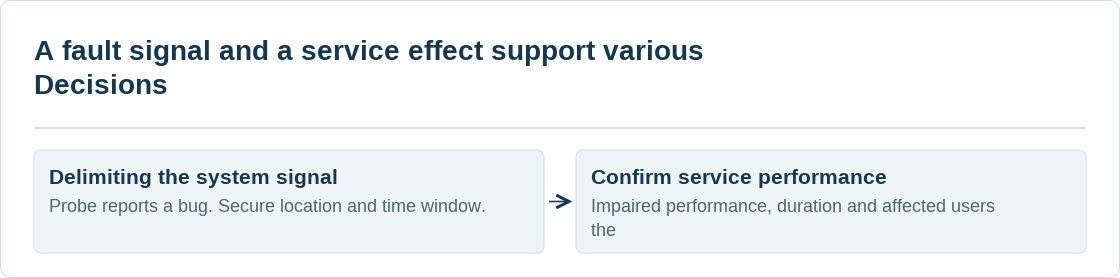
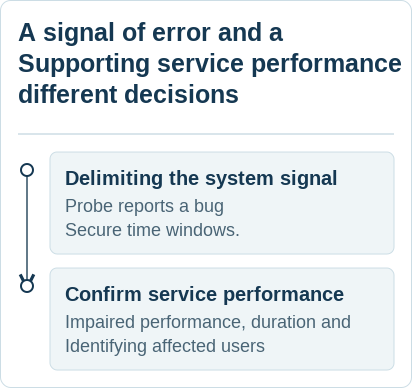
System status, observed service performance and relevant user group provide different information. The regulatory assessment refers to the service concerned, the period of time and the confirmed impact.
Starting position, assessment and counter-test
Situation The availability of a CDN at individual locations may differ from actual delivery in the agreed service. For recorded services, Art. 9 of the implementing regulation determines the appropriate alternatives.
Situation
Three of four regional probes show a fault. Access to one part of the customer continues to work via other delivery points. The measurement first counts each failed request individually. The proof of operation is directed towards the users of the CDN service who are specifically affected.
Evaluation and decision
The case team secures the partial limitations and filters multiple attempts from the number of users. Without a confirmed user base, the relevant numerical alternative remains open in the test proof. Other possible alternatives are processed with their own factual basis.
Negative test for your own operation
Provide all four probes as faulty. Verify the full effect on the service using appropriate customer samples before taking over the alternative evaluation.
- Audit record
- Comparison of the original finding and retest showing the changed condition, observed effect and closure decision.
Help for your decision
Follow the first hints, confirmed development and own relevance decision time per affected performance.
Incident Triage and Confirmed Knowledge
Follow the first hints, confirmed development and own relevance decision time per affected performance.
Outcome A robust decision-making protocol from the first signal to the earliest evidenced relevant knowledge.
Read the instructions
Fictional example N21 · Message from the platform at 08:10 clock, confirmed serious impact at 08:25 clock. Later facts remain visible in the course of the process.
- Separating signal and knowledge Record evidenced facts and UTC time per performance affected.
- Technical examination of criteria Keep a clear record of the legal basis, concrete alternative and lack of information.
- Reporting decision handed over Secure the earliest confirmed knowledge in the event overview.
Registration deadlines for DORA, NIS2 and specialist law
Calculate the basic periods of time for the same event from the respective knowledge, classification and transmission times. Run DORA and national paths in separate sheets.
Outcome Time and receipt chains per legal entity and reporting obligation. Each reporting stage has its own time reference.
Read the instructions
Fictional example N11 · The dispatch of the DORA initial report sets the 72-hour reference for the intermediate report. In the TK and MSP thread, knowledge of the significant incident determines the 72 hours. N12 adds EnWG and critical water system.
- Confirm Concern and Classification Link the same event identifier to service, jurisdiction, knowledge and each path of confirmed classification.
- Check shipping times and steps Capture actual shipping times. Use the last relevant intermediate message or the national No. 2 message matching the path.
- Confirm calendar and transmission Check work calendar, exception and progress reference if necessary. Link the decision to the relevant reporting channel.
Legal basis for the verification task
First check for this task
Art. 9 DVO (EU) 2024/2690 · Substantiality of content delivery networks
For the CDN service specifically concerned, raise the impact, EU user reference, time window and, where applicable, data processing.
Art. 3 DVO (EU) 2024/2690 · Common criteria for relevance
Check the alternatives in paragraph 1 and the specificities of planned maintenance. Direct losses are driven by the lower limit of EUR 500.000 and 5% of total sales in the previous year.
§ 2 BSIG · Concepts and relevance
Arrange an observation based on the actual impact and ability to cause damage. Capture relevant terms and facts at the known time.

Other official references1
- § 32 BSIG · Reporting of significant incidents (opens in new tab)
Deutsche Anwendung · BSIG
The early first report and the incident report are linked to the knowledge of the significant incident. The monthly reference follows the actual reported incident report. In case of a continuous incident, the reporting level changes.
Next step for your editing level
First, take the decisive observation from the case. Then, based on your open question, choose whether you want to check your own process or play a comparable case.
Reasoning incident, impact and time of knowledge
Secure time and affected service for the first signal. Knowledge of a significant incident must be comprehensible based on the facts then known.
The service performance is observed and the first time with sufficiently substantiated facts must be attributed to the same decision.
Evaluate an event from the first indication to the confirmed materiality decision continuously.
Your decision A documented substantive decision with a period of knowledge and open information for the notifier.
Work through the caseApplying EU standards for digital providers
They work in parallel on tasks from the same department.
Starting point Description of service, proof of operation, role of provider and user and event data if applicable.
The overview will classify further audit orders and aids.
Work result Technical requirements and incident criteria are assigned to the service actually provided.
View the guide

