
Assess DNS and TLD incidents
Distinguishing full failure and response time as well as checking the appropriate data alternative.
IMPLEMENTATION
EVIDENCE
Differentiating the performance of DNA and TLD
Check the actual role as DNS provider or TLD registry and the performance specifically affected. The DVO sets partially different conditions for DNA and TLD. Include the duration, type of name resolution and in case of data deviation the confirmed causes as well as the affected quantity.
Name the concrete provider role, the measured service and all actual effects. Hold on to observation time and evidence.
Evaluate the measured effect of the applicable rule
Perform the test
Use shared service measurements and separate categories for unavailability and slowed down response. Check the conditions for misconfiguration exception in DNS in the relevant case of Art. 5(c). For TLD, follow your own reference according to Art. 6.
- Acceptance criterion
- Use the same metric, population and unit for expected and observed results. Record the measurement point at which the business service is achieved.
- Evidence
- Measurement record with baseline population, source, expected and observed values, unit and timestamp.
Result and further processing
Service-related classification with documented measurement, own legal alternative and documented reporting verification. The decision leads to the appropriate reporting path and determines when the significant impact for this service was confirmed.
- Acceptance criterion
- Justify applicability using evidenced activity or intended use, role and date. Assign an owner and due date to any unresolved assumption.
- Evidence
- Reasoned applicability assessment recording facts, reference, role, date and open assumptions.
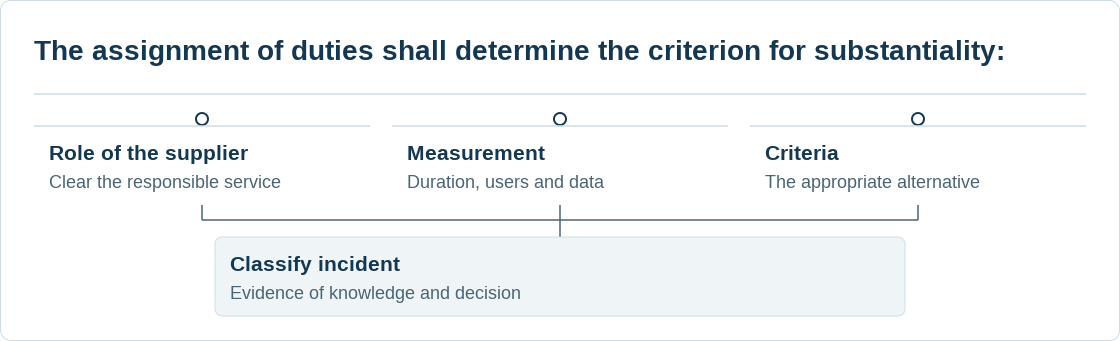
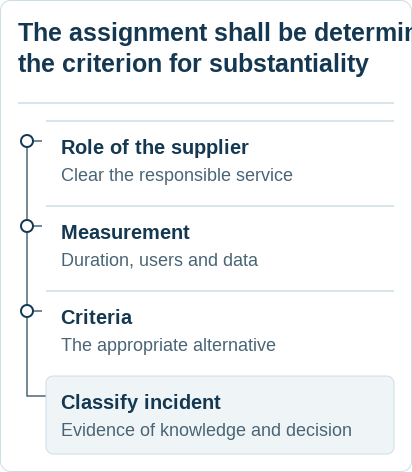
The confirmed role of the provider, the performance affected and the observed effect determine the appropriate assessment.
Decision and counter-test
Situation Check the actual role as DNS provider or TLD registry and the performance specifically affected. The DVO provides some different conditions for DNS and TLD.
Initial situation and observed findings
A confirmed DNS service is not available for exactly 30 minutes. This duration alone does not exceed the limit of Art. 5(a). In a TLD registry, the authoritative service has failed completely in its own practice case. Art. 6(a) does not specify any minimum duration for this purpose.
Negative test
Change the DNS full failure to 31 minutes and check the other criteria and the specific service. Be sure to consider when the relevance was known.
- Audit record
- Comparison of the original finding and retest showing the changed condition, observed effect and closure decision.
The own test bench
Follow the first hints, confirmed development and own relevance decision time per affected performance.
Incident Triage and Confirmed Knowledge
Follow the first hints, confirmed development and own relevance decision time per affected performance.
Outcome A robust decision-making protocol from the first signal to the earliest evidenced relevant knowledge.
Read the instructions
Fictional example N21 · Message from the platform at 08:10 clock, confirmed serious impact at 08:25 clock. Later facts remain visible in the course of the process.
- Separating signal and knowledge Record evidenced facts and UTC time per performance affected.
- Technical examination of criteria Keep a clear record of the legal basis, concrete alternative and lack of information.
- Reporting decision handed over Secure the earliest confirmed knowledge in the event overview.
MSP significantity and loss threshold
Calculate selected alternatives to loss and MSP availability. Sample two additional recurring incidents.
Outcome Calculation of the tested alternatives with open questions for the substantive decision.
Read the instructions
Fictional example For 20.000 EU users, 1.001 affected persons exceed the alternative of 61 minutes according to Art. 10(b) Two similar incidents without common identifiable cause do not meet the same collective test.
- Base and effect evidence The data collected in the previous year include direct losses, EU users, partial and full loss.
- Further criteria to be assessed Evaluate all other alternatives of the DVO separately with Yes, No or Open.
- Grouping Recurring Cases examine the period, individual evaluation, cause and common sum.
Legal basis for this task
First check for this task
Art. 3 DVO (EU) 2024/2690 · Common criteria for relevance
Check the alternatives in paragraph 1 and the specificities of planned maintenance. Direct losses are driven by the lower limit of EUR 500.000 and 5% of total sales in the previous year.
Art. 5 DVO (EU) 2024/2690 · Considerability of DNS services
Distinguishing complete non-availability, response time and other legal criteria. Secure time windows and the recursive or authoritative name resolution concerned.
Art. 6 DVO (EU) 2024/2690 · Considerability of TLD registers
Arrange the incident of the specific TLD rule and the relevant registry or name resolution service. If you have a data deviation, support the verified version.

Other official references1
- § 60 BSIG · Main office and EU representative (opens in new tab)
Deutsche Anwendung · BSIG
The assignment takes place in the legal order. First, prove where decisions on cybersecurity risk management are mostly taken. If there is no best possible solution, check the statutory catch criteria.
Deriving the next order from the result
First, take the decisive observation from the case. Then, based on your open question, choose whether you want to check your own process or play a comparable case.
Deriving progress report and final notification
The DNS or TLD incident is classified and reported. Prepare progress report or completion.
Starting point The dispatch record of the incident report, confirmed processing status and measure level with time basis.
Connect status, affected dispatch and processing end with evidence per reporting stage.
Work result Progress report or final report with comprehensible date and released version.
View the guideApplying EU standards for digital providers
The specific rule for a digital provider shall be examined.
Starting point Description of service, proof of operation, role of provider and user and event data if applicable.
Merge the type of supplier, technical requirements and service-specific reporting criteria.
Work result Technical requirements and incident criteria are assigned to the service actually provided.
View the guide

