
Platform role and reporting threshold
Evaluate online marketplace, search engine and social network of service and own DVO regulation.
IMPLEMENTATION
EVIDENCE
Deriving the platform function from use and contract
Start with the function actually offered and the customer relationship. Online marketplace, search engine and platform for social networks are to be classified separately for the recorded services. The DVO assigns to these types of providers own articles for the concreteization of security incidents.
Arrange the incident of the affected platform performance. Separately raise the user base concerned for this service.
The impact on the relevant alternative
Perform the test
Secure contract and product descriptions, technical responsibility and, if necessary, the registration obligation. Determine for the incident the service concerned, the appropriate observation and the denominator used. Document general and specific criteria separately.
- Acceptance criterion
- Trace the commitment from the current agreement or amendment to the service actually used. Record discrepancies as specific conditions or open contractual points.
- Evidence
- Agreement reconciliation linking the service, current clause, operating evidence and decision on any discrepancy.
Result and further processing
Reasoned provider and incident classification per digital service with comprehensible DVO rule. The reporting office receives a comprehensible classification for exactly this service with time window and denominator.
- Acceptance criterion
- Justify applicability using evidenced activity or intended use, role and date. Assign an owner and due date to any unresolved assumption.
- Evidence
- Reasoned applicability assessment recording facts, reference, role, date and open assumptions.
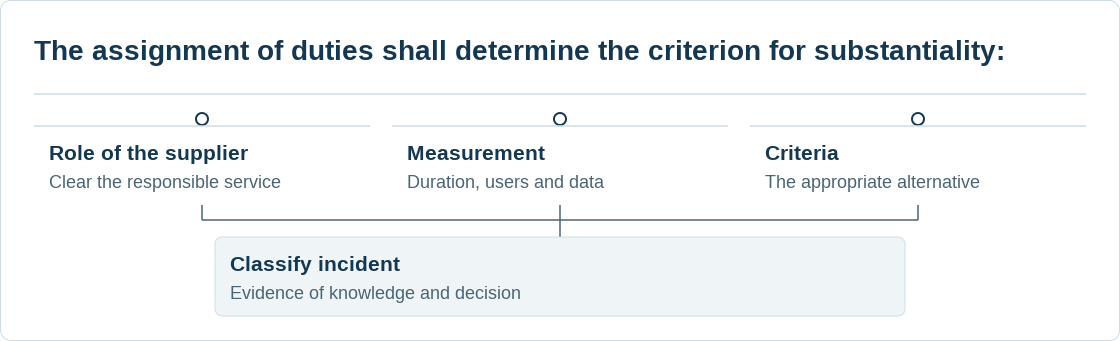
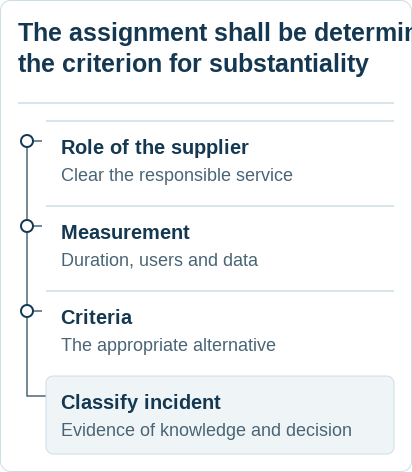
The confirmed role of the provider, the performance affected and the observed effect determine the appropriate assessment.
Decision and counter-test
Situation Start with the function actually offered and the customer relationship. Online marketplace, search engine and platform for social networks are to be classified separately for the recorded services.
Initial situation and observed findings
A group of companies offers a marketplace and an independent search function. A fault in the marketplace is first mistakenly recorded under a common platform name. The service assignment is corrected before classification by contract, user population and operating document.
Negative test
Replace the confirmed user base of a service with the total number of offers. Check why the denominator for the specific classification needs to be re-occupied.
- Audit record
- Comparison of the original finding and retest showing the changed condition, observed effect and closure decision.
The own test bench
Follow the first hints, confirmed development and own relevance decision time per affected performance.
Incident Triage and Confirmed Knowledge
Follow the first hints, confirmed development and own relevance decision time per affected performance.
Outcome A robust decision-making protocol from the first signal to the earliest evidenced relevant knowledge.
Read the instructions
Fictional example N21 · Message from the platform at 08:10 clock, confirmed serious impact at 08:25 clock. Later facts remain visible in the course of the process.
- Separating signal and knowledge Record evidenced facts and UTC time per performance affected.
- Technical examination of criteria Keep a clear record of the legal basis, concrete alternative and lack of information.
- Reporting decision handed over Secure the earliest confirmed knowledge in the event overview.
Decision of incident and reporting deadlines
Support knowledge, reporting levels and recipients. Calculate the 24-hour and 72-hour limits as well as the monthly receipt.
Outcome Chronology with separate right triggers, maximum limits, shipping and reception.
Read the instructions
Fictional example A significant incident is reported around 09:30 UTC. The incident report is sent 50 hours later. The conclusion follows calendarly from the actual message. In case of an ongoing incident, the progress must be made first.
- Evidence Identify the relevant time, service concerned, competent body and facts.
- Select stages and exceptions Document regular hours profile, trust service review and individual process separately.
- Check calendar limit and shipping Technically confirm the monthly limit and special cases. Organise immediate transmission and secure all receipts.
Legal basis for this task
First check for this task
Art. 11 DVO (EU) 2024/2690 · Considerability of online marketplaces
Arrange the effect of the actual market place and check the addressee's reference as well as the alternatives mentioned for this type of provider.
Art. 12 DVO (EU) 2024/2690 · Considerability of online search engines
Check the user effect on the search engine in the Union. Keep complete and limited availability as well as any data impairments apart.
Art. 13 DVO (EU) 2024/2690 · Considerability of social networks
Determine the platform function and its user impact in the Union. Choose from the alternatives for this type of provider.

Other official references3
- Art. 3 DVO (EU) 2024/2690 · Common criteria for relevance (opens in new tab)
Technische Vorgaben · (EU) 2024/2690
Check the alternatives in paragraph 1 and the specificities of planned maintenance. Direct losses are driven by the lower limit of EUR 500.000 and 5% of total sales in the previous year.
- Art. 1 DVO (EU) 2024/2690 · Subject matter and types of suppliers covered (opens in new tab)
Technische Vorgaben · (EU) 2024/2690
Direct the technical examination to the service that the institution actually performs as one of the mentioned types of provider.The assignment to the type of supplier belongs in the endorsement of validity.
- § 34 BSIG · Special registration of digital providers (opens in new tab)
Deutsche Anwendung · BSIG
Determine the main branch office, operating states as well as the additional data of the special register. Check initial registration and changes after each individual deadline.
Deriving the next order from the result
First, take the decisive observation from the case. Then, based on your open question, choose whether you want to check your own process or play a comparable case.
Reasoning incident, impact and time of knowledge
Secure time and affected service for the first signal. Knowledge of a significant incident must be comprehensible based on the facts then known.
The platform role is confirmed. Determine the facts that bear your substantive decision.
Evaluate an event from the first indication to the confirmed materiality decision continuously.
Your decision A documented substantive decision with a period of knowledge and open information for the notifier.
Work through the caseApplying EU standards for digital providers
The specific rule for a digital provider shall be examined.
Starting point Description of service, proof of operation, role of provider and user and event data if applicable.
Merge the type of supplier, technical requirements and service-specific reporting criteria.
Work result Technical requirements and incident criteria are assigned to the service actually provided.
View the guide

