
Test a security measure
From the measurable target criterion to appropriate samples to the reasoned statement of the observed effect.
IMPLEMENTATION
EVIDENCE
Before testing determine which observation counts as success
Set the benchmark and responsibility
Determine the performance, the tested status and the expected effect. An alarm is only proven as an effective reaction when the responsible role receives it and the agreed action begins to be demonstrable. § 30 para. 2 sentence 1 no. 6 BSIG requires concepts and procedures for the evaluation of effectiveness. For providers in the scope of DVO 2024/2690, their annex No. 7 concretely defines what must be determined when measuring, responsibility, timing and evaluation.
Select the samples based
Determine the selection and number of samples from risk and previous events. Combine a target case in which the reaction must occur with a negative sample where the measure is not intended to generate an unjustified escalation. Document failed or discontinued attempts and the reasons for their exclusion.
From the test order to the secured result
Determine the criterion and scope before release
Describe service, version, time scale, roles, observation windows and criteria for a valid trial. Release the scale and expected sample before readings are available.
- Acceptance criterion
- Justify applicability using evidenced activity or intended use, role and date. Assign an owner and due date to any unresolved assumption.
- Evidence
Versioned test order with minimum sample, target value and evaluation criteria.
Observe expected and adverse reactions
Use shared synthetic input data in the exercise. Measure all valid tests and check with negative sample whether an acceptable process is processed without false escalation.
- Acceptance criterion
- Use the same metric, population and unit for expected and observed results. Record the measurement point at which the business service is achieved.
- Evidence
Per experiment a raw receipt for input, expected response, time and actual processing.
Evaluate the hit rate and time together
Calculate the quota from all valid tests. Check the longest observed reaction time separately. Mark missing attempts and conspicuous or unallocated observations.
- Acceptance criterion
- Use the same metric, population and unit for expected and observed results. Record the measurement point at which the business service is achieved.
- Evidence
Reasoned result for each criterion and comprehensible statement for the entire test run.
Keep track of findings and repetitive response
Document deviation, affected extent, responsible role and resubmission. Also specify which change or event triggers an additional sample.
- Acceptance criterion
- Trace the submission by time, version sent and acknowledgement. Resolve missing or changed information for each reporting stage.
- Evidence
Findings with original scale and specific order for the post-test.
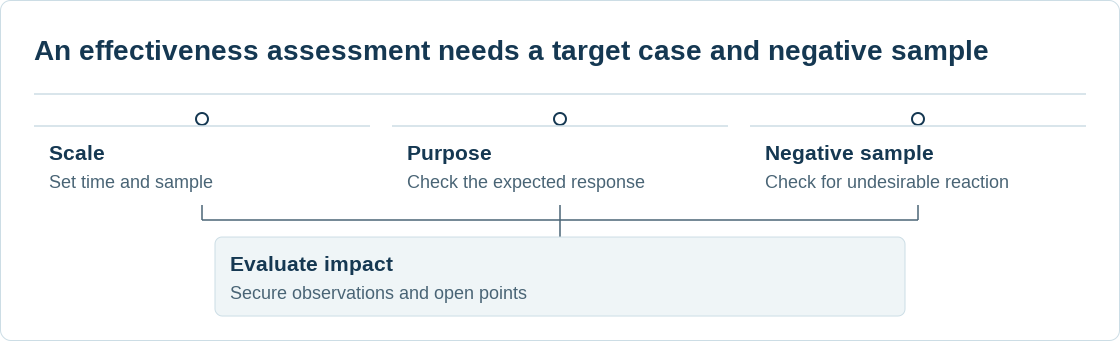
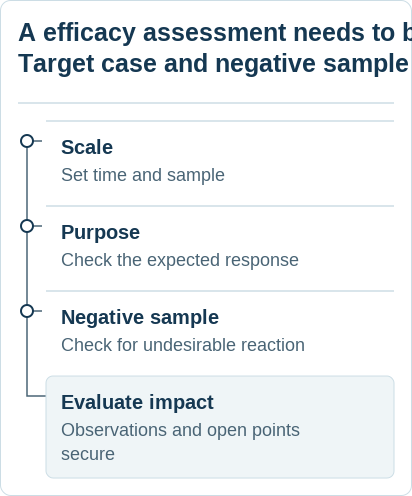
Test scale, target case and negative sample shall be confirmed separately before the decision on effect is taken.
Three punctual reactions from four samples
Situation Determine the performance, the status checked and the expected effect.
- Purpose
- 3 out of 4Target missed
- Takeover period
- 8 of a maximum of 10 minutesObjective achieved
- Control cases without escalation
- 2 out of 2Objective achieved
Situation
The fictitious HanseWerk Betrieb GmbH checks order platform HW-04 · Stand 4.1. The pre-released test order requires 4 correct reactions from 4 valid target cases.The responsible role must take place within 10 minutes. The 2 control cases must not trigger escalation.
Monitoring and evaluation
During the N08-L01 run, readiness is assumed in 3 out of 4 cases. The longest measured takeover time is 8 minutes. Both control cases are as expected. The time of the observed takeovers lies in the goal. The run fails to determine the full reaction criterion.
Reasoned decision
The evaluation marks the affected target case as a result. The original running data is retained. For the subsequent test, the same mandatory scope, negative sample and confirmed new version are used.
Negative test
Replace four valid target cases with three in the example. The test run shows the sample too small. Then restore the four tests and enter four observed correct takeovers. Without a suitable negative sample, the evaluation of the run overview remains open.
- Audit record
- Comparison of the original finding and retest showing the changed condition, observed effect and closure decision.
Work result
The approved test scale, the observations and the first finding can be found via the same running and criteria identification.
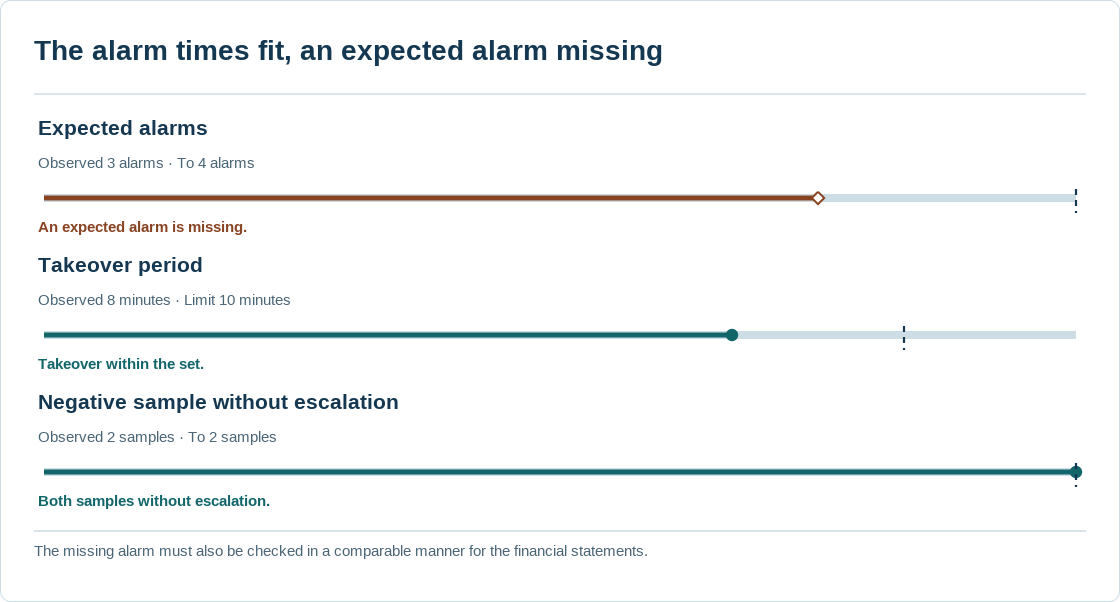
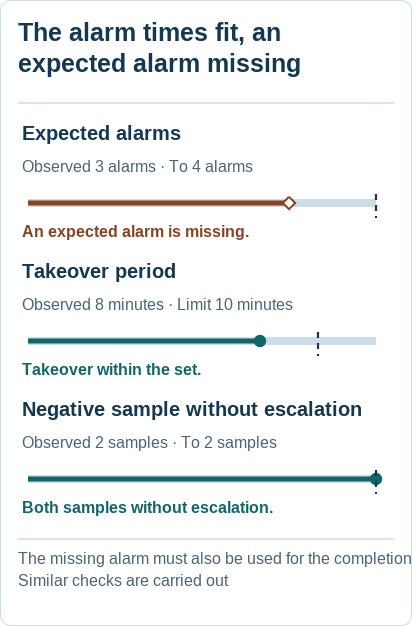
In the example, the measured acquisitions are punctual, but a target case remains without the expected response.
Working aids for your own operation
Set minimum sample, hit rate and time limit. Calculate the individual observation and complete test run with set-off cases and negative sample separately.
Efficacy test and run release
Set minimum sample, hit rate and time limit. Calculate the individual observation and complete test run with set-off cases and negative sample separately.
Outcome Evaluation per criterion and per run. Incomplete samples, double criteria and missing counters are visible.
Read the instructions
Fictional example N08 · All the acquisitions observed are on time. The workbook shows the missed hit rate and the own meaning of the negative sample. Change the number and supporting evidence for individual tests for the counter-test.
- Fix Test Task Enter the run and criteria identifiers, appropriate scale and planned minimum scope.
- Document valid samples Calculate the amount of hits over all valid tests and use the longest measured reaction for time.
- Check the progress overview Compare number and types of criteria with the released order. Secure deviations and post-test order.
Findings, post-test and completion
After a change, check whether the original criterion is met to a comparable extent. Track counter-test, release and date.
Outcome Reasoned financial status per finding and visible deviation from the agreed date.
Read the instructions
Fictional example N09 · The correction is documented. Only the comparable sample with counter-test and release is completed. Another criteria version and a stand without release are entered as counter-tests.
- Connect findings and first test Secure criteria, initial findings, proof and correction under the same identifier.
- Evaluate comparable sample Confirm result, counter-test, role and, if necessary, demonstrate required independence.
- Document release and appointment Collect date and release receipt. Use the valuation reference date for a comprehensible date.
Legal basis and official information
First check for this task
§ 30 BSIG · Risk management measures
For each relevant service, combine risks, ten fields of action, evidence and effectively verified effect. § 30 para. 3 gives priority to the technical requirements of the DVO for the providers covered there.
Annex 7 · (EU) 2024/2690 · Evaluate the effectiveness of measures
Link individual test criteria to the observed result and the verified handling of a deviation.
§ 38 BSIG · Implementation, monitoring and training
Support roles, decisions, supervised implementation and regular training at the services actually provided. Document responsibility and resubmission.

Other official references3
- Art. 21 NIS2 · Risk management in cybersecurity (opens in new tab)
Europäischer Rahmen · NIS-2-Richtlinie
Determine verifiable criteria from the risk analysis for all ten policy areas. Consider applicability, proportionality and additional technical regulations.
- Annex 6 · (EU) 2024/2690 · Procurement, development and maintenance (opens in new tab)
Technische Vorgaben · (EU) 2024/2690
Check the safety in selecting, changing, maintaining and controlled removal of a system under the relevant rule of the Annex.
- Technical implementation assistance to the implementing regulation (opens in new tab)
ENISA · Technical Implementation Guidance, Juni 2025
Use examples of evidence and assignments for testing. The benchmark for the binding requirement remains the relevant legal act.
What follows from the result of your sample?
An open result leads to correction and subsequent testing. A fully documented result flows into the overall examination.
Findings and follow-up
In addition to the deviation, also ensure the observed condition, the original scale and the performance affected. Perform cause, correction and follow-up testing under the same detection code. The remedy certificate confirms the changed status.
A result is available and the correction should be confirmed by a comparable follow-up test.
Evidence of cause, released change, comparability, counter-sample and completion for the same finding
Your decision Which run completely checks the original problem? Connect the result to the documented release.
Evidence and supervision
The result is available and you must prove the scope of the inspection, approval or supervision.
Merge test order, efficacy test, deviation and follow-up test.
Work result A second person can understand the findings and clearance decisions from the sources.

