
Demonstrate control effectiveness
Merge test order, efficacy test, deviation and follow-up test.
IMPLEMENTATION
EVIDENCE
From proof to repeatable test
Limiting the test task
A proof becomes useful if it combines the test object, the underlying measure and an observed effect. Work per service with a unique evidence identification, a verified version and a person responsible for the deviation.
Check the proof
The supervision can have different occasions and instruments per type of facility. Separate the specific order or request, proof for critical installations and regular internal effectiveness tests.
So you go ahead
Tracking the job and selection
Name the setup, service, test period, scope and desired effect. Reason the sample and secure the status used.
Work result Demarcation that a second person can use.
To merge, observation and evidence
Link a duty to the observed result. Instead of a flat-rate evaluation, note the significance and limits of each document.
Work result Reproducible findings with jurisdiction.
Remedy and follow up review
Determine the cause, concrete correction and maturity. Apply the original test scale to the corrected level in the subsequent test and document the professional decision.
Work result Closed receipt chain until after-test.
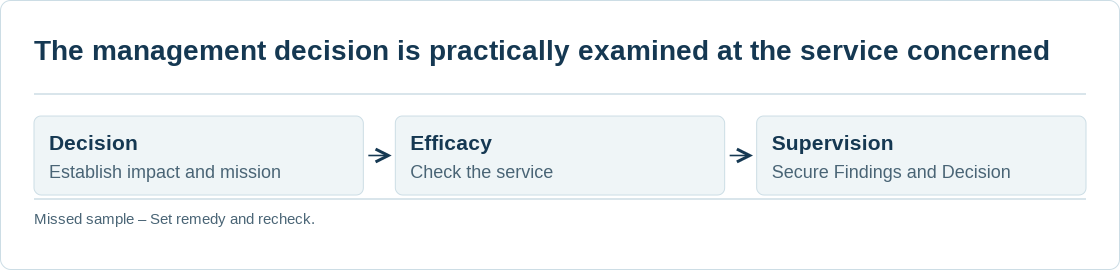
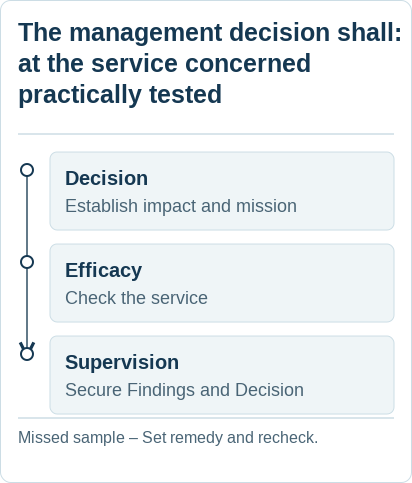
A management order leads to the decision via an observed sample. An incorrect effect returns to the examination with concrete remedy.
Test example and counter-probe
Situation
A test report mentions data backup as effective. The underlying evidence only shows the technical backup run. The test also requires a usable recovery level and a documented sample.
Negative test
After the correction, a second person compares the approved test question with the actual business process. The result remains open if missing data records continue to occur despite successful backup.

From the blog
Checking the effectiveness of security measures
Here you will find examples of how controls can be tailored to specific risks and assessed on the basis of company records.
Work aids for your operation
Use the predictable template and check the result with the fully described example.
Measures and efficacy samples
Arrange the ten fields of action. Treat test criteria, measurement, detection, findings and retest in the same work position.
Outcome Summary of measures with observed effect and pending retests.
Read the instructions
Fictional example A back-up is achieved in 88 minutes. The sample from the department is missing. The measure remains open until the agreed result is fully documented.
- Select criterion and type of test The ten action fields bear prepared examples. Set the appropriate yes-no criterion or a measurable setpoint.
- Record impact and evidence Refer to the target and is on the same performance and the relevant time.
- Track deviation and follow-up Record correction order, re-result and receipt with the same verification identifier.
Plant limit and detection planning
Gather asset assignment, scope, set date of detection and tracking of defects.
Outcome The test task with documented time frame was documented with sources.
Read the instructions
Fictional example A new operator knows his date of classification, but not yet a BSI date. The process remains open on time. An old operator carries out the concretely confirmed date with the old proof reference.
- Lines of installation and threshold The following are the main points of reference for the European Parliament:
- Documenting evidence Record the initial case, BSI date and referenced confirmation.
- Review and follow up on shortcomings Document the state of the art, evidence and re-examination.
Intensify the preparation for an examination
Take the confirmed samples and open evidence as the starting point for the structured evaluation. This makes it possible to identify which statement a sample is missing.
Select NIS2 on EUGRC.AIOfficial references for this task
First check for this task
§ 30 BSIG · Risk management measures
For each relevant service, combine risks, ten fields of action, evidence and effectively verified effect. § 30 para. 3 gives priority to the technical requirements of the DVO for the providers covered there.
§ 39 BSIG · Proof of critical installations
Determine the concrete BSI determination, classification as a new or existing operator and an appropriate exception. Plan scope of examination, handover and remedy open defects.
§ 61 BSIG · Supervision of particularly important institutions
Keep the implementation with a verifiable record chain available for each requirement. In case of ordered tests or measures, you will record the specific order scope and feedback.

Other official references2
- § 62 BSIG · Supervision of important institutions (opens in new tab)
Deutsche Anwendung · BSIG
If actual information triggers a review, bring the specifically requested measures, reporting channels or training to the service in the verifiable context.
- § 65 BSIG · Penalties (opens in new tab)
Deutsche Anwendung · BSIG
Determine the specific facts and scope of each paragraph. Follow the facts, the relevant category and the correction separately.
From the audit order to the completed contract
Edit target case, negative sample and the comparable follow-up test with cases N08 and N09.
Efficacy sample
Determine a measurable target from the expected protective effect. Select a comprehensible sample and determine which observation the target actually confirms.
Findings and follow-up
Bring together cause, released change and observation for the same finding. Check whether the repetition is comparable to the original criterion.
Prepare your own result for examination and supervision
Determine the coverage of evidence per service and obligation
The following are clear evidences of the lack, outdated and factually inappropriate nature.
Evaluable test cover with transparent denominator and concrete work order for each deviation.
Work through the caseSet the scope of the test risk-based
Connect relevant services, samples and planned evidence in a specific test order.
Released test order with tested object, selection justification, number of samples and planned evidence.
View the guideAnswering a supervisory request intelligible
Securely assign specific requirement, deadline, full evidence and sent version
A comprehensible response with each requested position, supporting evidence and own transmission.
View the guide
Release, interim measure and limit of information
Verify that temporary compensating controls are effective and have an expiry date
Released target for limited effect and duration.
An open finding has a responsible interim decision, a sample and a specified follow-up date. The operation can see when the intermediate decision needs to be reassessed.
Work through the caseMatching test report and limits to raw material
List of verifiable statements with associated supporting documents.
Any essential statement can be attributed to target criterion, sample and evidence. Limits of validity and follow-up requirements are clearly stated before release.
View the guide
Prepare proof for management and operational testing
Management
A decision by the management is missing for action or follow-up test.
Decision, implementation, monitoring and training of specific services
Work result A management mandate with responsibility, target criterion and comprehensible monitoring.
Critical installations
The scope of the installation or the official time of proof shall be clarified.
Check the installation limit, transition level, reporting route and established detection date.
Work result A documented system delimitation with separate detection and reporting order.
Restart
In the fictitious HanseWerk, order processing must be professionally usable within 90 minutes. Up to 15 minutes of data loss are allowed in the exercise target. The department expects all 10.000 reference data sets to be checked.
They want to take a restart on the basis of time and data.
Check measurement values, data quality and acceptance in the HanseWerk practice case.
Your decision Can the department release the service? Determine time, data level and completeness separately.

