
A loan device retains the old account
Twelve returned logger patterns start fresh.
ACCOUNT
APPROVAL
Starting position and test order
A manufacturer prepares twelve networked loan loggers for transmission. The devices work with a necessary remote function for the client assignment. The test plan requires a safe starting state for each of the twelve units, the deletion of the test data in the device and the separation of the old account allocation before re-output.
All twelve devices start in the intended secure profile. The documented deletion check does not find any old test data in the viewed memory areas. For ten devices, the test notes confirm that the old account does not maintain connection or display. For two devices, the old assignment remains visible in the portal. The devices are still clearly identifiable.
Compare test data and consequences
Local extinguishing sample
- Scale
- 12 of 12 without old test data
- Observation
- 12 out of 12 observed
- Follow
- Local criterion met
Safe starting state
- Scale
- 12 of 12 in the released start profile
- Observation
- 12 of 12 confirmed
- Follow
- Start Profile Occupied
Old account
- Scale
- 12 of 12 separated
- Observation
- 10 separated, 2 old assignments
- Follow
- Hold back two units
Three documents for the same twelve devices
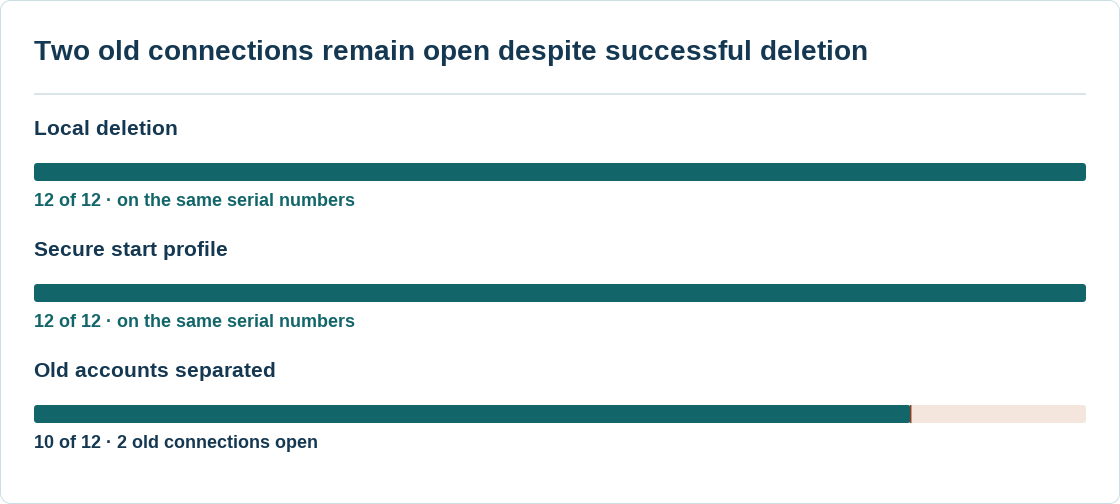
Compare the three test criteria over the same twelve serial numbers. The two open old assignments limit the release.
Edit the test step by step
Refund and determine the scope of the action
Arrange device, product acquisition, old clients and necessary remote function. Set safe starting values and the expected extinguishing effect before the sample.
Testable evidence Checklist with serial numbers, desired final condition and test reference.
- Acceptance criterion
- Justify applicability using evidenced activity or intended use, role and date. Assign an owner and due date to any unresolved assumption.
- Evidence
- Reasoned applicability assessment recording facts, reference, role, date and open assumptions.
Deletion and separation of account
Perform the documented return using the instructions. Capture data and settings in the device as well as the status of the old assignment. Confirm the safe start when rerecorded.
Testable evidence Separate original documents to device, old connection and new recording.
- Acceptance criterion
- Use the same metric, population and unit for expected and observed results. Record the measurement point at which the business service is achieved.
- Evidence
- Measurement record with baseline population, source, expected and observed values, unit and timestamp.
Set transferable release scope
Arrange the twelve results. Keep affected units until their account and deletion status is established. Take into account transferred data separately.
Testable evidence Release for the ten units checked and a dated clarification order for two devices.
- Acceptance criterion
- Justify applicability using evidenced activity or intended use, role and date. Assign an owner and due date to any unresolved assumption.
- Evidence
- Reasoned applicability assessment recording facts, reference, role, date and open assumptions.
Worked decision and negative test
Decision in case
The ten units with a complete sample can be released for the verified transfer. For two units, there is no proof of the old account assignment. The deviation clarifies the manufacturer on the actual device and on the connected service.
Secure the released status of the user's manual and the results for re-recording. The serial number connects the three tests with the decision.
Counter-sample and impact
Resetting two devices successfully and showing the empty local measurement window. Make the previous account visible again. As long as the old assignment is confirmed, the passing of these units remains blocked.
- Audit record
- Comparison of the original finding and retest showing the changed condition, observed effect and closure decision.
Templates and worksheets
Device return, deletion and new assignment
Check the local deletion, safe start profile and separation of old accounts per device profile.
Outcome Return log with secured release scope and open units.
Read the instructions
Fictional example Twelve loggers are deleted locally, and two of them keep the previous account assignment visible.
- Identify the starting situation assign serial number, version and necessary remote function.
- Run the test Deletion, old assignment and re-recording individually.
- Secure decision and evidence Document secure transmission and open after-test per device.
Official sources
First check for this task
Cyberresilience Regulation in text
Use the article or attachment that regulates the task to be solved.
Responsibility of manufacturers of digital products
Compare preparation, product release and care with your own manufacturer role.
Guidelines for the application of CRA
Check inter alia the remote processing, expected use and delimitation to other legal acts.

Other official references1
- General Product Safety Regulation (opens in new tab)
EUR-Lex · Verordnung (EU) 2023/988
Arrange the parts of the Regulation referred to in Article 11 CRA only for the aspects and risks covered by each regulation.
What depends on your result?
Resetting and checking transfer
Transfer the same test criteria to your own product and save the different starting data.
View the guideSample user information in the purchase channel
Then check whether the instructions for safe return and re-commissioning are available in the actual purchase or service channel.
View the guideTest matrix Annex I
Arrange the three observations to the relevant lines in Annex I.
Use the test matrix

