
A retest with a different time limit
Nine successful samples are only valid for five minutes instead of three.
CONFORMITY
MAINTENANCE
Starting position and test order
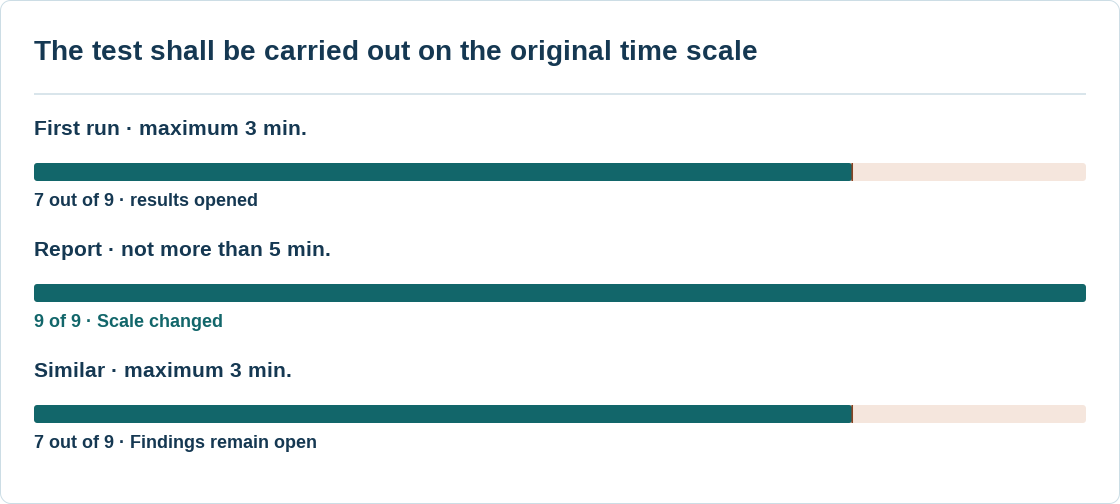
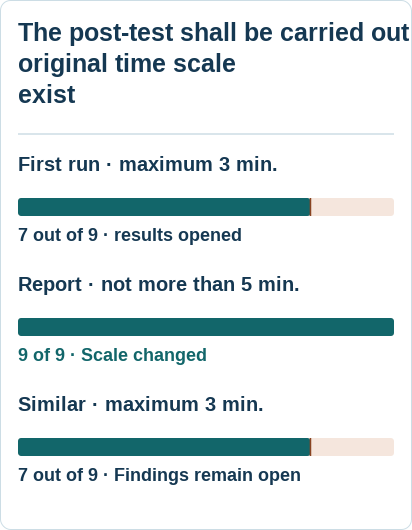
A provider of networked goods readers checks the re-start of the recording after a controlled interruption. Nine representative runs should start again within three minutes each with the original functionality. Seven out of nine achieve the internal target.
After the correction, the same nine devices are tested with the new version. The new protocol reports nine passed runs because it uses a five-minute limit. Two of these runs continue to be longer than three minutes. The normal case is unchanged in the exercise.
Compare test data and consequences
Original scale
- Scale
- 9 of 9 in a maximum of 3 minutes
- Observation
- 7 out of 9 in first run
- Follow
- Findings opened
Post-test log
- Scale
- The same scale confirms
- Observation
- 9 out of 9 only at 5 minutes
- Follow
- Findings remain open
Effective completion
- Scale
- New version under equal conditions
- Observation
- 2 times over 3 minutes
- Follow
- Repetition required
The three minutes are also valid in the post-test
Reassess the raw times against the original three minutes. Determine the basis of assessment and delivery.
Edit the test step by step
Ensure the original criterion and the result
Capture nine target cases, the three-minute scale, version reference and the two faulty observations.
Testable evidence Continuously detectable findings to the original target.
- Acceptance criterion
- Use the same metric, population and unit for expected and observed results. Record the measurement point at which the business service is achieved.
- Evidence
- Measurement record with baseline population, source, expected and observed values, unit and timestamp.
Evaluate the modified protocol with the original scale
Compare the raw times with three minutes. Check the origin of the five-minute limit and the observed function.
Testable evidence Evidence of the ongoing open post-test for two races.
- Acceptance criterion
- Use the same metric, population and unit for expected and observed results. Record the measurement point at which the business service is achieved.
- Evidence
- Measurement record with baseline population, source, expected and observed values, unit and timestamp.
Check validly after the next procedure
Repeat the run with the original scale and check the unchanged function. Arrange the decision exactly to the new delivery version.
Testable evidence Comparable financial statements or scheduled follow-up.
- Acceptance criterion
- The item under review and the documents refer to the same approved version. Record obsolete evidence as a separate discrepancy.
- Evidence
- Versioned mapping of item, source and approved version with any discrepancy recorded.
Which evidence actually closes the finding
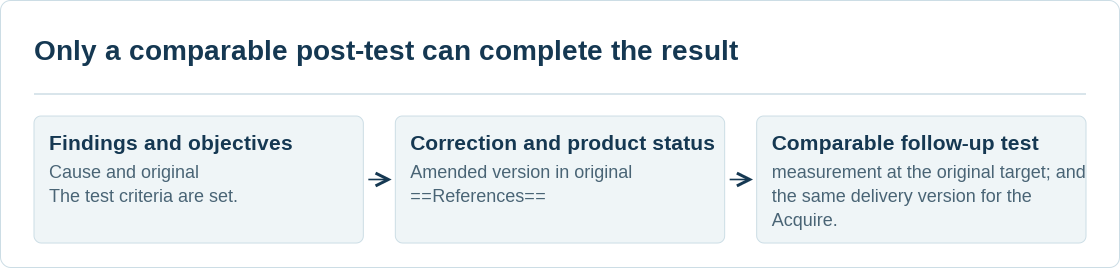
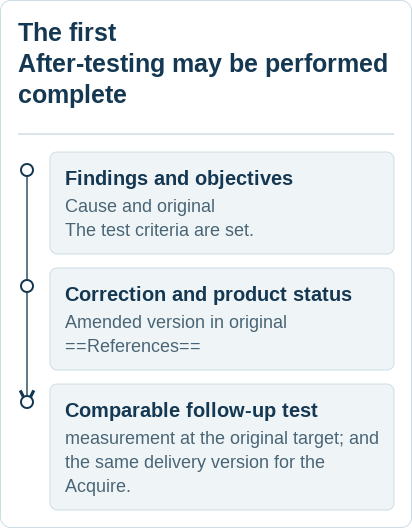
Link cause, correction and comparable sample. The conclusion needs the appropriate proof at the actual released stand.
Worked decision and negative test
Decision in case
The protocol counts with a different scale. Two runs are still too slow on the original criterion. The result remains open in case, even if the updated run overview looks green.
A technically justified change of the target criterion would be a documented decision. For the completion of this deviation, the manufacturer will prove an effective correction under the originally valid conditions.
Counter-sample and impact
Complete nine raw times of no more than three minutes each and accidentally take over the old product status in the report. The times fit to the target. The assignment to the corrected delivery version must be further proven.
- Audit record
- Comparison of the original finding and retest showing the changed condition, observed effect and closure decision.
Templates and worksheets
Findings and comparable follow-up
Track first run, correction and re-test at the original target with the same detection identifier.
Outcome Final act with documented comparability and released delivery.
Read the instructions
Fictional example Nine devices are only available at five minutes instead of the original three-minute target.
- Identify the starting situation Findings and keeping unchanged.
- Run the test Adjust the test conditions, raw values and normal case.
- Secure decision and evidence The reasons for this are:
Official sources
Cyberresilience Regulation in text
Use the article or attachment that regulates the task to be solved.
Responsibility of manufacturers of digital products
Compare preparation, product release and care with your own manufacturer role.
Guidelines for the application of CRA
Check inter alia the remote processing, expected use and delimitation to other legal acts.

What depends on your result?
Close findings with comparable follow-up
Transfer the same test criteria to your own product and save the different starting data.
Prepare for post-testBuilding a release file
Merge the original finding, effective correction and clearly assigned completion in the product dossier.
Prepare release fileCRA file check
Check in the browser which protocol actually carries the closure in the file.
Practice the selection of documents

