
A standard covers only some requirements
A fictitious standard appears in the dossier.
CONFORMITY
MAINTENANCE
Starting position and test order
A manufacturer uses a standard for device management for a fictitious Class I product. In the model, the official reference contains a restriction on two criteria of remote processing necessary for the product. Another laboratory report mentions an older version not documented on the audited date.
Six of the nine relevant criteria are confirmed by reference and actual application. Technical documentation misleads all nine as being fully covered by the standard. In case no specific real standards are required.
Compare test data and consequences
Requirements
- Scale
- 9 criteria applicable
- Observation
- 6 with secured cover
- Follow
- 3 further examine separately
Limitation
- Scale
- Applying the official scope
- Observation
- 2 Criteria excluded
- Follow
- Clearing procedures for these gaps
Issue of the report
- Scale
- Tested standard version confirmed
- Observation
- 1 Report mentions old edition
- Follow
- Secure version or portability
The standard covers six of the nine requirements
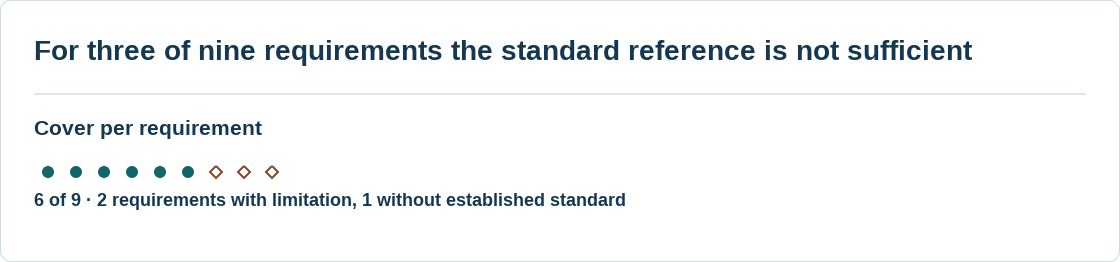
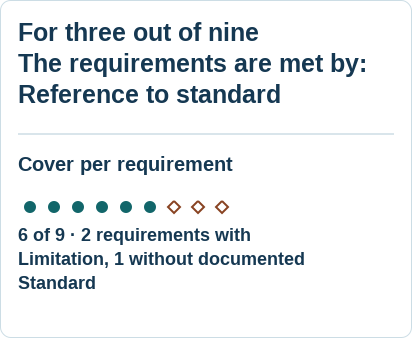
Name the three open criteria individually. Track the evaluation required for them to actual proof.
Edit the test step by step
Supporting the legal status of the basis used
Capture the location and check the output used as well as validity on the date of the record.
Testable evidence Perceptible status per basis used.
- Acceptance criterion
- Link the edition used, the official reference and the assessment date.
- Evidence
- Evidence list recording original source, version, documented mapping and owner.
Determine the coverage per requirement
Arrange the comprehensiblely applied sections to the nine criteria. Determine restriction and different output individually.
Testable evidence Six confirmed covers and three concrete gaps.
- Acceptance criterion
- Map each of the nine requirements to the specific clause applied or an unresolved gap.
- Evidence
- Evidence list recording original source, version, documented mapping and owner.
Apply missing requirements to the appropriate procedure
Clear the evaluation route of the three other requirements and update the compliance file.
Testable evidence Dated method and location of the additional required documents.
- Acceptance criterion
- Record the three open requirements, the assessed procedure and the evidence needed in the conformity file.
- Evidence
- Evidence list recording original source, version, documented mapping and owner.
Worked decision and negative test
Decision in case
Six requirements benefit from the established basis in the example. Two are explicitly not covered and for one missing the appropriate version. Continue these three positions in the permissible procedure.
The technical examination of an unmet requirement remains valuable. For the overall decision, it must be noted at which point the correct proof is available and who has confirmed the procedure.
Counter-sample and impact
Replace the date for the three open positions in the dossier with a new reference date without changing the official location or actual laboratory report, which will not allow the range to be established.
- Audit record
- Comparison of the original finding and retest showing the changed condition, observed effect and closure decision.
Templates and worksheets
Standard coverage and type level
Track standard reference, actual application, procedural gap and confirmed scope of the type.
Outcome Evidence per requirement and release status of the appropriate assessment method.
Read the instructions
Fictional example Six out of nine requirements are covered by the approved standard version.
- Identify the starting situation Confirm the official basis and actual edition.
- Run the test assess coverage and the necessary complementary procedure.
- Secure decision and evidence Check the certificate and the actual delivered stand.
Official sources
First check for this task
Cyberresilience Regulation in text
Use the article or attachment that regulates the task to be solved.
Standardisation on the Cyber Resilience Act
Follow the development of standards and check for release decision the official find site and the scope covered.
First European standard to support the CRA
Distinguishing the publication of the standard from the publication of its reference in the Official Journal.

Other official references1
- Findings of European harmonised standards (opens in new tab)
EU-Kommission · Harmonisierte Normen
Confirm the reference, version and any restrictions published on the act.
What depends on your result?
Verify standard level and coverage
Transfer the same test criteria to your own product and save the different starting data.
View the guideProduct category and test procedures
The proven coverage is not sufficient in Class I. Check the reference to your actual conformity path.
View the guide

