
Late warning after an operating change
Check whether a new operator of the remote function ensures the promised warning and the agreed relapse.
CONFORMITY
MAINTENANCE
Starting position and test order
A manufacturer of connected temperature sensors will be able to operate the central warning processing by another service provider in future. The own manufacturer remains responsible for the development of the necessary remote function. The purpose "Warning if limit value is exceeded" remains the same.
The exercise is considered to be a release standard with a warning within 60 seconds for each of six representative locations and a successful response in the intended environment. Four locations are located in the target, two receive the indication only after 95 seconds. The feedback has so far only been tested in a separate laboratory environment.
Compare test data and consequences
Warning time
- Scale
- 6 locations up to 60 seconds
- Observation
- 4 in target, 2 at 95 seconds
- Follow
- Resetting the changeover
Reactivation
- Scale
- Observation in the target environment
- Observation
- Only laboratory test available
- Follow
- Comparable sample missing
Responsibility
- Scale
- Manufacturer responsible for remote function
- Observation
- Change of service provider for the same purpose
- Follow
- Evaluate product reference and change
Warning time and relapse certificate
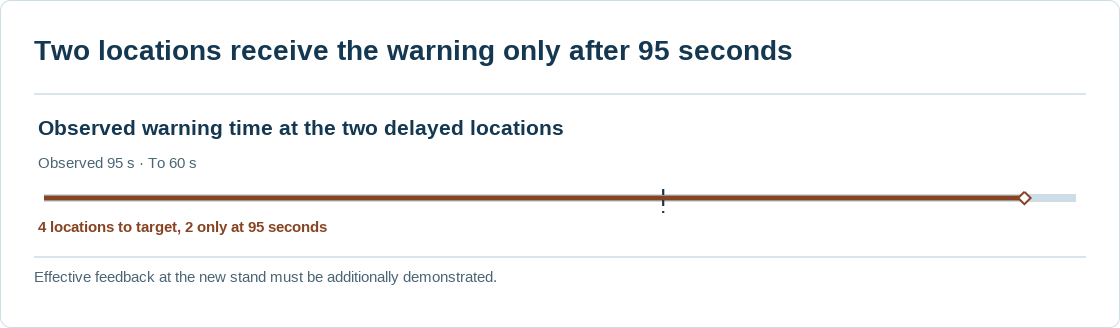
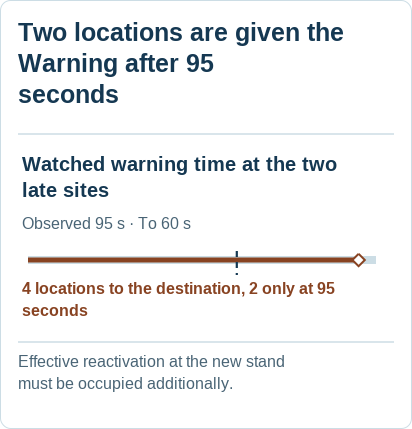
Two locations miss the warning time. For a release, the team also needs to reset in the target environment.
Edit the test step by step
Describe the remote function and change needed
Show which promised function is missing without remote processing. Arrange old and target operation and the development responsibility.
Testable evidence Version and sequence comparison including the remote function responsible.
- Acceptance criterion
- The item under review and the documents refer to the same approved version. Record obsolete evidence as a separate discrepancy.
- Evidence
- Versioned mapping of item, source and approved version with any discrepancy recorded.
Check conformity and timely warning
Test the six locations with the same measurement and time base. Evaluate whether the modified effect affects compliance.
Testable evidence Six individually assigned observations and documented change effects.
- Acceptance criterion
- Use the same metric, population and unit for expected and observed results. Record the measurement point at which the business service is achieved.
- Evidence
- Measurement record with baseline population, source, expected and observed values, unit and timestamp.
The reactivation under comparable conditions proves
Check the intended reactivation and restart of the warning chain with appropriate permissions and receivers.
Testable evidence Reproducible follow-up and release decision for the new plant version.
- Acceptance criterion
- The item under review and the documents refer to the same approved version. Record obsolete evidence as a separate discrepancy.
- Evidence
- Versioned mapping of item, source and approved version with any discrepancy recorded.
Worked decision and negative test
Decision in case
The conversion is blocked in the case because the warning time is missed at two locations and the reactivation under the conditions provided for is not documented. The manufacturer also evaluates the effect of the change on the conformity. The same purpose alone does not end the test.
The new release requires confirmation of the warning time and the reset. The original observations are retained so that the cause and effect of the correction can be traced later.
Counter-sample and impact
In the sample sample, set all warning times to a maximum of 55 seconds and leave the feedback in the laboratory. Proof of warning time is now fulfilled. The relapse test and thus the release remain open.
- Audit record
- Comparison of the original finding and retest showing the changed condition, observed effect and closure decision.
Templates and worksheets
Product change and new release
Compare original purpose, new effect, requirements and documented release of the amended version.
Outcome Reasoned decision on the amendment with open tests per product level.
Read the instructions
Fictional example After a change in purpose, four out of six documents are transferable. Two documents and the new release are missing.
- Identify the starting situation Record the old and the target with purpose and source.
- Run the test The test shall be carried out in accordance with the following procedures:
- Secure decision and evidence Confirm approval including new test route and remedy.
Official sources
Cyberresilience Regulation in text
Use the article or attachment that regulates the task to be solved.
Guidelines for the application of CRA
Check inter alia the remote processing, expected use and delimitation to other legal acts.
Responsibility of manufacturers of digital products
Compare preparation, product release and care with your own manufacturer role.

What depends on your result?
Re-route necessary remote processing
Transfer the same test criteria to your own product and save the different starting data.
View the guideReplace third component with discontinued care
A direct software component is also affected by the operation change. Open their version and maintenance in the same release.
View the guideRelease laboratory
Practice the release decision with a modified relapse monitoring.
Start exercise

