
Check whether DORA applies
The European Commission has set out its objectives and priorities.
MANAGEMENT
ACCOUNTABILITY
Which company should be assessed?
Start with the legal entity. Capture concession, activity and group role. Check the affected category, concrete exceptions and a possible assignment to the simplified framework separately.
A group may have several companies with different activities. Support the unit considered and its status before deciding on the framework. For each open question, you will find the missing document, the competent body and the next audit date.
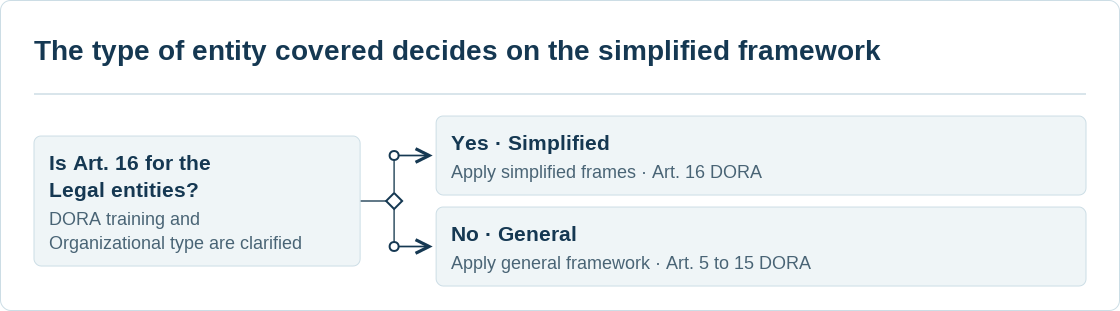
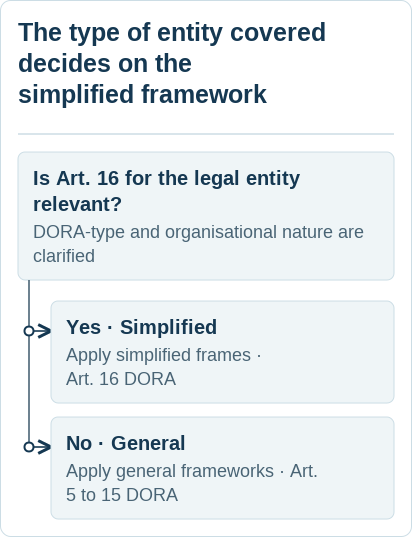
First, determine which category the financial entity is in. Then, check in the path shown whether Art. 16 DORA provides for a simplified ICT risk management framework.
Choose the task that matches what you need to assess. Each work path identifies the records you need and how to evidence the outcome.
Legal entities and management obligations
Use the same date for the organization chart, registration documents and performance overview. Start with a unit that provides services to other companies.
Supporting the company profile
Document the authorisation, activities actually carried out, reporting level and competent body in a note. Keep local responsibility in group cases.
- Acceptance criterion
- Trace execution, review and approval to named roles. Check handover and deputy arrangements in the exercise.
- Evidence
- Roles record naming responsibilities, deputies and documented approval or escalation.
Evaluate simplified frameworks
Match Art. 16 DORA with the concrete facts. Document the classification in question, its supporting documents and the technical approval. Determine further mandatory areas separately.
- Acceptance criterion
- Justify applicability using evidenced activity or intended use, role and date. Assign an owner and due date to any unresolved assumption.
- Evidence
- Reasoned applicability assessment recording facts, reference, role, date and open assumptions.
Incorporating decision in the management body
The Board shall have open points, competence and date per decision.
- Acceptance criterion
- Observe the intended effect in a defined transaction. Record how an absent effect changes acceptance or the follow-up action.
- Evidence
- Test record with transaction, expected business result, observed effect and finding decision.
Secure the statement with a sample
Compare the justification with a unit of the same group performing another activity. The classification must show which differences are decisive for validity or framework.
- Acceptance criterion
- Assess the bank and service company separately against their status and actual activity. Record the applicable framework, approval and reference to status evidence for each entity.
- Evidence
- Reasoned applicability assessment recording facts, reference, role, date and open assumptions.
Case study with two companies
A bank uses a service that a service company purchases centrally. The bank documents its own validity. The group structure explains who is running the contract and which unit is using the service.
Approved application Legal entities, sources, assessments, evidence, releasing role and next review date are comprehensible on one side.
- What you are examining
- Compare the bank's approval certificate with the service description of the service company. In addition, place the contractual partners, the actual unit and the role responsible for payment processing.
- What the post-test decides
- Let a second person explain to both companies what the classification is based on. The contract file must prove the use by the bank, even if the service company manages the contract.
- Audit record
- Agreement reconciliation linking the service, current clause, operating evidence and decision on any discrepancy.
Tasks in this thematic area
Select the work page for your role, next check point or corresponding proof.
Determine the DORA treatment for a legal entity
Arrange the legal person and his actual activity. A note per legal entity combines authorisation or registration, possible exceptions, the applicable risk framework and the competent authority.
Your result Decision-making endorsement with source of authorisation, activity, result, open points and link to the information register.
Proportionality
Evaluate size, risk profile and complexity for a risk-based implementation and document the chosen design.
Prepare management decision
Prepare and document a decision of the management body on risk tolerance, budget and monitoring.
Roles and independent control
Separate operation, control function and audit using a concrete ICT decision and assign representation to clarify responsibility from the enterprise to the audit.
Practice examination decisions in the case
Edit the initial data and compare your result with the well-founded solution.
Case D03
Deciding on Resilience Tolerance in the Conductor
In the fictitious case, the management board decides on payment processing. The decision must identify the business impact, measured restart and the conditions for a temporary transition.
Your result Brief draft decision with options for action, recommendation, risk to be accepted and timed audit.
Legal basis for this task
Compare the decision from the test example with the relevant rule.
Articles 2, 5 and 16 DORA
Check the legal entity covered, the management responsibility and, where appropriate, the simplified framework in the text.
For your exam Legal entities, sources, assessments, evidence, releasing role and next review date are comprehensible on one side.

For your own operation
DORA Scope and management decision
Merge legal entities, relevant category, exceptions and the decision of the management body in one transaction.
Outcome A management decision shall be valid and shall set out the open test requirements separately.
Read the instructions
Fictional example An approved bank uses an internal company IT operation. The company of the IT enterprise does not conclude its own banking contracts. For the group IT the audited service description is missing.
- Evidence of decision Capture observation, scope and evidence per test step. Clear each open result before release.
- Linking Evidence For relevant checkpoints, deposit the specific source, the verified version and the proof ID.
- Treatment of deviation Keep the role of the service company open, resubmit and document the bank's decision separately.
Building risk management
Building on ICT risk management framework, strategy and controls from business process to proof. Assessments are available for internal evaluation on EUGRC.AI.

