
Report incidents under DORA
The results of the study are presented in the following sections:
CLASSIFY
REPORT
What are the facts of the classification?
From the moment you recognize a common incident file, document affected services, functions and timings. The classification decision is based on the criteria and thresholds of the applicable technical rules.
The first level of knowledge may change with each confirmed notification. A joint incident record determines which performance was affected at what time, which criteria were assessed and which version went to the intended recipient.
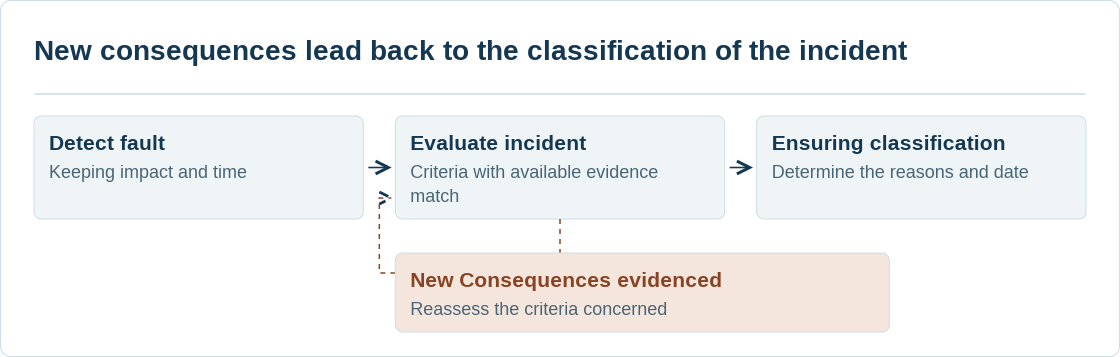
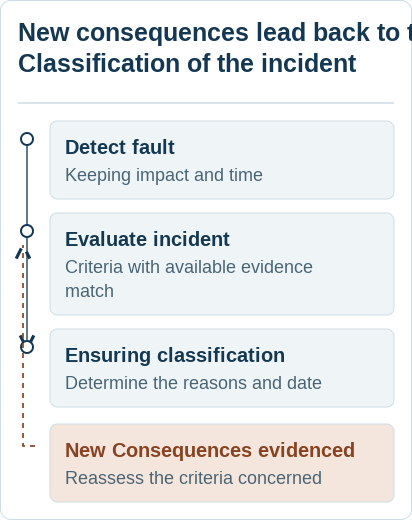
Track the incident from the first observation to the documented notification decision. Once new effects become known, check the classification again.
Evidence of knowledge, classification and notification
Merge event log, knowledge time, service reference and available impact data on a time axis.
Keeping Watch
Document detection time, first performance affected, known effects and initial evidence. Identify unexplained information as open and designate responsible persons for their examination.
Decide Substantially
Apply the relevant criteria to each incident. Keep separate knowledge, classification, decision time and supporting documents used.
Control message and update
Determine relevant deadlines and reporting from the current official specifications. Version first report, interim reports and final report together with confirmation of receipt.
Secure the statement with a sample
Repeat the classification with the documented knowledge at that time. Check which new information has changed the evaluation and when this information was available.
Example with later findings
At the beginning, a fault is local. Later, a second business unit reports effects on the same performance. Keep track of the time of discovery and re-check the classification based on updated evidence.
Reportable Incidental Records The documents show the time of knowledge, decision on classification, release, transmission and follow-up.
- What you are examining
- Secure the first state of knowledge with time and the business area concerned at first. Document when the second area has confirmed its impact and whether both messages concern the same service and user base.
- What the post-test decides
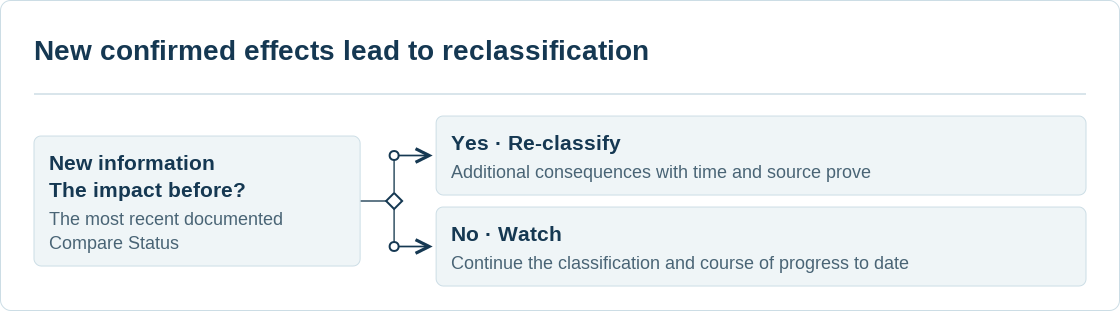
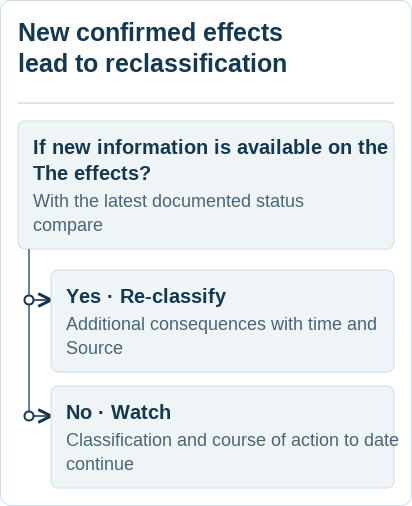
- Play the decision with the information that was available at both times. The file shows which additional findings led to the reassessment and who documented them.
New effects change the basis for decision
If the payment failure records further services, update the observed consequences. Link the new assessment to the previous incident file.
Tasks in this thematic area
Select the work page for your role, next check point or corresponding proof.
Identifying and working in a coordinated manner ICT incidents
Arrange technical observations immediately to a function concerned and the relevant role. The incident record records knowledge, assumptions, treatment and decisions in a common time sequence.
Your result Continuous incident file with knowledge, effect and confirmed return to the plant.
ICT incident
bring together the services concerned, materiality thresholds and new insights in a comprehensible classification decision.
Calculate DORA reporting periods using the correct triggers
Calculate deadlines from the actual documented triggers. The first message combines knowledge and classification. The intermediate message follows on from the dispatch of the initial message. The final report refers to the intermediate message or its last update.
Your result Time-limits sheet with reference dates, sources, rules used and actual transmissions.
Initial notification, interim notification and conclusion
Report a serious ICT incident with documented dates and keep track of reporting, recipients and transmission documents.
Repeated incidents and special reporting situations
Repeated individual incidents can be considered a serious incident together. Voluntary threat reporting, group-related report organisation and outsourced reporting activity each require their own classification.
Your result Decision with individual files, observation window, cause and comprehensible threshold test.
Practice examination decisions in the case
Edit the initial data and compare your result with the well-founded solution.
Case D07
Evaluate repeated disruptions in payment transactions together
Two fictitious disturbances are discovered in the monthly comparison. Check common obvious cause, time windows and effects after common consideration.
Your result Classification note with decision on the relationship, audited sums and justification per criterion.
Case D06
Disruption in payments and notification decision
To classify a fictitious payment error by two thresholds, calculate the reporting time and compile proof of completion.
Your result Classification note with calculation, earliest documented knowledge, release of classification and transmission document.
Connection check for this product stand or incident
Co-ordinate notifications from manufacturers and operators
The bank and a product manufacturer know the common event at different times. Underlying the actual DORA classification.
View the guide
Legal basis for this task
Compare the decision from the test example with the relevant rule.
Delegated Regulation (EU) 2024/1772
Use the official criteria and materiality thresholds for classification. Reporting details and templates are listed in the source register.
For your exam The documents show the time of knowledge, decision on classification, release, transmission and follow-up.

For your own operation
DORA Incidental file and notification decision
Perform the evidence, classification and handover to the reporting officer in an incident file.
Outcome The classification can be calculated at each point of knowledge and repeated in the decision-making protocol.
Read the instructions
Fictional example A supervised financial service is affected. The downtime is 142 minutes, the geographical reference is initially open. A second cross-border affected state is initially only suspected.
- Check classification Support the Art. 6 alternatives and each relevant threshold criterion individually.
- Linking Evidence For relevant checkpoints, deposit the specific source, the verified version and the proof ID.
- Treatment of deviation Keep the review version, verify the new information and check the trigger for a new classification.
Finding Reporting Rules and Templates
Official acts, technical standards, register templates and references of EBA and Bundesbank are available after work. For internal evaluation, assessments on EUGRC.AI are available.

