
Assess recurring incidents
Match cause and effect.
EVIDENCE
SAMPLE
Common causes and special reporting situations
Repeated individual incidents can be considered a serious incident together. Voluntary threat reporting, group-related report organisation and outsourced reporting activity each require their own classification.
Several events on the same platform may have different causes. Compare cause, time period and service concerned based on the underlying reports. When merging, you will note how data subjects, time or other values have been demarcated in common view.
Work steps and verifiable documents
Connect repetitions to cause
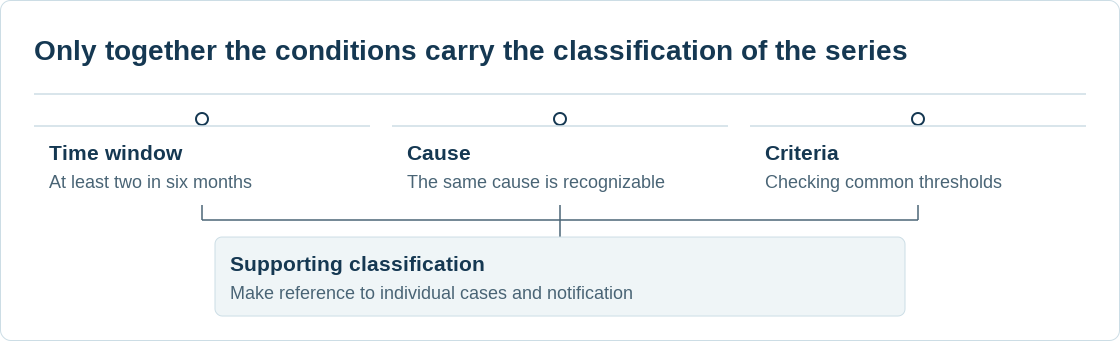
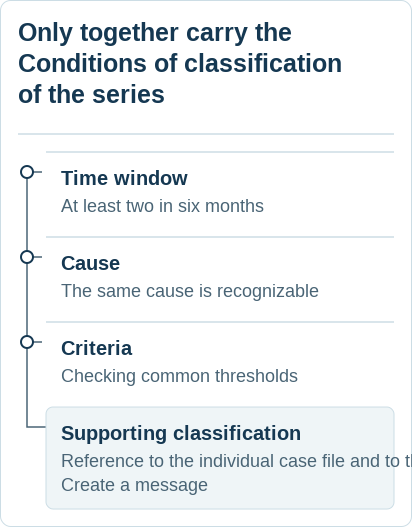
Ensure that relevant companies are audited monthly. Track at least two incidents in six months, an equally obvious cause and the common criteria of a serious incident.
Testable supporting evidence Reasoned aggregation decision with individual files and assessment of the joint impact.
Evaluate threat reporting separately
In the event of a significant cyber threat, determine which affected persons or services are affected and why voluntary reporting may be useful. Use the content provided.
Testable supporting evidence Decision to make voluntary notification with separate file reference.
Monitor transmitted reporting activity
When you are engaged in reporting, check the continued responsibility of the financial company. Set confirmation, escalation and a substitute for late reporting.
Testable supporting evidence Contractually assigned reporting role and documented acknowledgement of receipt.
Decision in the test example
Short disturbances occur repeatedly in the fictitious payment operation. The monthly comparison shows a common obvious cause. In the common stock, the effects are to be included in the criteria examination.
- Compilation of documents
- List the individual cases concerned, including time and common cause. The comparison shows the combined effect and the reference value used separately.
- Keeping a decision
- The Bank brings together the timing and impact of individual files. The concrete corporate status and common thresholds decide on further treatment.
- Complete the test file
- Decision with individual files, observation window, cause and comprehensible threshold test.
- Sample and acceptance
- Change a cause in the exercise stock. The same control run must show why this event falls out of aggregation.
The common classification depends on established conditions
Repeated observation leads to a joint threshold check over time windows and causes. Incidental record keeps the company status beside it.
Legal basis for this task
Classification of incidents · (EU) 2024/1772 · Article 8(2) · Repeated incidents
The provision regulates the cumulative classification and specifies exceptions, including for micro-enterprises and enterprises under Article 16(1) DORA.
For your exam Prove time reference, same obvious cause and common criteria.
DORA · Art. 19 para. 2 and 5 · Special reporting positions
The provisions cover voluntary reporting of significant cyber threats and the outsourcing of reporting obligations.
For your exam Arrange the facts to the relevant path.

What is the next decision?
In case of payment, evaluate two confirmed events individually and then on their context. Secure the numbers and reference values used in the audit file.
Two fictitious disturbances are discovered in the monthly comparison. Check common obvious cause, time windows and effects after common consideration.
Case D07
Your decision Classification note with decision on the relationship, audited sums and justification per criterion.
Evaluate repeated disruptions in payment transactions together
Two fictitious disturbances are discovered in the monthly comparison. Check common obvious cause, time windows and effects after common consideration.
Your result Classification note with decision on the relationship, audited sums and justification per criterion.
Detection dossier
Test job, original sample, version reference, correction and documented retest.
Link target criterion, drawn sample, findings and retest. The memory example shows which protocols prove the effectiveness of alarming to the checked status.
Work result A dossier in which a third party monitors expectations, observations, findings and conclusions per test criterion.
Your result A dossier from which another person can repeat the same sample.

