
Recurring payment disruptions
Evaluate two events based on their evidence.
DECISION
RETEST
Are there two payment failures in the same valuation?
Two fictitious disturbances are discovered in the monthly comparison. Check common obvious cause, time windows and effects after common consideration.
You will check the monthly comparison of the incident processing. Place the individual reports and the user stock side by side. Based on the causes and the period considered, reason whether a joint evaluation is carried out and which reference values apply then.
Initial data of the exercise
- First event
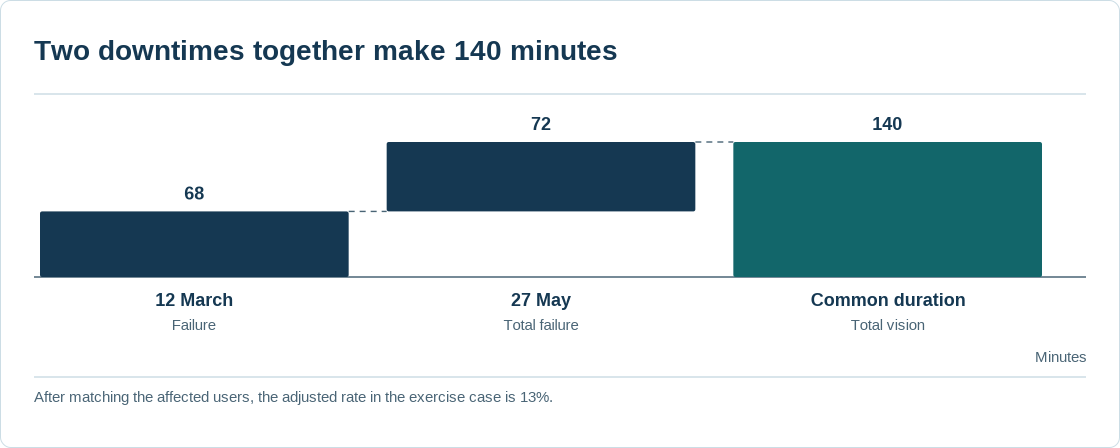
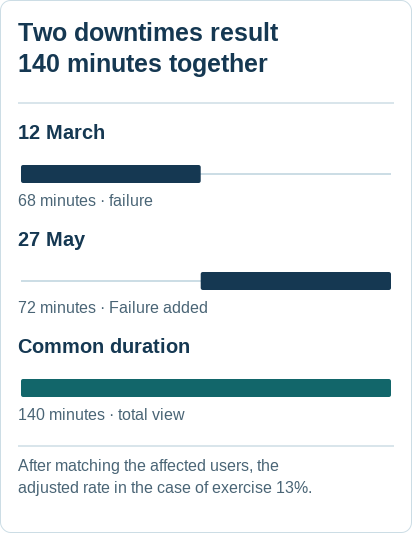
- On March 12, the processing of a critical payment service is 68 minutes. Around 6 percent of customers in the same service are affected.
- Second event
- On May 27, the service expires for 72 minutes. After verified duplicate cleaning, a total of 13 percent of users of the same service are affected.
- Causes
- Both technical reports confirm the same defect in the module used. In case of exercise, the bank falls under the rule for repeated incidents.
Tasks for processing
Keep track of your decision, the original document used and still open information. Only open the sample solution once you have documented your justification.
- Check whether the events fall into the relevant time window and have the same obvious cause.
- Check together reached criteria for the critical service and cleanly delimit the user stock.
- Document the classification decision and, if you have reached the threshold, arrange for the reporting obligation to be checked.
Model solution with justification
Situation Two fictitious disturbances are discovered in the monthly comparison. Check common obvious cause, time windows and effects after common consideration.
- Merge Time and Cause
- March and May are the same six-month period. The common obvious cause is documented per event.
- Check thresholds separately
- The user rate and the combined downtime are assessed separately. In the exercise, the confirmed values for the critical service result in 13 percent as well as 140 minutes.
- Documenting the reporting route
- The Bank shall incorporate decision, inventory definition and time records into the incident file and shall justify the criteria used.
Two incidents lead to a joint evaluation
Set downtime and the confirmed common user base against legal criteria.
Secure the result in the post-test
Situation Two fictitious disturbances are discovered in the monthly comparison. Check common obvious cause, time windows and effects after common consideration.
Change the cause of the second event in the exercise stock. Monthly control must discard the connection and continue to perform both events individually.
Keep the confirmed individual values and log the different cause as a changed factor. A second person must see why the connection changes in the overall assessment.
Legal basis for this task
Classification of incidents · (EU) 2024/1772 · Article 8(2) · Repeated incidents
The conditions for a common classification include time frames, equal obvious cause and jointly met criteria.
For your exam Establish both relationships and the common threshold test.
Classification of incidents · (EU) 2024/1772 · Art. 9 · Materiality thresholds
The Article contains criteria and thresholds for classification.
For your exam Check customer reference and downtime based on its units and reference sizes.

What is the next decision?
Transfer the decision to your own process and set the checked criterion. Then, in the case directory, select an exercise with other source data or a different role.
Repeated incidents and special reporting situations
The data shall be reported in the following table:
Repeated individual incidents can be considered a serious incident together. Voluntary threat reporting, group-related report organisation and outsourced reporting activity each require their own classification.
Work result Reasoned decision on individual or joint consideration with evidence of the relevant criteria.
Your result Decision with individual files, observation window, cause and comprehensible threshold test.
Edit DORA case studies
Edit a DORA case with fictitious initial data, for example to the information register or to a payment malfunction. Solution and counter-probe help in the transfer.
Your result Reasoned decisions with supporting evidence and a repeatable follow-up test.

