
Explain AI decisions
Collect information, concrete reasons for decision and a real way to correct it.
DEPLOYMENT
OVERSIGHT
Check information, explanation and correction on your own system
Separate the information about the use according to Art. 26 para. 11 from the explanation of a concrete decision under Art. 86. Capture the system output actually used, the professional role, the criteria and the observed effect on the person. Check the scope and relevant rights from other Union law.
In the case of personal data, you should also assess Art. 22 GDPR. Document whether the decision is made exclusively automatically and what significant consequences it has. A mandatory technical control must actually be comprehensible. Keep separate the internal correction path and if necessary the complaint with the market surveillance authority.
Building the decision path from the original document
Explain specific reasons for the decision
Reconstruct initial data, AI contribution and essential elements of the actual decision. Check applicability and priority of other claims.
Testable evidence Understandable and verifiable explanation, including technical control and actual reason.
System information at the real decision-making channel
Secure the information available to the data subject on the use of the relevant high-risk system.
Testable evidence Original view and actual information per decision channel.
The supervisory complaint and internal correction
Check the correct addressee and the evidence trail for a possible complaint. Perform the internal review separately.
Testable evidence Reasoned allocation of beneficiaries and proof of an effective correction.
Answer the request of a fundamental rights body
Arrange responsibility, purpose, concrete request and the reasonable scope of the documents to the process.
Testable evidence Response file without any necessary personal documentation.
An applicant needs the main reason for her decision
A fictitious training college answers a question about a rejected application for vocational training. The scope of Art. 86 is confirmed in the exercise. AI prioritises applications.
Reconstruct information, AI contribution and actual professional exams.
An understandable answer with a justified separation of usage information, explanation and GDPR verification.
Case handling · An applicant needs the underlying reason for her decision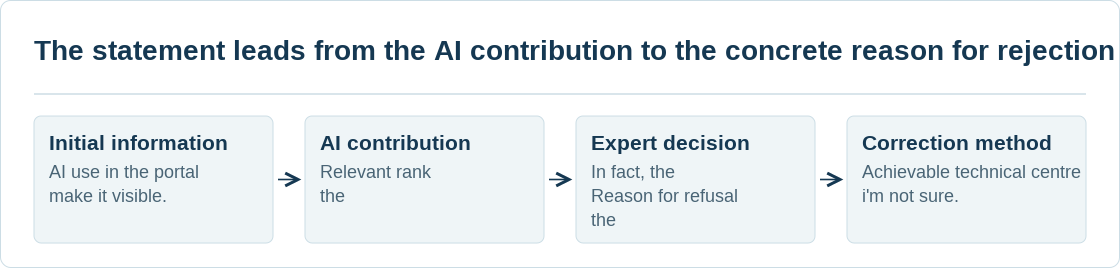
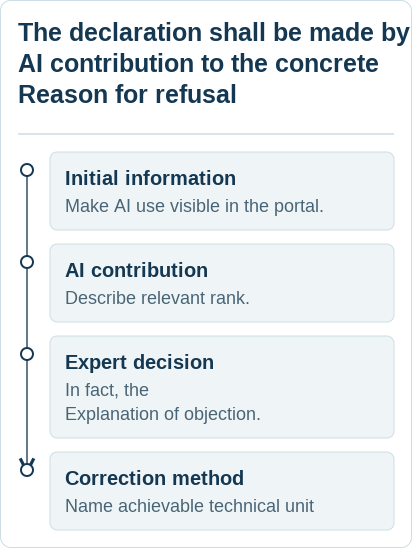
The person concerned needs the basic reason for his own decision and a qualified position.
Documenting your own test
A clear explanation with actual reasons for decision, release and a verifiable correction.
Explanation and correction of an AI decision
Secure system information, concrete reasons for decision and the comprehensible human contribution. Perform the data protection review independently.
Outcome A clear explanation with actual reasons for decision, release and a verifiable correction.
Read the instructions
Fictional example KI21 · Three out of four evidences are available. The documented human contribution must fit into the concrete rejection.
- The starting position Evidence of the system and decision
- Editing the Process Understanding the underlying reason and actual examination
- Secure Decision Determine the correct way to achieve this and the data protection issue
Official sources
First check for this task
Regulation (EU) 2024/1689 as amended on 27 July 2026
Readable version with the changes made by Digital Omnibus on AI. The application rules are to be read for your own deadline.
Art. 22 GDPR · Automated decisions in individual cases
Determine significant effects, actual human participation and the conditions for any exceptions and guarantees.
Charter of Fundamental Rights of the European Union
In particular, consider the relation to equal treatment and effective remedy. Arrange the effect of actual access or procedure.

Other official references1
- Enforcement of the AI Regulation (opens in new tab)
EU-Kommission · Zuständigkeit
The Commission shall explain the role of the AI Office and the national authorities. Confirm the competent recipient for each individual case.
What is the next decision?
Choose the work path that fits your open decision. The descriptions show what you start with and which proof you then hold.
Fundamental rights in concrete application
If there are gaps in the explanation, compare the findings with the risks for the group concerned.
Starting point Use, groups concerned, original sample documents, existing DSFA, role and clearance level.
Work result A rewriteable impact assessment with segmented findings, remedy, observable follow-up and communication document.
View the guideProtocols and supervision
If the version or procedure is missing, reconstruct the track and get the expert decision.
Starting point A pseudonymous case identification, time base, observed work steps and a permissible retrieval path.
Work result A reproducible decision track with comparison to the downstream action and a check of access limits.
View the guide

