
Set a risk-based audit scope
Connect relevant services, samples and planned evidence in a specific test order.
IMPLEMENTATION
EVIDENCE
Select the risk-relevant operating conditions
Distinguishing from internal effectiveness assessment, officially ordered evidence and proof of critical installations. Determine the actual relevant order, time period and service. Samples are based on risk, earlier findings and the purpose of the test.
Select the service and check open findings, changes and other risks since the last review.
Justify the scope of the test with appropriate samples
Perform the test
Consider which processes, dependencies and changes are included. Document the number of expected criteria and the reasons for limited samples. Arrange the approved examination of a qualified and, if necessary, independent role.
- Acceptance criterion
- A second reviewer can follow the statement to the original evidence and the version checked. Record the evidence identifier or file reference with the decision.
- Evidence
- Evidence list recording original source, version, documented mapping and owner.
Result and further processing
Released test job with tested object, selection statement, number of samples and planned proofs. The evaluation shows which statement is covered and where another sample is needed.
- Acceptance criterion
- The item under review and the documents refer to the same approved version. Record obsolete evidence as a separate discrepancy.
- Evidence
- Versioned mapping of item, source and approved version with any discrepancy recorded.
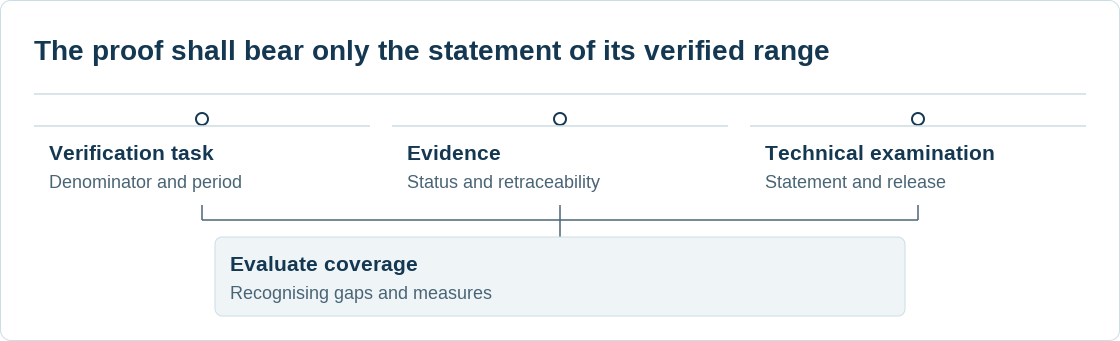
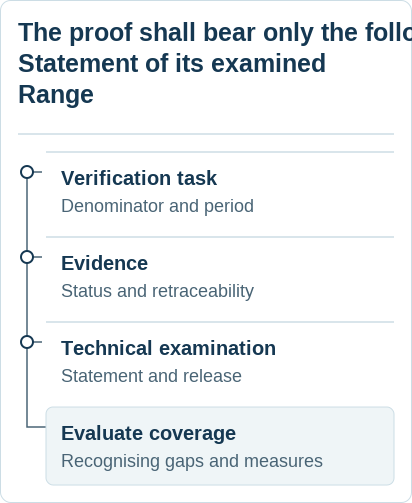
The expected scope, the current document and the factual statement are examined separately.
An example with negative test
Initial situation and observed findings
The team selects regular test runs of all services. A service had been changed twice since the last test. Therefore, the test planning takes up exactly one run from the new status and its relapse test. The planning explains the priority of this finding.
Negative test
Replace the run in the new state with a formally successful old sample. The measure is not recognised for the modified version without appropriate test reference.
- Audit record
- Comparison of the original finding and retest showing the changed condition, observed effect and closure decision.
The own test bench
Check for each service and obligation whether the proof is available, fits the status and is currently released. Track the reliable denominator.
Detection coverage and evidence gaps
Check for each service and obligation whether the proof is available, fits the status and is currently released. Track the reliable denominator.
Outcome The following table shows the results of the assessment carried out by each test group:
Read the instructions
Fictional example N22 · Six positions are expected. Four documents are current and relevant, one has expired, one is missing.
- Determine target size Provide unique identifiers for the verified obligations and demonstrate their scope.
- Matching Evidence Confirm receipt date, validity, coverage and release separately.
- Solve gaps Arrange responsibility, appointment and professional standard for any open document.
Efficacy test and run release
Set minimum sample, hit rate and time limit. Calculate the individual observation and complete test run with set-off cases and negative sample separately.
Outcome Evaluation per criterion and per run. Incomplete samples, double criteria and missing counters are visible.
Read the instructions
Fictional example N08 · All the acquisitions observed are on time. The workbook shows the missed hit rate and the own meaning of the negative sample. Change the number and supporting evidence for individual tests for the counter-test.
- Fix Test Task Enter the run and criteria identifiers, appropriate scale and planned minimum scope.
- Document valid samples Calculate the amount of hits over all valid tests and use the longest measured reaction for time.
- Check the progress overview Compare number and types of criteria with the released order. Secure deviations and post-test order.
Legal basis for this task
First check for this task
§ 30 BSIG · Risk management measures
For each relevant service, combine risks, ten fields of action, evidence and effectively verified effect. § 30 para. 3 gives priority to the technical requirements of the DVO for the providers covered there.
§ 39 BSIG · Proof of critical installations
Determine the concrete BSI determination, classification as a new or existing operator and an appropriate exception. Plan scope of examination, handover and remedy open defects.
§ 61 BSIG · Supervision of particularly important institutions
Keep the implementation with a verifiable record chain available for each requirement. In case of ordered tests or measures, you will record the specific order scope and feedback.

Other official references1
- Annex 7 · (EU) 2024/2690 · Evaluate the effectiveness of measures (opens in new tab)
Technische Vorgaben · (EU) 2024/2690
Link individual test criteria to the observed result and the verified handling of a deviation.
Deriving the next order from the result
Choose the work path that fits your open decision. The descriptions show what you start with and which proof you then hold.
Checking for effectiveness of a safety measure
Determine the performance, the status checked and the expected effect.
Test objects and sample are determined. Arrange the evaluation before the first run.
From the measurable target criterion to appropriate samples to the reasoned statement of the observed effect.
Your decision Which observation carries the release? Determine your own findings if scope or effect is missing.
Work through the caseThe effectiveness of NIS2 measures is demonstrated
They shall provide evidence of the audit mandate for management, internal audit or oversight.
Starting point Test order, target criteria, sampling plan and dated raw documents of the same service.
Merge test order, efficacy test, deviation and follow-up test.
Work result A second person can understand the findings and clearance decisions from the sources.
View the guide

