
Define a critical installation network
List of installations with documented association decision.
IMPLEMENTATION
EVIDENCE
Technical and operational boundaries between common critical installations
Several installations can be assessed jointly for a critical service. The merger must be based on the requirements of the relevant regulation and the actual, joint operation. Same property provides only part of the facts.
Perform the verification task
Set the installation category and joint performance
Name the part of the service that each plant provides. Determine location, facility, purpose and operator and check the relevant rule on common facilities.
- Acceptance criterion
- A second reviewer can follow the statement to the original evidence and the version checked. Record the evidence identifier or file reference with the decision.
- Evidence
List of installations with documented association decision.
Check technical and operational connections
Open common facilities, personnel, control and transfer points using schematics and operating procedures. Mark measured values before and after an internal transfer.
- Acceptance criterion
- Use the same metric, population and unit for expected and observed results. Record the measurement point at which the business service is achieved.
- Evidence
Matched dependencies and measuring point map.
Check figures at aggregated level
Compare individual quantities and merged data. Draw the same physical quantity only once and have open measurements confirmed professionally.
- Acceptance criterion
- Use the same metric, population and unit for expected and observed results. Record the measurement point at which the business service is achieved.
- Evidence
Released denominator and comprehensible exceptions.
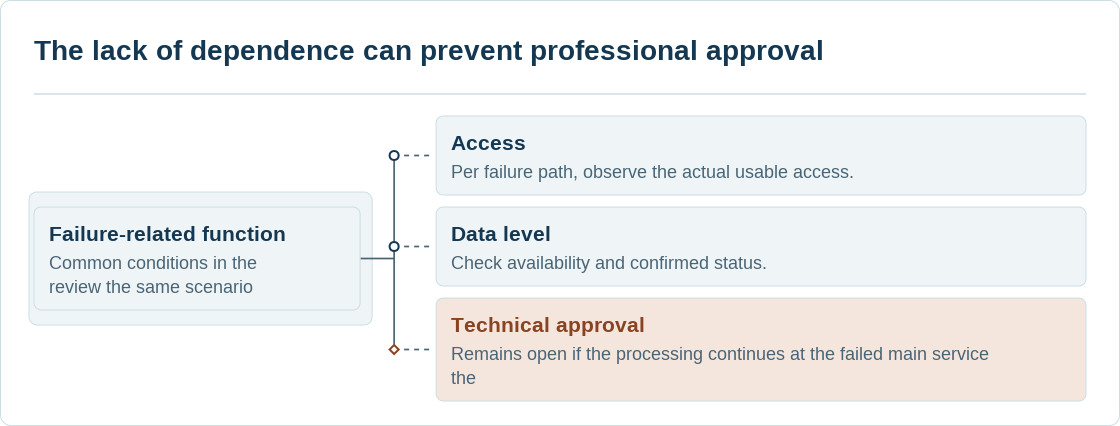
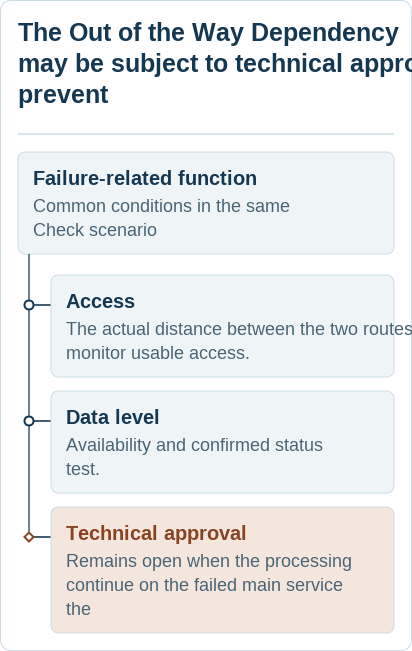
The performance sample records access, data and technical processing as separate dependencies. In the example, the professional approval remains open as long as it needs the failed main service.
Starting position, assessment and counter-test
Situation Several installations can be assessed jointly for a critical service. The merger must be based on the requirements of the relevant regulation and the actual, joint operation. Same property provides only part of the facts.
Situation
Two treatment sections are run over the same facility. An internal transfer appears at the exit of the first and the entrance of the second section. The list is 23.4 million cubic metres. After matching the flow measurement, 2.1 million cubic metres of the same physical quantity are double recorded.
Evaluation and decision
The consolidated quantity is 21.3 million cubic metres. The test separately documents whether the sections constitute a common installation and which threshold belongs to the respective plant category.
Negative test for your own operation
Remove the proof to the internal measuring point. Mark the clarification as open and designate the responsible body with appointment. The number field alone then does not bear the decision.
- Audit record
- Comparison of the original finding and retest showing the changed condition, observed effect and closure decision.
Help for your decision
Vote for annual measurement, double-recorded internal transfers and the actual plant category. Calculate the confirmed processing amount against the threshold.
Supply quantity and threshold in the waterworks
Vote for annual measurement, double-recorded internal transfers and the actual plant category. Calculate the confirmed processing amount against the threshold.
Outcome Adjusted supply volume with measuring certificate, threshold level and date for the own plant test.
Read the instructions
Fictional example A plant shows 22.4 million cubic metres of treated drinking water. In a second case, a seemingly higher total quantity after cleaning up internal double counting drops to 21.3 million.
- Determine the installation category and time period Capture waterworks, calendar year, operator and the confirmed processing quantity in cubic meters.
- A double counting Determine each internal transfer with measurement event and test document.
- Prepare status decision Compare the adjusted analysis and the calculated reference date with the existing system status.
Operating effects and restart order
Arrange operational consequences and restart targets per performance. Calculate necessary parallel and subsequent steps against the internal target
Outcome Prioritized performance with comprehensible restart chain and visible target deviations.
Read the instructions
Fictional example N18 · The target of the order service is 90 minutes. The operational dependence takes 70 minutes, the subsequent handover 35 minutes.
- Coordinating objectives Set tolerable interruption, restart target and data loss.
- Count order Confirm the parallel requirements and the duration of the subsequent professional transfer.
- Sharing time and data Compare the calculated values and open evidence for the organizational decision.
Legal basis for the verification task
First check for this task
§ 1 BSI-KritisV · Installations, supply level and joint installations
Check which parts and ancillary equipment are necessary for the critical service. In common installations, record the same category, operational context and the jointly provided critical service.
Annex 2 BSI-KritisV · Level of supply and thresholds in the water sector
Compare year, quantity unit and the appropriate category. For water plants, a threshold of 22 million cubic meters of treated drinking water per year applies. Consider the determination until 31 March and the regulation on the status change on 1 April.
§ 28 BSIG · Particularly important and important institutions
Check legal form, actual paid activity, type of facility, size values and special cases. § 28 para. 5–8 alters the scope of obligations for certain activities or institutions.

Other official references2
- § 31 BSIG · Additional requirements for critical installations (opens in new tab)
Deutsche Anwendung · BSIG
Limit the systems that are relevant to the functioning of the affected installation. Check additional risk-appropriate precautions and the effectiveness of attack detection.
- § 39 BSIG · Proof of critical installations (opens in new tab)
Deutsche Anwendung · BSIG
Determine the concrete BSI determination, classification as a new or existing operator and an appropriate exception. Plan scope of examination, handover and remedy open defects.
Next step for your editing level
First, take the decisive observation from the case. Then, based on your open question, choose whether you want to check your own process or play a comparable case.
Check drinking water supply and KRITIS threshold separately
A water supplier may be identified as a BSIG facility. The classification of a particular water plant as a critical installation requires additionally the correct plant category, unit quantity and reference period according to the applicable regulation.
The system network is documented. They calculate the supply quantity for the appropriate category.
The category of the device and the system status are two findings. The test and detection date has a proven basis.
Your decision An appendix with a comprehensible quantity calculation and a reasoned result for each operator.
Work through the caseList critical plants and the verification order
They work in parallel on tasks from the same department.
Starting point Operator and system inventory, confirmed volume records as well as existing test and reporting data.
The overview will classify further audit orders and aids.
Work result A documented system delimitation with separate detection and reporting order.
View the guide

